
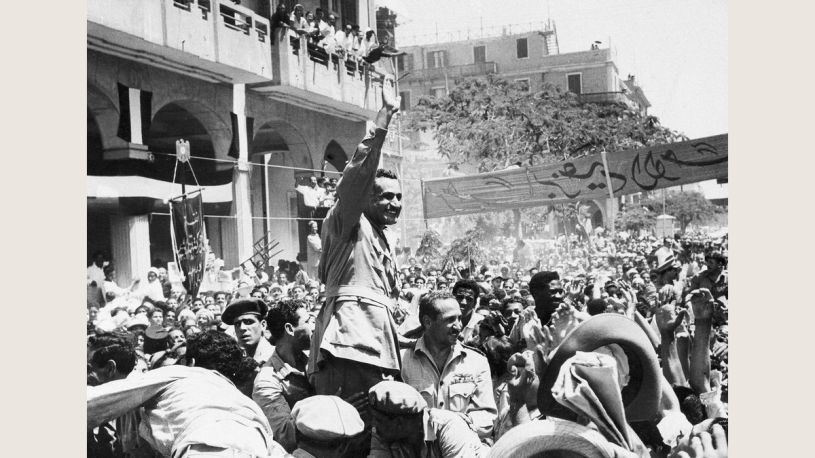
In October 1956, Britain and France launched a military attack on Egypt alongside Israel after President Gamal Abdel Nasser nationalised the Suez Canal Company. The attackers could seize ground. They could not secure the financial and diplomatic conditions required to continue the operation. Britain’s position revealed how a great power can lose strategic independence before it loses the capacity to fight.
An imperial route and a newly assertive Egypt
The Suez Canal linked Europe to the Indian Ocean and had long been entangled with Britain’s imperial strategy. Nasser’s July 1956 nationalisation threatened British and French interests and humiliated leaders accustomed to controlling the waterway. Britain and France secretly coordinated with Israel, whose invasion of Sinai gave them a pretext to issue an ultimatum and intervene.
The operations achieved some military objectives around Port Said, but the invasion produced severe international condemnation, including from the United States. The United Nations demanded a ceasefire. The Soviet government also issued threats. Britain confronted a diplomatic crisis it could not solve by moving additional troops.
The currency mechanism
Sterling was under pressure in international markets. Britain needed foreign exchange reserves and financial assistance to defend the pound and support confidence. Washington declined to provide the help London sought while the military operation continued. Access to international financial support, including from the IMF, was tied to the political outcome.
This did not mean that US financiers single-handedly decided the war. Military risks, domestic opinion, United Nations diplomacy and Britain’s own fiscal weaknesses mattered. The essential constraint was that the British government could not indefinitely sustain an operation that required the cooperation of the world’s dominant financial power.
The hierarchy behind the alliance
The crisis marked a conspicuous limitation on Britain’s independent imperial power. A country could possess aircraft carriers, experienced troops and nuclear weapons while remaining dependent on another state’s willingness to support its currency and international borrowing.
For understanding global politics, the lesson extends beyond the Suez Canal: military power is only one dimension of sovereignty. A government whose financial system depends on another country may discover that its most important battlefield lies in the balance of payments.
Sources and image provenance
IMF research paper: Northwest of Suez, the 1956 Crisis and the IMF; Council on Foreign Relations, the Suez crisis and financial power. Featured image: period photograph, map or primary document, prepared as a landscape image with the original content fully visible.
Support DEPTH
Independent, source-based historical writing takes time. Your contribution supports more accessible investigations.

Boost us
If you like our content help us to create more.
$5.00
Discover more from The Confessor
Subscribe to get the latest posts sent to your email.
