
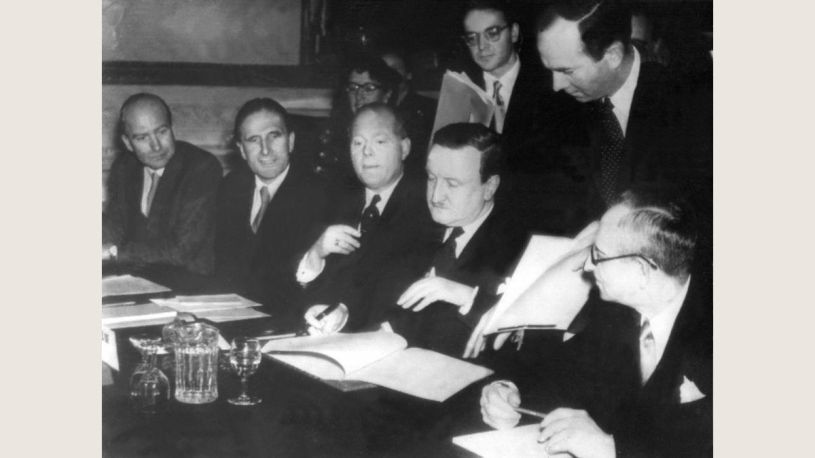
Eight years after defeat in World War II, West Germany was granted an international debt deal that reduced major obligations and made repayment more compatible with economic recovery. The London Debt Agreement of 1953 shows that debt policy is never only about arithmetic. It is also about what creditors want a debtor country to become.
An unusually constructive settlement
After the war, West Germany had prewar debts, postwar assistance obligations and an economy that the Western powers wanted to reconstruct. In London, creditor governments and private representatives negotiated rather than simply demanding the immediate maximum they could recover.
The agreement reduced or rescheduled substantial obligations—accounts commonly describe the reduction as around half, though exact percentages depend on which debts are counted. Some claims, notably those connected to war reparations, were deferred. Repayment arrangements took Germany’s capacity to earn foreign currency seriously. An arrangement linked the burden to its ability to export, rather than requiring immediate payments regardless of economic conditions.
Creditors were making a geopolitical investment
The United States, Britain and France were not motivated only by generosity. Cold War competition made a prosperous, stable West Germany strategically valuable. The emerging European economic order also required German industrial production, trade and political legitimacy. Creditors believed that recovery could yield more than perpetual strangulation.
The agreement did not create the entire West German economic miracle. Currency reform, industrial capacity, skilled labour, Marshall Plan assistance, international demand and other policies also contributed. Nor was every country treated equally in every dimension of the settlement. Nonetheless, its premise was unusual and powerful: if a debtor cannot grow, squeezing it harder may undermine both repayment and stability.
The questions it raises for modern debt crises
In later sovereign-debt emergencies, poorer countries were frequently asked to cut public expenditure, raise revenue and prioritise external payments under stringent conditions. Those experiences differed enormously and cannot all be reduced to a single comparison. But the contrast invites an uncomfortable question: who gets to treat debt forgiveness as an investment in future prosperity, and who is told that creditors’ claims are morally untouchable?
Germany’s experience demonstrates that debt contracts are political choices made inside a world of unequal power. A creditor may call a payment schedule realistic when it values the debtor’s success—and intolerable when it does not.
Sources and image provenance
London Debt Agreement historical analysis, Timothy Guinnane; German newspaper Der Tagesspiegel, 1953 relief and archival photograph. Featured image: period photograph, map or primary document, prepared as a landscape image with the original content fully visible.
Support DEPTH
Independent, source-based historical writing takes time. Your contribution supports more accessible investigations.

Boost us
If you like our content help us to create more.
$5.00
Discover more from The Confessor
Subscribe to get the latest posts sent to your email.
