
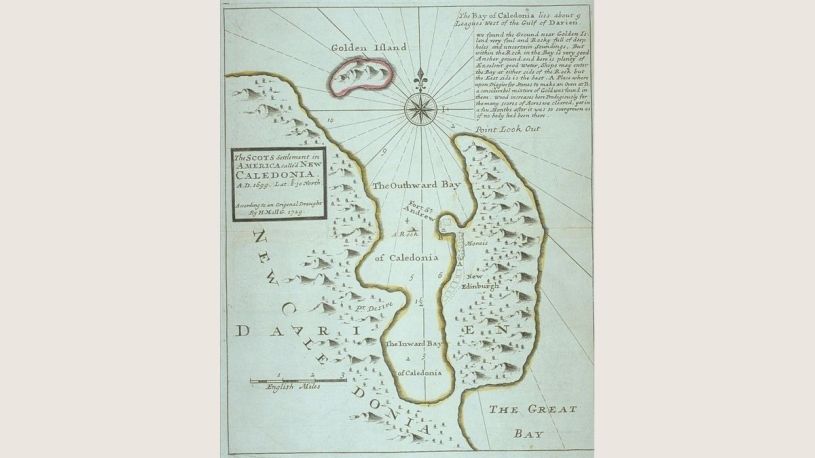
In 1698, Scottish investors sent colonists across the Atlantic to establish New Caledonia on the Isthmus of Panama. Their dream was a commercial gateway between two oceans. What they built instead was a deadly settlement—and a financial disaster that strengthened the case for union with England.
Scotland’s great imperial gamble
The Company of Scotland was founded in 1695 in an era when access to colonial trading networks made some European states rich. Scots resented barriers to English colonial commerce, and promoters imagined Darien as a strategic port connecting Atlantic and Pacific trade. A wide range of Scottish institutions and wealthy families committed substantial funds.
The geography was enticing on a map. On the ground it was much less promising. Disease, hunger, unfamiliar conditions, weak supply arrangements and Spanish opposition devastated the colony. English colonial officials were unwilling or unable to help Scottish colonists in ways the scheme needed. By 1700, the settlement had collapsed; thousands had died.
Why the catastrophe mattered in Edinburgh
The losses damaged the fortunes of influential investors and reduced Scotland’s financial resilience. National Museums Scotland estimates the disaster consumed roughly a quarter of the country’s liquid capital. Yet the failure was not solely a tragedy for the Scots: the colonial project rested on European ambitions to seize trade and territory in a region already inhabited and claimed by others.
When union negotiations resumed, a financial payment known as the Equivalent—£398,085 10 shillings—became part of the settlement. Some of that money was used to compensate Darien investors, making agreement more attractive to powerful stakeholders. In 1707 the Scottish and English parliaments united under a single parliament at Westminster.
The difference between cause and leverage
Darien did not mechanically cause the Union. Protestant succession, security, access to markets and competing national visions also mattered. Nor were all Scots enthusiastic about the resulting settlement. But the crisis changed who needed what from the negotiation—and gave those with financial losses an especially strong incentive to reach a deal.
A colonial venture failed overseas; the consequences reshaped sovereignty at home. That is the larger historical pattern: financial losses can alter a country’s constitution when those who lost money have enough political influence.
Sources and image provenance
National Museums Scotland, The Darien Scheme; Scottish Archives for Schools, Union of 1707 and Darien. Featured image: period photograph, map or primary document, prepared as a landscape image with the original content fully visible.
Support DEPTH
Independent, source-based historical writing takes time. Your contribution supports more accessible investigations.

Boost us
If you like our content help us to create more.
$5.00
Discover more from The Confessor
Subscribe to get the latest posts sent to your email.

