
In Salvador Allende’s Chile, engineers attempted to build an information network that would help managers understand what was happening across state-owned industries. Project Cybersyn is often described as a socialist internet before the internet. That sells the story short—and exaggerates what the technology actually achieved.
An economy with a nervous system
Chile’s socialist government expanded public ownership in strategic industries after 1970. The resulting planning challenge was immense: a ministry in Santiago could not simply issue orders to thousands of workplaces without understanding shortages, transport, production and equipment failures.
British management cybernetician Stafford Beer worked with Chilean engineer Fernando Flores and others to design a feedback system. An existing telex network allowed participating factories to transmit data to a central facility. Statistical software was intended to flag problems and help officials respond rather than waiting for slow chains of reports.
What the operations room really represented
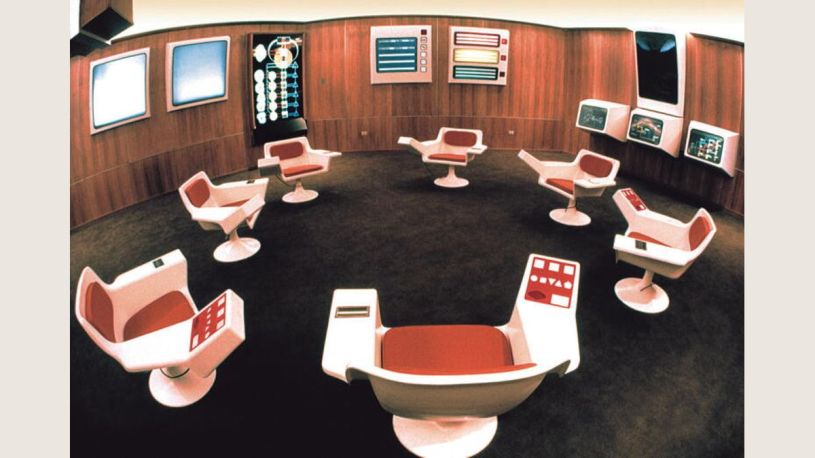
The project’s most famous image shows a futuristic operations room: chairs with controls, wall displays and graphic interfaces. It was designed for people to discuss and evaluate information, not as a machine secretly deciding everything for them. Allende visited a prototype in 1972.
The contrast between ambition and reality is important. Cybersyn was experimental and incomplete. Much of its communications infrastructure relied on ordinary telex machines, while implementation remained far smaller than the vision of an integrated national feedback system. Claims that it successfully managed the whole Chilean economy are not supported by the archival evidence.
What the coup destroyed
The military coup of 11 September 1973 overthrew Allende, and the subsequent dictatorship ended the project. The fate of Cybersyn is often told as a parable of a humane technological future cut short. That is one possible political interpretation, but it is not an experiment whose eventual success can be established.
Its deepest lesson concerns information and power. In large organisations, senior officials frequently act on reports that arrive late, conceal failure or reflect the interests of those producing them. Cybersyn tried to shorten the distance between what was happening on the ground and what decision-makers knew. The essential question—who controls the information and who gets to act on it—remains at the centre of technology today.
Sources and historical visual
MIT Press Reader, Project Cybersyn: Chile’s Radical Experiment; Research on Cybersyn archival evidence and its limits; Los Angeles Times on Chile’s Cybernetic Experiment. Featured image: authentic historical photograph, object or illustration, framed for the site’s homepage.
Support DEPTH
Support evidence-based historical investigation and accessible long-form writing.

Boost us
If you like our content help us to create more.
$5.00
Discover more from The Confessor
Subscribe to get the latest posts sent to your email.
