
During the final descent of Apollo 11 in July 1969, the Lunar Module’s guidance computer began issuing alarms. The machine was receiving more demands than it could complete on schedule. Neil Armstrong and Buzz Aldrin still needed its help to land safely.
The software had been designed with a priority scheduling and recovery system that allowed crucial navigation tasks to continue while less essential operations were dropped. Mission Control interpreted the alarms as acceptable and the landing proceeded.
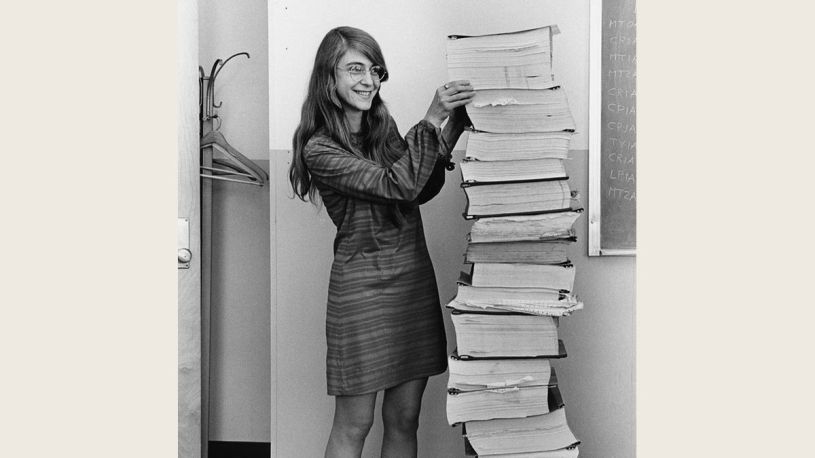
Margaret Hamilton led the team at MIT’s Instrumentation Laboratory responsible for Apollo flight software. The famous photograph of her standing beside a towering stack of printed code is a reminder that spaceflight depended not only on rockets and pilots but also on thousands of decisions made by programmers.
The computer was not saved by one woman’s last-second intervention, and Hamilton did not write the entire system alone. Her leadership and the team’s emphasis on error detection, prioritisation and recovery nevertheless made a critical difference.
The deeper lesson is about engineering. A successful design must account not only for what a system does when conditions are perfect, but for how it behaves when reality becomes messy. Space exploration was made safer by people who expected that things would go wrong.
Sources and image provenance
NASA, Margaret Hamilton. The featured image is a historical photograph or primary historical document; attribution details are stored with the image in the site’s media library.
Support DEPTH
If you want more rigorously researched history on Project Authenticity, support independent publishing.

Boost us
If you like our content help us to create more.
$5.00
Discover more from The Confessor
Subscribe to get the latest posts sent to your email.
