
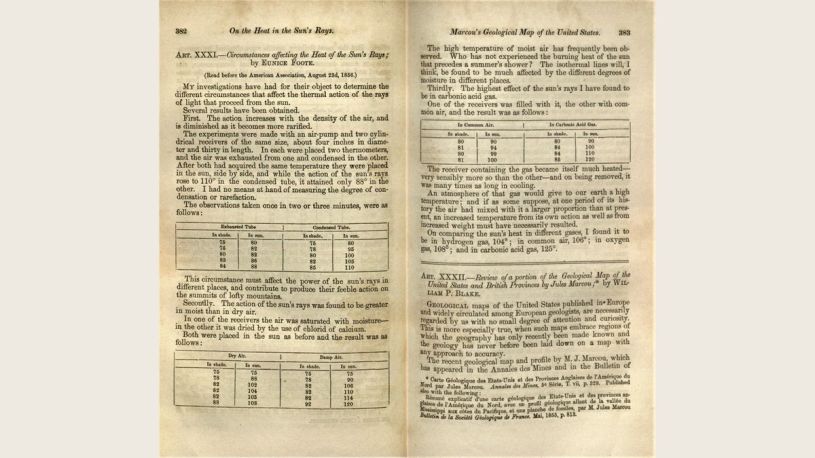
In 1856, Eunice Newton Foote placed thermometers inside glass cylinders filled with different gases and exposed them to sunlight. She noticed that a cylinder containing carbon dioxide became warmer than one filled with ordinary air and cooled differently afterward.
Her short paper, Circumstances Affecting the Heat of the Sun’s Rays, proposed that a change in atmospheric carbon dioxide could affect Earth’s temperature. The statement anticipated a crucial connection between atmospheric composition and climate.
Foote did not establish the full modern physics of the greenhouse effect. Her sunlight experiment differed from later measurements of the absorption of infrared radiation emitted by Earth’s surface. John Tyndall’s subsequent experiments supplied essential physical evidence. Distinguishing their contributions makes the history more interesting, not less.
Foote’s paper was presented to the American Association for the Advancement of Science by Joseph Henry rather than by Foote herself, in a period that excluded women from many scientific institutions. Her contribution faded from mainstream accounts for generations.
The image accompanying this article reproduces her own 1856 publication. It is a stronger historical object than the many supposed portraits of Foote circulated online without reliable identification.
Sources and image provenance
Eunice Newton Foote’s original 1856 scientific paper. The featured image is a historical photograph or primary historical document; attribution details are stored with the image in the site’s media library.
Support DEPTH
If you want more rigorously researched history on Project Authenticity, support independent publishing.

Boost us
If you like our content help us to create more.
$5.00
Discover more from The Confessor
Subscribe to get the latest posts sent to your email.

