
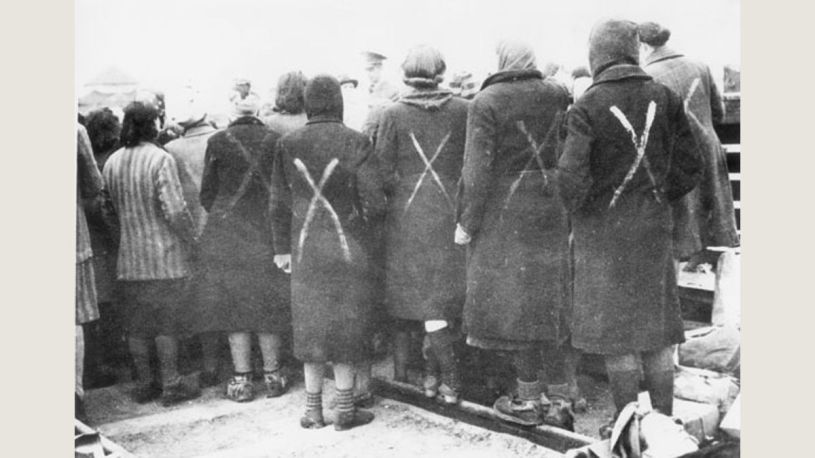
In January 1945, nineteen-year-old Polish Jewish prisoner Manya Moszkowicz Friedman was forced into an open railway wagon with other prisoners evacuated from Gleiwitz. The journey to Ravensbrück lasted ten days in freezing weather. There was no food. To drink, they melted snow. A sick friend was in danger of being crushed by the bodies packed around her. Manya used her own body to shield her.
Ten days in an open freight wagon
The Soviet army was advancing. Nazi authorities were evacuating concentration camps and their subcamps, subjecting prisoners to marches and rail transports in deadly conditions. Manya had already endured years of persecution, separation from her family and forced labour. Her parents and two younger brothers were deported to Auschwitz and did not survive.
She had been assigned prisoner number 79357 in the Gleiwitz camp complex. During the January 1945 evacuation, Manya and other inmates were transported toward Ravensbrück in open railway cars. The United States Holocaust Memorial Museum records that the journey lasted ten days, during which people had no food and only melted snow to drink.
Protecting another person when you can barely stand
A sick friend, Lola, was trapped among the overcrowded prisoners. Manya shielded her from being crushed during the journey. The museum’s account records that Manya’s arms became bruised and swollen. She was herself a prisoner enduring hunger and extreme cold; protecting Lola made her own situation harder.
That detail is the heart of the story because it comes from the survivor’s actual experience, not from a later dramatic illustration. Pictures circulating online that show specific people on an open railway car should not be presented as photographs of Manya and Lola without identifying archival evidence.
What happened afterward
Manya was later transferred to a Ravensbrück subcamp and rescued through the Swedish Red Cross effort in late April 1945. She reached Sweden and gradually began a new life. She learned after the war that her parents and brothers had been murdered.
She initially believed Lola had also died. But a letter eventually arrived from Germany: Lola was alive. In Manya’s account published by the US Holocaust Memorial Museum, Lola reported that she had been liberated by Soviet forces after another severe illness. Manya received that letter after an enormous period of uncertainty.
She survived to become a witness
Manya emigrated to the United States in 1950. She volunteered for many years at the United States Holocaust Memorial Museum, speaking about her experiences and contributing written testimony. She died in 2013.
Her story is not about someone possessing miraculous strength. It concerns the choices people sometimes made when virtually every form of freedom had been stripped from them. In a wagon where the prisoners had hardly enough space to live, she tried to keep one friend alive. Decades later, her words ensured that the act of protection would not be forgotten.
Sources and image attribution
United States Holocaust Memorial Museum: Manya Friedman’s biography and transport testimony
United States Holocaust Memorial Museum: My Friend Lola, by Manya Friedman
USHMM Holocaust Encyclopedia: Manya Friedman
Swedish Red Cross historic photograph of Ravensbrück women, April 1945
Authentic documentary photograph of women imprisoned at Ravensbrück in April 1945, supplied by the Swedish Red Cross, as reproduced on Wikimedia Commons. These women are NOT identified as Manya Friedman or Lola; the photograph is historical context for the rescue period, not a reconstruction of the wagon. Framed on a 1200 × 675 canvas.
Support DEPTH
Help keep sourced, independent history writing available. Support the project if you value these stories.

Boost us
If you like our content help us to create more.
$5.00
Discover more from The Confessor
Subscribe to get the latest posts sent to your email.

