
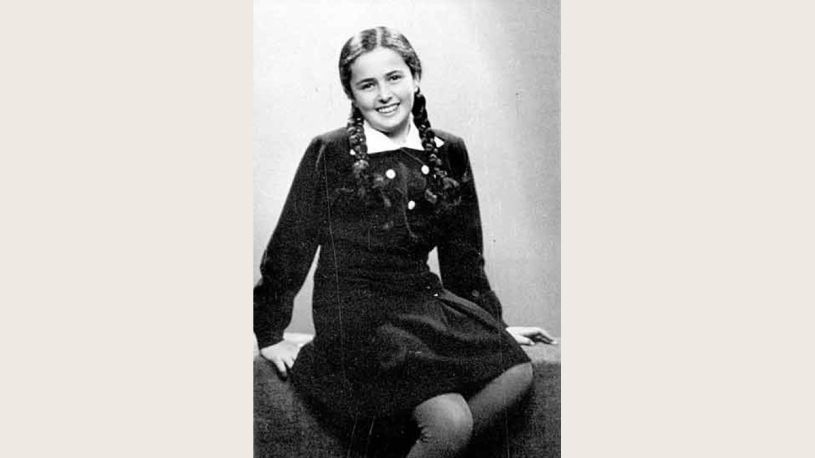
On 30 May 1944, thirteen-year-old Éva Heyman wrote in her diary that she did not want to die. She would hide anywhere, she said, if only she were allowed to live. Weeks later, she was deported from the Nagyvárad ghetto—today Oradea, Romania—to Auschwitz. She was murdered there on 17 October 1944.
She wanted to become a photographer
Éva was born on 13 February 1931 in Oradea, a city whose political borders and names changed with the upheavals of central European history. During the Second World War, it belonged to Hungary and was known in Hungarian as Nagyvárad. Éva grew up with her grandparents after her parents’ separation and dreamed of becoming a news photographer.
Her diary began on her thirteenth birthday, 13 February 1944. In the first pages she wrote about birthday food, her friends, languages, cameras and the kind of adult life she imagined. These ordinary concerns matter: she was not born to become a symbol of persecution. She was a child looking forward to the future.
A diary written as a world closed in
Nazi Germany occupied Hungary on 19 March 1944. In the following weeks, Hungarian authorities working under German direction imposed increasingly severe measures upon Jewish citizens. Éva saw everyday freedoms vanish, including the loss of possessions and the forced move into the Nagyvárad ghetto.
Her family was relocated to overcrowded rooms under rules enforced by the threat of death. She documented fear, restrictions and what she heard about people being taken away. Her diary follows the rapid transformation of home from a place of ordinary routines to a place where nearly every decision was controlled by others.
The last entry
The diary ends on 30 May 1944, shortly before the deportation. One line from English translations has become inseparable from her name: ‘I don’t want to die.’ She asked to be allowed to live even if the only refuge were a hidden place away from everyone she knew.
Her words were not written with the benefit of hindsight. They came from a thirteen-year-old who understood that death was approaching but could not know what would happen next. The final entry is especially devastating because the diary had opened with the practical ambitions of a child learning photography.
What survived
Éva was deported in June 1944 and died at Auschwitz on 17 October 1944, according to Yad Vashem and the US Holocaust Memorial Museum. Her mother, Ágnes Zsolt, survived and arranged for the diary’s publication after the war. Scholarly sources date its first Hungarian edition to the late 1940s, with some disagreement about the exact year. Her mother died by suicide in 1951.
The diary survives as an individual account of the persecution of Jews in wartime Hungary. It is a record of a person who wanted an ordinary life and had the ability to write about it. The original photograph of Éva used here is black-and-white; modern colourised or AI-made portraits should not be confused with verified historical images.
Sources and image attribution
Yad Vashem: Éva Heyman’s diary, life and date of death
US Holocaust Memorial Museum: Éva Heyman’s life and Auschwitz death
Holocaust Memorial Day Trust: genuine diary excerpts and portrait
Hungarian Studies Review, Agatha Schwartz on diary publication and family history
Archival photographs and historical material from the Oradea Holocaust history collection
Featured image replaced with a fuller archival portrait of Éva Heyman from Wikimedia Commons (Diary1b.jpg), shared by Brandnewwta under Creative Commons BY-SA 4.0. An adaptation of the original photograph, placed against a pale background in a 1200 × 675 landscape canvas without cropping the subject. This corrected image replaces an earlier source thumbnail that cut off the top of her head.
Support DEPTH
Help keep sourced, independent history writing available. Support the project if you value these stories.

Boost us
If you like our content help us to create more.
$5.00
Discover more from The Confessor
Subscribe to get the latest posts sent to your email.

