
A government announces that a policy is necessary. A company says that its prices are determined by the market. A newspaper explains what happened. A general says that the bombing will bring security. Each statement might be true, partly true, self-serving, or false. The question that changes how you understand the world is: who has the power to make a claim consequential, and who pays if it is wrong?
The world is not governed by one secret committee. It is shaped by institutions, incentives, resources, technology, history, human judgment and conflict. People act within systems they did not design, and some people have far more ability than others to rewrite those systems.
Power is the capacity to shape other people’s options
Power is not just commanding an army or occupying a presidential office. It is deciding who owns land, who receives loans, which crimes are investigated, which borders may be crossed, whose labor is expensive, and which questions are considered respectable. It operates through laws, employment contracts, ownership, social norms, networks and administrative routines.
The World Bank’s 2017 report on governance identifies unequal power as a major reason apparently sensible policies fail. Powerful groups can capture decisions, exclude rivals or reward supporters. But the same report emphasizes that reforms and collective action can alter power relations. Institutions are neither neutral machines nor immovable prisons.
Ask of every important decision: who can veto it? Who can fund it? Who has information unavailable to the public? Who will benefit in five years? Who bears the risk today? These questions often reveal more than the official slogan.
Money is a claim on labor, resources and future choices
Money makes exchange easier, but its distribution is not a verdict on human worth. A person’s income depends on bargaining power, skills, capital, inheritance, location, discrimination, productivity, public policy and luck. Wealth is different from salary: it can buy assets, time, legal expertise and opportunities that produce still more advantages.
Markets coordinate extraordinary quantities of information, but they do not decide moral priorities. A profitable business can meet human needs, exploit workers, generate pollution, or do several of those things at once. The relevant question is not whether markets are inherently good or evil. It is what they reward, what costs they leave outside their prices, and what rules prevent abuse.
Violence is not confined to battlefields
War is the most visible expression of coercive power. Less visible are the threats that make a person accept an arrangement: loss of housing, incarceration, political persecution, exclusion from essential services. These experiences are not interchangeable with physical violence, but they can constrain freedom profoundly.
Governments can use force legitimately to protect people from harm; they can also abuse it. Non-state armed groups can terrorize civilians. A serious moral standard must apply to all sides: examine evidence, distinguish combatants from civilians, scrutinize proportionality and refuse to treat human beings as expendable because of identity.
Propaganda works by selecting what you notice
Propaganda is not always an outright lie. It may be an accurate fact separated from its context, an emotionally irresistible photograph, a repeated slogan or a silence around inconvenient suffering. Governments, corporations, movements and individual influencers all have incentives to frame reality in their own favor.
A competent reader distinguishes the event from the interpretation, the source from the messenger, and evidence from repetition. Be especially careful when a message makes you feel morally certain before it tells you what can be verified.
History provides the missing comparison
What appears natural in one generation may have been fought over in the previous one. Universal schooling, women’s voting rights, the eight-hour day, decolonization and restrictions on child labor were not delivered automatically by benevolent elites. Nor were victories uniform or irreversible.
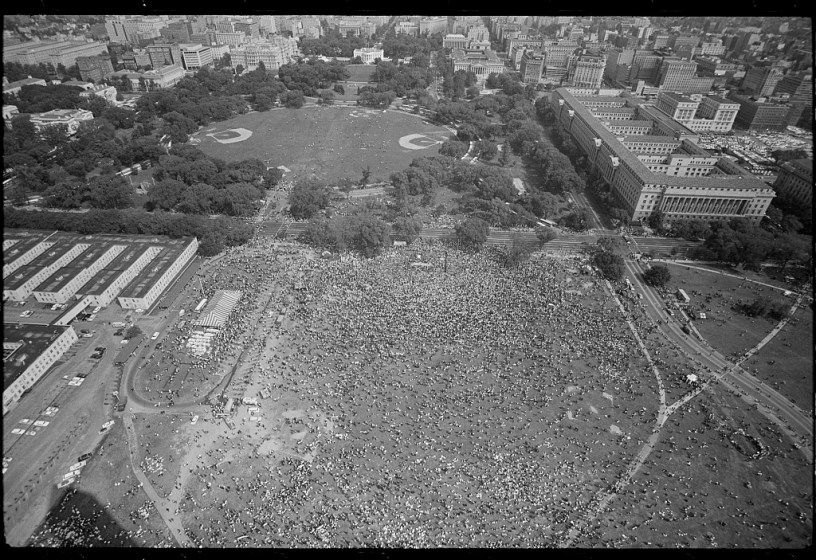
The photograph above shows people gathered for the 1963 March on Washington for Jobs and Freedom. They did not possess the government’s coercive machinery. They possessed numbers, organization, moral argument, strategy and political pressure. The image is a reminder that power can be contested.
Five habits for understanding any important event
First, reconstruct the timeline before adopting anyone’s explanation. Second, separate what is observed from what is alleged and inferred. Third, follow money and institutional incentives without assuming they explain every human action. Fourth, examine who is missing from the story. Fifth, ask what evidence would make you change your mind.
The deepest political mistake is to imagine either that everything happens by accident or that everything is secretly controlled. Much of history is the collision of limited knowledge, competing interests, institutional inertia and determined human agency.
The world becomes more intelligible when you stop asking only who is right and start asking who can do what, to whom, under which rules, and with what consequences.
Sources and further reading
World Bank, World Development Report 2017: Governance and the Law
Our World in Data, literacy and the distribution of knowledge
UNESCO, media and information literacy
Featured photograph: Marion S. Trikosko / Library of Congress, aerial view of the 1963 March on Washington for Jobs and Freedom (public domain).
Support DEPTH
Independent, evidence-based writing takes time. Help keep these articles freely accessible.

Boost us
If you like our content help us to create more.
$5.00
Discover more from The Confessor
Subscribe to get the latest posts sent to your email.
