
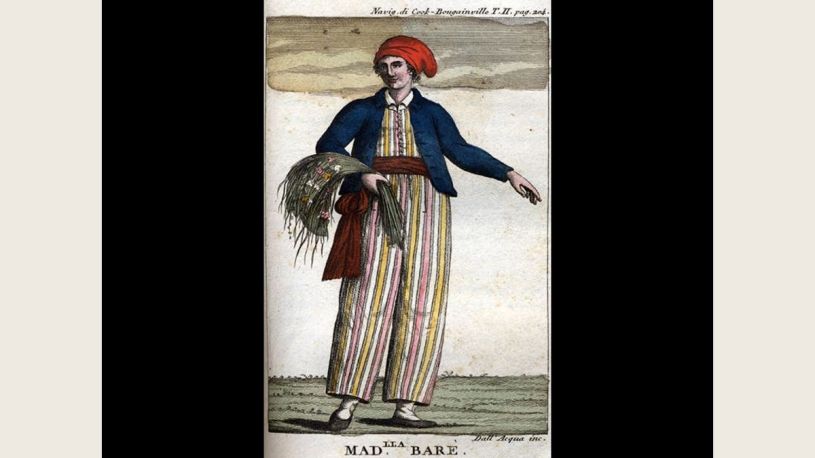
In 1766, the French explorer Louis Antoine de Bougainville prepared a voyage around the world. Women were not permitted to join French naval expeditions as crew. The botanist Philibert Commerson brought an assistant named Jean Baret aboard. Jean was Jeanne.
Baret had botanical knowledge and assisted with the collection, handling and classification of specimens. Under a male identity she entered a world of expeditionary science that would otherwise have excluded her. Her presence could not remain secret indefinitely; Bougainville’s account records how suspicions eventually arose and how her identity became known.
Commerson and Baret left the expedition in Mauritius, where they spent years before Baret eventually returned to France. She is recognised as the first woman known to have completed a circumnavigation of the globe.
Many plants collected by the expedition became part of the history of European science, but assistants’ labour was not always recognised in the same way as that of official scientific authorities. The voyage is therefore a story of exploration and a question about whose work is allowed to become discovery.
The featured image is an early nineteenth-century engraving identifying Baret—not an authentic photographic portrait, which could not exist for her eighteenth-century voyage.
Sources and illustration
Western Australian Museum, Jeanne Baret. This post uses an authentic period photograph, engraving, archival illustration or related primary document for its featured image—not an AI reconstruction. The image is framed for wide homepage display.
Support DEPTH
If this kind of historically grounded writing is useful to you, support independent publishing.

Boost us
If you like our content help us to create more.
$5.00
Discover more from The Confessor
Subscribe to get the latest posts sent to your email.
