
At the Battle of Plassey in 1757, Robert Clive led a force of roughly 3,000 men against a vastly larger Bengal army. Approximately 2,100 of Clive’s soldiers were Indian sepoys, not Europeans. Britain’s empire in India was built to a remarkable extent by Indian troops, Indian revenues and alliances with Indian political elites.
A trading company acquired an army
The East India Company began as a commercial venture but increasingly needed armed force to protect its ports, warehouses and privileges. Its military organisation evolved into the Bengal, Madras and Bombay armies. Soldiers from the subcontinent provided much of the manpower, while European commanders supplied some of the training, command structure and support.
At Plassey, military defections and political intrigue within Bengal were at least as consequential as battlefield tactics. After subsequent victories, the Company obtained revenue-collection rights in Bengal in 1765. This created a feedback mechanism: conquest brought tax revenues, and revenues helped fund larger armies capable of further conquest.
Why British manpower was not enough
Britain could not have conquered the subcontinent merely by landing a few thousand Europeans on the coast. The Company recruited within India’s existing military labour markets, paid soldiers, took advantage of rivalries among courts and states, and used Indian troops against Indian opponents. Its opponents were not a unified modern nation-state; India contained powerful kingdoms, confederacies and regions with competing interests.
Company armies fought Mysore, the Marathas, the Sikhs and other powers. Indian participation was not simply coerced collaboration. Soldiers made decisions within local economic, cultural and political constraints, including the attraction of pay and advancement, and sometimes resisted changes to their conditions.
1857 exposed the danger of depending on colonial soldiers
An uprising began in 1857 among soldiers of the Bengal Army and spread into a much wider rebellion against Company rule. Its causes included grievances over service, religion, political annexations and broader forms of colonial exploitation. Other Indian troops remained loyal to the British and helped defeat the uprising.
After the rebellion, Britain abolished Company government and transferred political authority to the Crown in 1858. The imperial army was reorganised to reduce the risk of another unified revolt. Recruitment policy increasingly divided soldiers by region and community, reinforcing differences that colonial authorities believed made the army easier to control.
The central insight is not that Indians ‘conquered themselves’ out of some collective failure. It is that imperial institutions become powerful when they recruit local manpower, exploit unequal bargaining positions and turn revenues from one victory into resources for the next. Foreign domination can be sustained by people whose labour and resources are drawn from the society being dominated.
Sources and historical visual
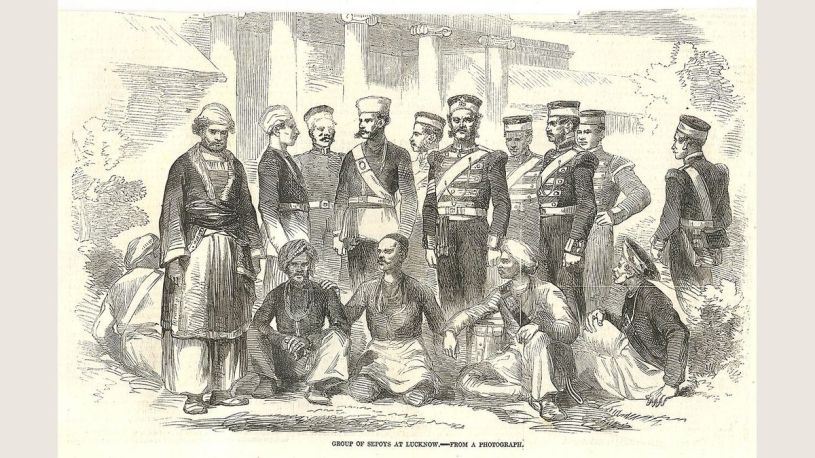
National Army Museum, Armies of the East India Company; National Army Museum, Battle of Plassey: troop numbers and alliances; Historical image: sepoys at Lucknow (1857). Featured image: authentic historical photograph, object or illustration, framed for the site’s homepage.
Support DEPTH
Support evidence-based historical investigation and accessible long-form writing.

Boost us
If you like our content help us to create more.
$5.00
Discover more from The Confessor
Subscribe to get the latest posts sent to your email.

