
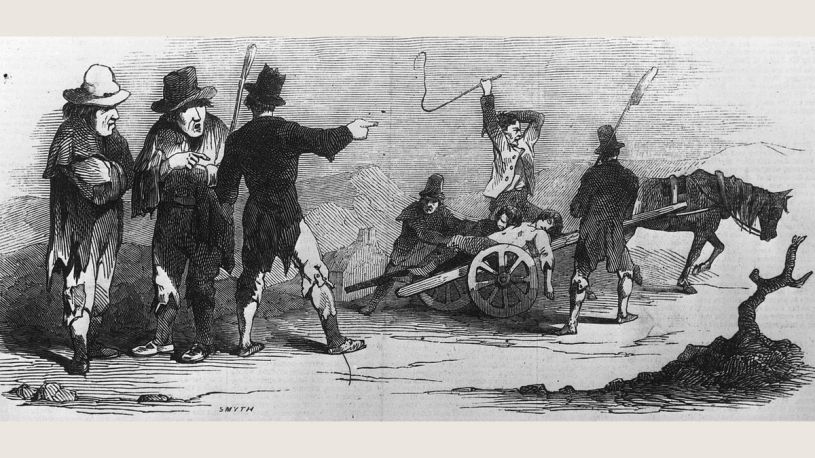
Potato blight struck Ireland in the 1840s, but fungus alone cannot explain why roughly a million people died and so many more left the island. During the disaster, Ireland still produced and exported some food. To understand the apparent contradiction, examine who owned the land, who could buy alternative food and how British policy defined its responsibilities.
A crop disease met an unequal society
The potato was central to the diet of a large proportion of poor Irish people. When blight destroyed successive harvests, labouring families and small tenants lost both food and the economic foundations of survival. Much other agricultural production was controlled by landlords and commercial markets; being surrounded by farmland did not grant the hungry a legal claim upon its produce.
Ireland was politically part of the United Kingdom but profoundly unequal. Land tenure, rent obligations and eviction made the consequences of crop failure worse. People without reliable incomes or reserves quickly became dependent on relief or charity.
Exports are evidence of a system—not a complete explanation
Livestock, grain and other agricultural goods continued to leave Ireland during the famine. Their movement drew bitter protests from people who could not obtain enough to eat. Yet the total scale and composition of trade changed over the crisis, and Ireland also imported substantial quantities of food. It would be inaccurate to suggest that simply halting exports would have automatically fed every victim.
The more profound point is about ownership and distribution: goods could move through a commercial system despite hunger because the people starving lacked the money or legally recognised claim to redirect them. That contradiction was amplified by government relief choices.
Why public policy was decisive
Prime Minister Robert Peel’s administration made food purchases and began relief measures, but his successors under Lord John Russell were strongly influenced by doctrines of market discipline and local responsibility. Public works, soup kitchens and then the Poor Law relief system provided assistance, but their design and uneven execution left devastating gaps. Evictions and disease turned a food crisis into a social disaster.
The famine became a lasting wound in Irish–British relations. Its lesson is not that blight can be legislated away. It is that the effects of an environmental shock depend enormously on institutions, property rights and the willingness of rulers to prioritise human survival over the normal operation of the market.
Sources and image provenance
Encyclopaedia Britannica, Great Famine of Ireland; Contemporary Illustrated London News engraving of Skibbereen (1847). Featured image: historical photograph, illustration or primary document.
Support DEPTH
Keep independent historical investigation accessible. Support DEPTH with a contribution.

Boost us
If you like our content help us to create more.
$5.00
Discover more from The Confessor
Subscribe to get the latest posts sent to your email.

