
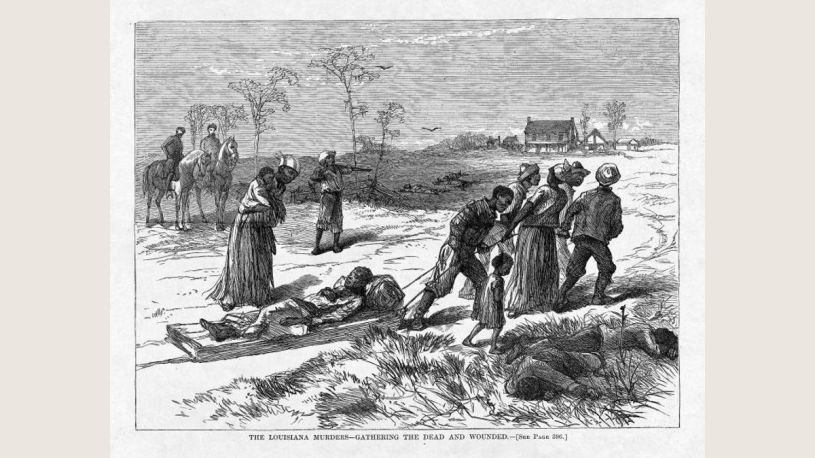
On Easter Sunday, April 13, 1873, armed white men attacked Black Republicans defending the courthouse at Colfax, Louisiana. More than one hundred Black people were killed, many after surrendering or being captured. The Supreme Court’s later handling of the case helped establish how difficult it would become for the federal government to protect the rights won during Reconstruction.
A struggle over legitimate government
The Civil War had abolished slavery, but the struggle over who would govern Southern states continued. In Louisiana, contested elections produced rival claims to political power. Black citizens who supported the Republican government held a courthouse in Grant Parish. White armed groups mobilised to drive them out.
The battle was grotesquely unequal. The attackers overran the defenders; many Black men were killed after organised resistance had ended. Estimates vary, but the massacre stands among the most lethal episodes of Reconstruction-era political violence.
From massacre to constitutional doctrine
Federal prosecutors pursued some perpetrators under the Enforcement Acts designed to safeguard civil and political rights. The resulting case, United States v. Cruikshank, reached the US Supreme Court. In 1876 the justices overturned convictions, using a narrow interpretation of federal constitutional protections and the circumstances under which they constrained private violence.
The decision did not formally declare that murdering Black citizens was lawful. It weakened one route through which federal authorities could punish conspiracies that deprived people of their rights. In a region where local courts and political institutions were often hostile to Black citizens, that distinction was enormous.
The mechanism of counter-revolution
Reconstruction was not defeated solely at the ballot box. Armed terror made voting, organising and holding office dangerous. Juridical restrictions on federal enforcement then helped shield local regimes built on intimidation. Voting rights can exist on paper while organised violence makes their exercise nearly impossible.
Colfax was not merely a mass killing: it was an attack on the credibility of interracial democratic government. The victims’ ability to vote and participate in political life threatened people who had lost the power to enslave them. By joining violence with restrictive legal interpretation, white supremacists could reclaim political control without restoring slavery’s legal name.
Sources and image provenance
US Federal Judicial Center, United States v. Cruikshank (1876); Federal Judicial Center: Cruikshank case and Colfax Massacre; Zinn Education Project on the Colfax massacre. Featured image: historical photograph, illustration or primary document.
Support DEPTH
Keep independent historical investigation accessible. Support DEPTH with a contribution.

Boost us
If you like our content help us to create more.
$5.00
Discover more from The Confessor
Subscribe to get the latest posts sent to your email.
