
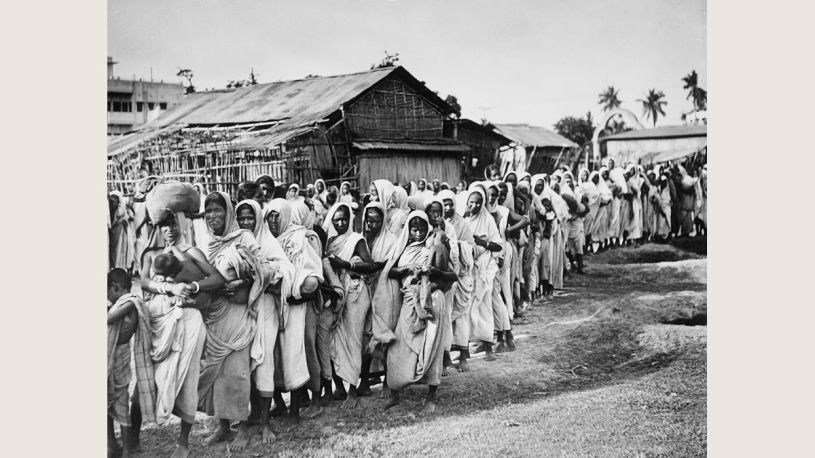
In 1943, millions of people died during famine in Bengal, then part of British India. The disaster unfolded inside a wartime economy that could feed some people while leaving others unable to afford rice. The mechanism matters: starvation can follow not merely from the absence of food, but from the loss of the power to obtain it.
War transformed a vulnerable food economy
The Japanese conquest of Burma disrupted a major source of rice imports. Fear of invasion of eastern India led to British denial policies intended to prevent advancing Japanese forces from exploiting local transport and resources. Boats and other assets were removed or destroyed in affected areas, damaging livelihoods and market access.
Cyclones and crop disease also harmed rice production. The scale of the aggregate food shortfall remains debated, but the existence of supply shocks does not explain why some social groups suffered far more than others. Wartime procurement, speculation and rapid inflation changed the price people had to pay for a basic necessity.
Who could still buy rice?
Workers with protected wages, soldiers and people in priority industries were comparatively more able to secure food. Rural labourers, fisherfolk, artisans and the urban poor could see their earnings collapse in real terms as rice prices rose. Possessing a legal right to purchase food is meaningless when the market price has moved beyond one’s means.
Amartya Sen’s famous entitlement approach drew attention to precisely such disparities in purchasing power and access. Scholars have since debated how much weight belongs to reduced supplies, public policies and failures to distribute existing grain. The false choice is to insist that famine must be either a crop failure or a policy disaster. It can be both, interacting destructively.
The political decisions
Officials in Bengal and London struggled, argued and failed to provide sufficient relief before the catastrophe had spread. Wartime shipping priorities and rejections or delays in grain-import requests intensified the emergency. Later relief efforts helped, but by then people had lost livelihoods, sold assets and become vulnerable to disease.
The precise death toll is uncertain; historians commonly describe a catastrophe costing around two to three million lives. The most unsettling lesson is that an economy can continue functioning for privileged groups while social collapse advances among those whose claims on food are weakest. The famine was not invisible. Its victims were unequal in political power as well as in wealth.
Sources and image provenance
Janam Mukherjee, Famine, Empire, and War: Bengal 1943, Oxford Research Encyclopedia (2026); Bengal Famine Inquiry Commission, original report (reprinted in Indian census archive); Documenta 14, Sunil Janah’s famine photographs. Featured image: historical photograph, illustration or primary document.
Support DEPTH
Keep independent historical investigation accessible. Support DEPTH with a contribution.

Boost us
If you like our content help us to create more.
$5.00
Discover more from The Confessor
Subscribe to get the latest posts sent to your email.
