
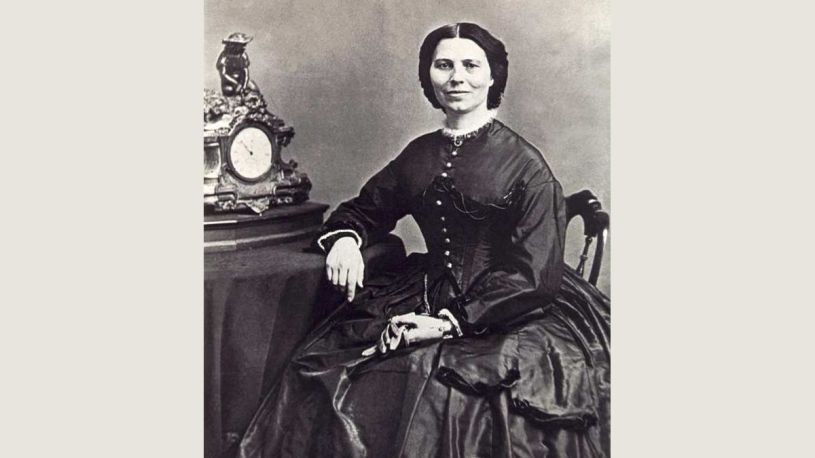
After America’s Civil War ended, thousands of families had no idea whether their sons, husbands and brothers were alive. Clara Barton did not simply mourn that uncertainty. She built an office to search for the missing—and ultimately helped establish the fate of more than 22,000 Union soldiers.
The men who disappeared from the records
During the Civil War, Barton had carried bandages, medicine and supplies to soldiers on Union battlefields. She assisted the wounded at places including Antietam, Fredericksburg and Cold Harbor, often working close to danger despite having no conventional military command. She earned the nickname Angel of the Battlefield, but an enormous humanitarian task remained once the armies stopped fighting.
People wrote to Barton asking whether a relative had been killed, wounded, captured or simply lost in the chaos. An army’s records were often incomplete. Bodies could be buried far from home, and prisoners might die without their families receiving reliable information. Not knowing what happened could mean years of grief and the inability to resolve pensions or family responsibilities.
An office for the missing
In 1865, with Abraham Lincoln’s authorisation, Barton began the Office of Correspondence with Friends of the Missing Men of the United States Army, later known as the Missing Soldiers Office. She and her staff compiled lists, wrote letters, examined military records and contacted people who might recognise a name. The endeavour was painstaking administrative detective work.
According to the American Red Cross, the office handled more than 63,000 letters and identified the fate of about 22,000 missing soldiers. Those were not 22,000 joyful reunions: many families learned that their loved ones had died. But the truth offered a way to mourn, document a death and sometimes obtain financial support.
From battlefields to international relief
Exhausted after years of relief work, Barton travelled to Europe and encountered the emerging international Red Cross movement. She assisted humanitarian efforts during the Franco-Prussian War and returned convinced that the United States needed a similar organisation.
On 21 May 1881, at age 59, Barton and her associates founded the American Red Cross. She led it for 23 years, expanding its mission to peacetime disasters. Its first major relief responses included the Michigan forest fires of 1881 and subsequent floods and hurricanes.
Why her achievement was bigger than a single charity
Barton saw that suffering extended beyond the battlefield: relatives searching for missing soldiers, communities facing fires, civilians caught in war. She helped build institutions that could act when their survival depended on somebody keeping track, organising supplies and making the needs of strangers impossible to ignore.
The extraordinary part of her story is not only that she cared. It is that she turned compassion into an organisation, complete with correspondence, records, supply chains and a system that survived her. The American Red Cross was built on a conviction she had already tested during the war: human lives disappear most easily when nobody accepts responsibility for finding them.
Sources and image attribution
American Red Cross, Clara Barton’s life and work
American Red Cross, chronology and 22,000 missing soldiers
Library of Congress, Clara Barton biography
Historical portrait from the National Park Service via Wikimedia Commons
Authentic mid-nineteenth-century photographic portrait of Clara Barton, credited to Mathew Brady, via the US National Park Service and Wikimedia Commons. Public-domain image, framed on a 1200 × 675 canvas.
Support DEPTH
Help keep sourced, independent history writing available. Support the project if you value these stories.

Boost us
If you like our content help us to create more.
$5.00
Discover more from The Confessor
Subscribe to get the latest posts sent to your email.

