
Google hired Timnit Gebru to examine the dangers of artificial intelligence. In December 2020, she lost her job in a dispute over a research paper that did precisely that. Roughly 7,000 Google employees and outside supporters eventually protested. Nine members of the US Congress demanded answers. Six years later, Gebru has been named a 2026 Right Livelihood Award laureate for challenging the concentration of power in artificial intelligence.
The story is not quite as simple as a viral graphic saying that Google ‘buried’ a paper about its racist technology. The paper was eventually published. Google’s account of how her employment ended differs from Gebru’s. And the research was a carefully argued warning about several risks of enormous language models—not an allegation that one specific Google product was inherently racist. None of those corrections makes the underlying controversy less significant. They reveal what was actually at stake.
A researcher the company was supposed to listen to
Gebru was born in Ethiopia in 1983 to a family of Eritrean origin. She later moved to the United States and earned a PhD in electrical engineering from Stanford. Before joining Google, she had already helped demonstrate that artificial intelligence could fail people in highly unequal ways.
In 2018, she and researcher Joy Buolamwini published Gender Shades, an audit of three commercial systems that attempted to classify people’s gender from images of their faces. For the darker-skinned women in their benchmark, error rates reached 34.7%; for lighter-skinned men, the worst error rate was 0.8%. Those numbers concerned gender-classification systems tested at that time—not every face-recognition product and not every modern AI model. They nevertheless exposed the danger of treating accuracy measured on one group as proof of reliability for everyone.
Google subsequently employed Gebru as a co-leader of its Ethical AI team. The job, in principle, was to ask difficult questions about technology developed by one of the world’s most powerful companies.
The paper that triggered a crisis
In 2020, Gebru collaborated with linguist Emily M. Bender and other researchers on a paper called On the Dangers of Stochastic Parrots: Can Language Models Be Too Big? The authors questioned the assumption that the future of artificial intelligence necessarily meant building ever-larger systems from ever-larger collections of scraped internet text.
Their objections were concrete. Training enormous models can consume significant energy and concentrate research capacity among wealthy institutions. Datasets assembled at industrial scale may contain undocumented biases, hateful language and the unexamined viewpoints of dominant groups. Models can produce fluent sentences that readers mistake for grounded understanding. And the people affected by deployment are often excluded from deciding whether a system should be built at all.
These questions are more interesting than the slogan ‘AI is racist’. They ask who chooses the data, who pays the costs, whose language is treated as normal, and whether a system that sounds convincing is actually worthy of trust. The paper recommended careful data documentation, scrutiny of environmental and financial costs, and serious consideration of alternative research directions.
Google’s management objected to the submitted manuscript and asked that it be withdrawn or that Google-affiliated authors remove their names. The company argued that it had not met its internal publication-review standards. Gebru challenged how that review had been conducted and raised additional concerns about treatment of Black researchers and workplace diversity.
Was she fired or did she resign?
On 2 December 2020, Gebru learned she would no longer work at Google. She said she had been fired. The company presented the departure as an accepted resignation following an email in which she set conditions for continuing in her role. Contemporary reporting reproduced the disputed language of Google’s response. There was no neutral agreement between the parties that she had voluntarily quit.
It is misleading to suggest that the contested paper was simply the only factor. The dispute also involved Gebru’s criticism of Google’s internal research procedures and diversity efforts, and management’s reaction to her communications with colleagues. What is not in serious doubt is that the paper became a central flashpoint and that the abrupt departure alarmed other researchers.
In a December 2020 report, The Washington Post counted nearly 3,000 Google employees and more than 4,000 academics, engineers and industry colleagues supporting the protest. Nine Democratic lawmakers, including Elizabeth Warren and Cory Booker, wrote to Google’s chief executive asking for answers about research freedom and diversity. Google CEO Sundar Pichai later apologised for how the departure had been handled and pledged to investigate; he did not simply concede the company’s substantive account was wrong.
And the paper was not buried forever. It was published in March 2021 in the peer-reviewed proceedings of the ACM Conference on Fairness, Accountability, and Transparency, with Bender, Gebru, Angelina McMillan-Major and Margaret Mitchell listed as authors. The effort to stop or alter its release made its warnings considerably more widely discussed.
She built a research institute instead
In December 2021, Gebru founded the Distributed AI Research Institute (DAIR), an independent organisation intended to study artificial intelligence outside the incentives and constraints of the largest technology companies. Its research programme examines how AI affects communities, workers, the environment and people who are often absent from corporate product decisions.
In 2022, TIME included Gebru among its 100 most influential people. And on 30 September 2026, the Right Livelihood organisation announced her as one of its 2026 laureates for challenging concentrated power in AI and advancing community-rooted research. The award ceremony is scheduled for December 2026.
The question Google could not escape
There is a tension at the centre of corporate AI ethics. A business may sincerely employ researchers to identify harmful effects. But a critical finding can also threaten its flagship products, reputation or commercial strategy. If management can decide which criticism gets published, how independent is the research? If a researcher’s career depends on keeping the company comfortable, how much pressure is needed to change the questions they choose to ask?
That does not mean every criticism of artificial intelligence is correct or that every company objection to a paper is censorship. Serious research requires scrutiny, including uncomfortable scrutiny of the critics. The issue exposed by the Gebru controversy is whether those standards were applied fairly and transparently when the work questioned a commercially important direction.
The lasting story is therefore not that Gebru proved technology was evil and was punished for it. It is that a scientist whose task was to question the consequences of AI became the centre of a conflict over who gets to ask such questions—and who has the power to stop them. The paper survived. The researcher built an independent institution. The questions have become harder to ignore as language models have spread into ordinary life.
Sources
- The original 2021 Stochastic Parrots paper (ACM FAccT)
- Gender Shades: Buolamwini and Gebru’s 2018 facial-analysis study
- WIRED: Behind the paper that led to a Google researcher’s firing (December 2020)
- The Washington Post: 7,000-plus signatories and nine US lawmakers (December 2020)
- TechCrunch: The dispute over resignation versus dismissal (December 2020)
- IEEE Spectrum: Gebru’s independent DAIR research institute (2022)
- TIME: Timnit Gebru among the 100 most influential people of 2022
- Right Livelihood: Gebru receives the 2026 Right Livelihood Award (30 September 2026)
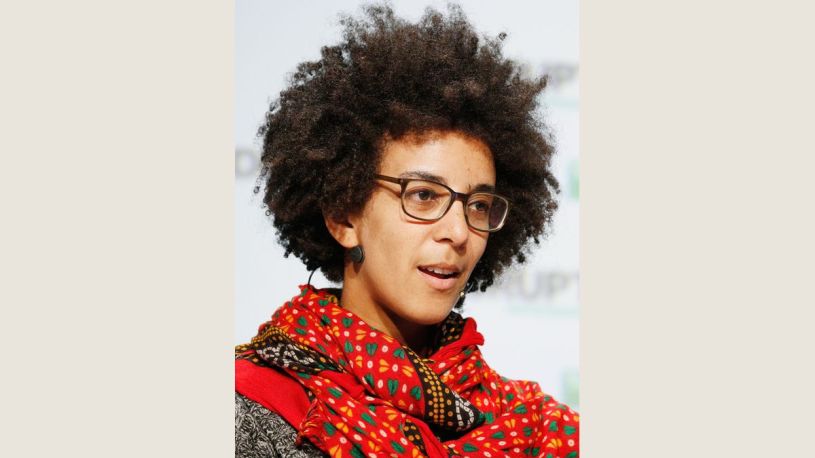
Featured photograph: Timnit Gebru speaking at TechCrunch Disrupt San Francisco on 7 September 2018. Photograph by Kimberly White/Getty Images for TechCrunch; distributed by TechCrunch under CC BY 2.0, via Wikimedia Commons. Adapted only by placing the photograph within an uncropped landscape canvas for this site.
Support DEPTH
If independent, evidence-based writing about technology and power matters to you, help keep it available to everyone.

Boost us
If you like our content help us to create more.
$5.00
Discover more from The Confessor
Subscribe to get the latest posts sent to your email.

