
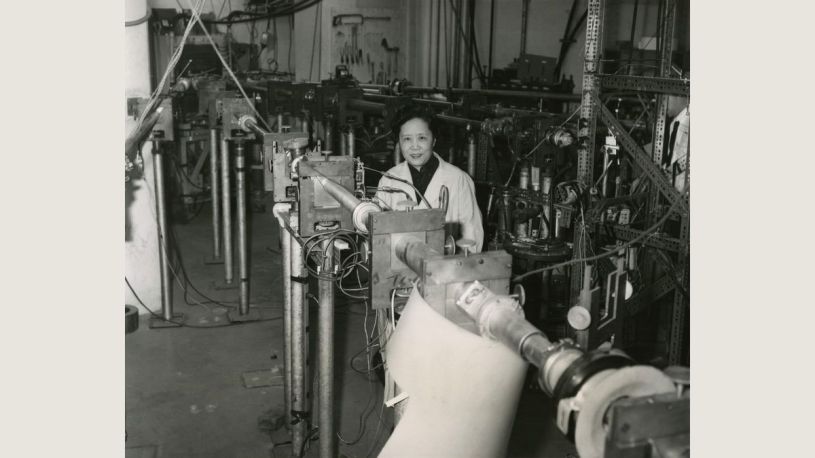
For decades, physicists had assumed the laws of nature behaved the same way in a mirror. Then Chien-Shiung Wu designed a brutal test of that beautiful idea. Her experiment overturned a foundational assumption of twentieth-century physics. The 1957 Nobel Prize went to the two theorists who had proposed the question—not to Wu.
When a mirror no longer shows the same universe
Scientists call the symmetry between a process and its mirror image parity. By the middle of the twentieth century, conservation of parity seemed natural across physics. Two physicists, Tsung-Dao Lee and Chen-Ning Yang, noticed that there was not good experimental evidence for assuming it applied to the weak nuclear interaction. They proposed experiments that could test the question.
Chien-Shiung Wu, an exceptionally accomplished Chinese-American nuclear physicist at Columbia University, designed a decisive experiment using radioactive cobalt-60 nuclei. The experiment was performed with a low-temperature team at the US National Bureau of Standards, now NIST, including Ernest Ambler, Raymond Hayward, Dale Hoppes and Ralph Hudson.
The frozen cobalt-60 experiment
At extremely low temperatures and under a magnetic field, the cobalt-60 nuclei could be aligned. If parity symmetry held, the directions of the emitted electrons would follow the expected mirror-symmetric pattern. What Wu and her collaborators measured was an asymmetry: more electrons were emitted in the direction opposite the nuclear spin.
By the end of December 1956, the result demonstrated that parity was not conserved in this weak interaction. The findings were publicly announced in January 1957 and the research published in February. Experiments by other scientists quickly corroborated the violation.
The prize that omitted the experimenter
That same year, Lee and Yang won the Nobel Prize in Physics for their theoretical work on the laws of parity. Wu did not receive the award. It would be unfair to say Lee and Yang did nothing: without their theoretical insight, the experimental question might not have been asked in this form. But it would be equally misleading to recount the discovery without the scientist who led the crucial test.
Wu was already respected for work on beta decay and nuclear physics, including contributions during the Manhattan Project. She later became the first woman to serve as president of the American Physical Society and received the prestigious Wolf Prize in Physics in 1978. She never won a Nobel.
Why the distinction matters
A good theory makes a prediction. A good experiment puts it at risk. Physics advances when both happen. Wu did not merely confirm the work of more important men; she conceived and helped perform the rigorous experimental test that established a new fact about nature.
The story is sometimes simplified into a morality play about an unfair prize. The deeper discovery is stranger: the universe itself does not perfectly respect the reflection symmetry that human beings once assumed was obvious. Wu supplied the evidence.
Sources and image attribution
US National Institute of Standards and Technology, the Wu experiment
American Physical Society, history of Lee, Yang and Wu
US National Park Service, Chien-Shiung Wu biography
Smithsonian photograph of Wu at work in 1963
Historic Smithsonian Institution Archives photograph of Chien-Shiung Wu working at Columbia in 1963. It shows a different experiment from the decisive 1956 parity test. No synthetic imagery.
Support DEPTH
Help keep sourced, independent history writing available. Support the project if you value these stories.

Boost us
If you like our content help us to create more.
$5.00
Discover more from The Confessor
Subscribe to get the latest posts sent to your email.

