
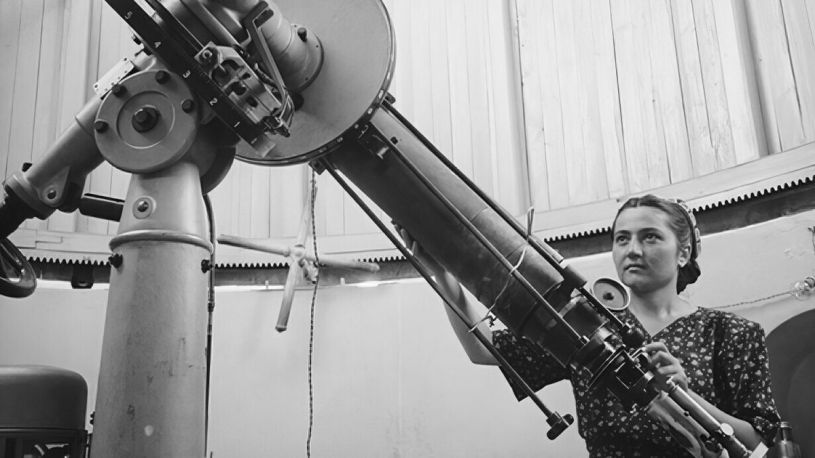
The stars look solid, distant and permanent. In 1925, Cecilia Payne’s doctoral thesis used stellar spectra to reveal something revolutionary about their composition: stars contain overwhelming amounts of hydrogen and helium rather than a mixture closely resembling the Earth’s surface.
Her interpretation challenged prevailing scientific expectations. The astronomer Henry Norris Russell was initially sceptical of the abundance results, and Payne expressed caution in her thesis. Later work confirmed the conclusion.
Spectroscopy made the insight possible. Atoms absorb or emit light at characteristic wavelengths, so the patterns visible in starlight carry information about matter across distances far beyond the reach of any spacecraft.
Payne-Gaposchkin’s accomplishment was not observing a new object. It was recognising that familiar evidence required an unfamiliar explanation. She later built a distinguished career studying variable stars at Harvard, where women had long performed crucial astronomical labour without receiving equal institutional status.
Her story offers a demanding lesson about scientific originality: the greatest breakthrough can occur when someone trusts a rigorous method enough to follow it beyond what senior authorities expect to be true.
Sources and illustration
American Institute of Physics, Cecilia Payne-Gaposchkin oral history. This post uses an authentic period photograph, engraving, archival illustration or related primary document for its featured image—not an AI reconstruction. The image is framed for wide homepage display.
Support DEPTH
If this kind of historically grounded writing is useful to you, support independent publishing.

Boost us
If you like our content help us to create more.
$5.00
Discover more from The Confessor
Subscribe to get the latest posts sent to your email.
