
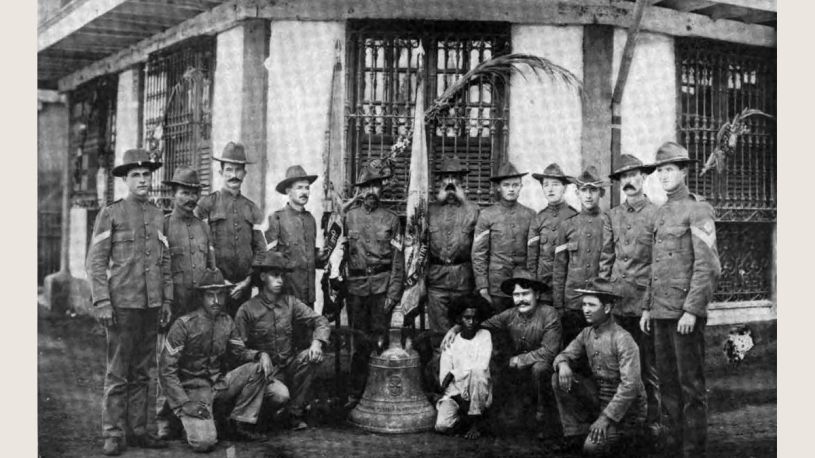
On 28 September 1901, Filipino guerrillas attacked American troops occupying Balangiga on the island of Samar. Roughly 44 to 48 US soldiers were killed. What followed was a sweeping American punitive campaign against the surrounding region, and a dispute over church bells that lasted more than a century.
A colony that had declared itself independent
The Philippine–American War began after Filipinos who had fought Spanish colonial rule declared their own independence and confronted the United States, which had acquired the Philippines from Spain in 1898. By 1901, American forces were occupying towns and attempting to break remaining Filipino resistance.
The Balangiga attack inflicted a humiliating defeat on Company C of the US 9th Infantry. Guerrilla fighters exploited surprise and local knowledge. US accounts called it a massacre; Filipino historical memory often emphasises resistance to foreign occupation. Both the dead American soldiers and the broader colonial situation must be understood.
Jacob Smith’s retaliatory campaign
Brigadier General Jacob H. Smith ordered a harsh campaign in Samar, including the notorious instruction to make the region a ‘howling wilderness’ and to treat males above the age of ten as potential enemies. Such orders did not mean that every boy above ten was systematically killed, and exact casualty numbers remain disputed. But villages were burned, civilians suffered and the methods attracted criticism even within the United States.
Smith was court-martialed and later retired. The episode exposes the danger when an occupying army interprets guerrilla resistance as evidence that an entire civilian population should be punished.
Three church bells became political objects
American soldiers seized three church bells from Balangiga and carried them away as war trophies. For Filipinos, they became visible symbols of an unhealed colonial humiliation. The bells remained in American custody for generations before being returned to the Philippines in December 2018.
Returning the bells did not reverse the deaths or erase the occupation. It did, however, acknowledge that memory can become bound to objects. The same metal that once sounded within a village church acquired a second history as an instrument through which a formerly colonised country demanded recognition.
Sources and historical visual
US Congressional Research Service: Return of the Balangiga Bells (2018); Photograph and provenance of Balangiga Bells. Featured image: authentic historical photograph, object or illustration, framed for the site’s homepage.
Support DEPTH
Support evidence-based historical investigation and accessible long-form writing.

Boost us
If you like our content help us to create more.
$5.00
Discover more from The Confessor
Subscribe to get the latest posts sent to your email.

