
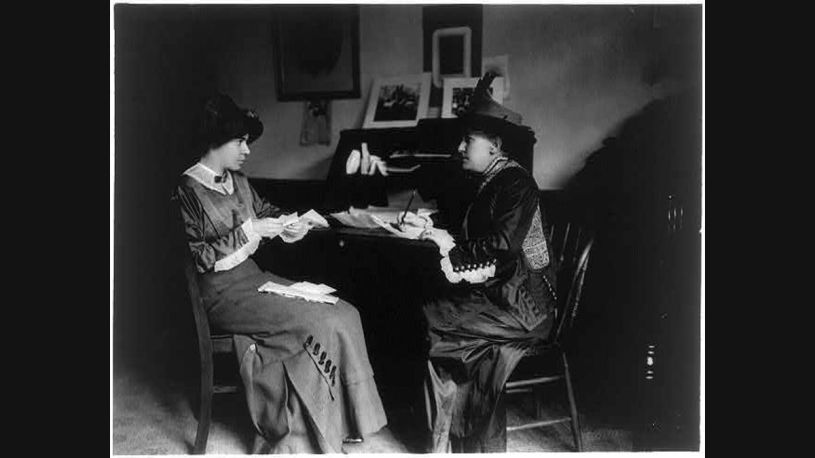
In the late nineteenth century, some American laws set the age below which a girl was legally incapable of consenting to sex shockingly low. Delaware’s statutory threshold was seven until 1889. In 1890, 38 U.S. states had an age of consent of twelve or younger. For girls, this could make the difference between a criminal prosecution for statutory rape and the absence of that particular legal protection.
One of the women who helped expose and challenge this system was Helen Hamilton Gardener (1853–1925), a writer, freethinker and political reformer. Her fight against the exploitation of girls was part of a broader campaign that eventually helped transform American laws—even though women themselves were denied the vote in most of the country.
Why was the age of consent once seven in Delaware?
Nineteenth-century American sexual-offence laws developed state by state, and they reflected inherited legal traditions, assumptions about maturity, social status, sexual reputation and the rights of men. An age-of-consent provision established a minimum age under which consent could not legally excuse the specified sexual act. It did not mean all sexual violence above that age was legal; coercion and other offences could still be prosecuted, often under restrictive evidentiary rules. But the low thresholds left many girls poorly protected and placed a terrible burden on victims.
In Delaware, the minimum age was raised from seven to fifteen in 1889, and then to eighteen in 1895. The detail is often misstated online as though seven remained the rule throughout the 1890s. The correct chronology is even more revealing: these were not ancient medieval provisions but laws being fought over in the United States in the lifetime of our great-grandparents.
Who was Helen Hamilton Gardener?
Gardener was born Mary Alice Chenoweth in Virginia and later established herself as an author and lecturer. She attacked sexual double standards and the claim that women were inherently less intelligent than men. In her influential essay Sex in Brain (1888), she scrutinized supposedly scientific arguments that used brain size or anatomy to justify women’s exclusion from education and public authority.
She also wrote fiction designed to make sexual exploitation impossible to ignore. Her novels Is This Your Son, My Lord? (1890) and Pray You, Sir, Whose Daughter? (1892) were part of a deliberate effort to dramatize the damage done by unequal sexual standards and inadequate protection for children.
A campaign against legislators who resisted protecting girls
In the 1890s Gardener worked alongside a wider coalition, including women’s clubs, the Woman’s Christian Temperance Union and other reform organisations. Though she disagreed with some allies about religion and temperance, she shared their determination to raise the age of consent. This was an organised, state-by-state political struggle, not the achievement of any single heroine.
Gardener used The Arena magazine to publish legislative comparisons, reports and voting records. She identified states that were refusing to raise the age above fourteen and urged readers to question nearly 9,000 state legislators. She also opposed proposals under which a girl would receive protection only if she could prove she had been a virgin before an assault.
The opposition was not imaginary. A report on the 1895 Texas campaign, reproduced in Gardener’s work, recorded arguments that girls physically matured early, that young women might blackmail employers, that punishment would ruin young men’s lives and that the supposed chivalry of Southern society provided enough protection. The report also recorded explicitly racist objections.
These arguments exposed the imbalance at the movement’s heart: adult lawmakers debated how much legal protection girls deserved, while the women pressing for reform were largely excluded from choosing those lawmakers.
How much did the age-of-consent campaign change American law?
The campaign contributed to measurable legislative change. By 1900, 32 states had raised their age-of-consent thresholds to between fourteen and eighteen, according to historian Kimberly A. Hamlin’s research. The reforms remained uneven, and statutory thresholds alone could not eliminate sexual abuse, coercion, discriminatory enforcement or victim-blaming. But the movement succeeded in overturning some extraordinarily inadequate legal standards.
Gardener’s story also connects two struggles usually told separately: protecting children from sexual exploitation and winning political rights for women. Reformers learned that persuading male legislators was an exhausting substitute for possessing the vote themselves.
From age-of-consent reform to women’s suffrage
Gardener became an important strategist and lobbyist for the National American Woman Suffrage Association, working behind the scenes with members of Congress and President Woodrow Wilson’s administration. She helped build support for the constitutional change that became the Nineteenth Amendment, ratified in 1920, prohibiting voting discrimination on account of sex.
That same year, Wilson appointed her to the United States Civil Service Commission, making her its first female commissioner. Gardener died in 1925, having witnessed both major changes in sexual-protection legislation and the establishment of federal constitutional voting rights for American women.
Her legacy is bigger than a single law or appointment. She challenged the notion that power conferred moral or intellectual superiority—and insisted that the people most exposed to a society’s rules should have a voice in making them.
Sources and further reading
- Kimberly A. Hamlin, Smithsonian Magazine, “What Raising the Age of Sexual Consent Taught Women About the Vote” — historical legal figures, campaign and reform outcomes.
- Children and Youth in History, “Review of the Age-of-Consent Legislation in Texas” (1895) — contemporary objections to reform, preserved and annotated.
- Kimberly A. Hamlin, Smithsonian Magazine, Gardener and the suffrage campaign.
- Library of Congress, Helen Hamilton Gardener (1853–1925), memorial collection — biographical record and writings.
- Featured photograph: Helen Hamilton Gardener and Alice Paul, Library of Congress, Bain Collection — historical photograph; no known restrictions on publication.
- Helen Hamilton Gardener, Facts and Fictions of Life (1893), Project Gutenberg — contains Sex in Brain.
Discover more from The Confessor
Subscribe to get the latest posts sent to your email.
