
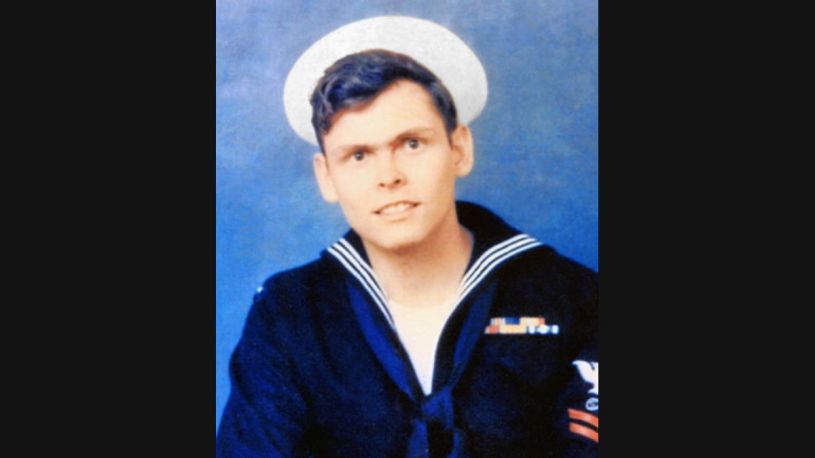
His North Vietnamese captors reportedly called him “The Incredibly Stupid One.” On 5 August 1969, they released the young American sailor Doug Hegdahl, unaware that he had memorized information about approximately 256 American prisoners of war—names, capture details and clues to their identities. He had kept the list in his head by singing it to the tune of a children’s song: Old MacDonald Had a Farm.
It was an extraordinary intelligence operation carried out by a man whom his guards believed could barely read. And it began with a bizarre accident at sea.
How Doug Hegdahl became a prisoner of war
Douglas Brent Hegdahl was a young sailor from Clark, South Dakota, serving aboard the guided-missile cruiser USS Canberra during the Vietnam War. Before dawn on 6 April 1967, he went on deck while the ship was firing its guns off the coast of North Vietnam. He later said that he could not remember exactly how he fell overboard. The next thing he knew, he was in the water. After roughly five hours, North Vietnamese fishermen picked him up.
Instead of returning to his ship, Hegdahl was taken into custody. He eventually became one of the Americans imprisoned in North Vietnam’s notorious prison system, including facilities that American POWs nicknamed the Hanoi Hilton. As a junior enlisted sailor among predominantly older, higher-ranking aviators, he initially appeared an unlikely figure in the prisoners’ resistance network.
The prisoner who pretended he could not read
Hegdahl deliberately encouraged his captors to underestimate him. He pretended to be illiterate and slow to understand, apparently convincing some guards that he posed no danger. Assigned menial jobs and allowed greater movement around the camp, he quietly gathered information. Official U.S. Navy histories also credit him with sabotaging five trucks, reportedly by putting dirt in their fuel tanks.
His more important mission was not destructive but mnemonic. The prisoners had developed ways of communicating despite isolation, including a tapping code. With help from fellow POWs, Hegdahl assembled an immense inventory of prisoners’ names, dates and circumstances of capture, and personal identifying details that could help confirm identities.
The 256 POW names hidden in Old MacDonald Had a Farm
To prevent the list from slipping away, Hegdahl repeatedly recited the information to the melody of Old MacDonald Had a Farm. The absurdity of the contrast became his advantage: a tune associated with small children helped him preserve a record of men whose whereabouts were often unknown to the outside world.
The most frequently cited figure is 256 POWs, used by the Naval History and Heritage Command. Other historical accounts, including a review of Marc Leepson’s biography, report 254. The precise total varies among sources; what is beyond serious dispute is that Hegdahl memorized identifying information about more than 250 fellow prisoners and was able to deliver it.
The distinction matters. This was not a miraculous rescue of 256 men, nor was every name necessarily unknown to the U.S. government. It was extraordinarily valuable corroboration: a detailed, firsthand account of prisoners being held by an enemy government that did not provide a reliable public accounting of all captives.
Why his fellow prisoners ordered him to accept early release
American POWs had pledged not to accept individual early release before their comrades. When North Vietnam selected Hegdahl to leave in August 1969, he initially resisted. Senior prisoner Richard Stratton ordered him to accept the offer because he could carry the list home and describe the treatment of prisoners, including torture, to U.S. officials.
Hegdahl was released on 5 August 1969. His captors intended the release of several Americans to support their public claims of humane treatment. Instead, his testimony gave the U.S. military and government information that could be used to challenge those claims at the Paris peace talks and to inform families of missing servicemen.
In a statement shortly after returning, Hegdahl explained that the fall itself had been accidental: he had gone to watch the firing, remembered nothing of the fall, and found himself in the sea. The sailor who had supposedly known so little came back with an astonishing amount of information.
What happened to Doug Hegdahl after the Vietnam War?
Hegdahl did not simply disappear after his return. He spoke about the POWs still held in Vietnam, contributed to the public campaign for better treatment of captives and later worked as an instructor in the U.S. Navy’s Survival, Evasion, Resistance and Escape (SERE) training system. His experiences helped prepare other service members for the possibility of captivity.
The most remarkable part of his story is not that he outwitted his guards by pretending to be foolish. It is that he used the freedom this deception afforded him to preserve the identities of other men. He memorized people so that they would not remain invisible.
Sources and further reading
- U.S. Naval History and Heritage Command, H-Gram 043-2: Vietnamization — official chronology and account of the memorized POW list.
- U.S. Navy CHIPS, “Dirt, Taps & Nursery Rhymes” — prisoner communications and the instructions to accept release.
- U.S. Congressional Record, 1969 — Hegdahl’s own post-release account of falling overboard.
- U.S. Army University Press, review of Marc Leepson’s biography — additional documentation and the alternative figure of 254 names.
- Featured photograph: official U.S. Navy portrait of Doug Hegdahl (1970), via Wikimedia Commons.
Discover more from The Confessor
Subscribe to get the latest posts sent to your email.

