
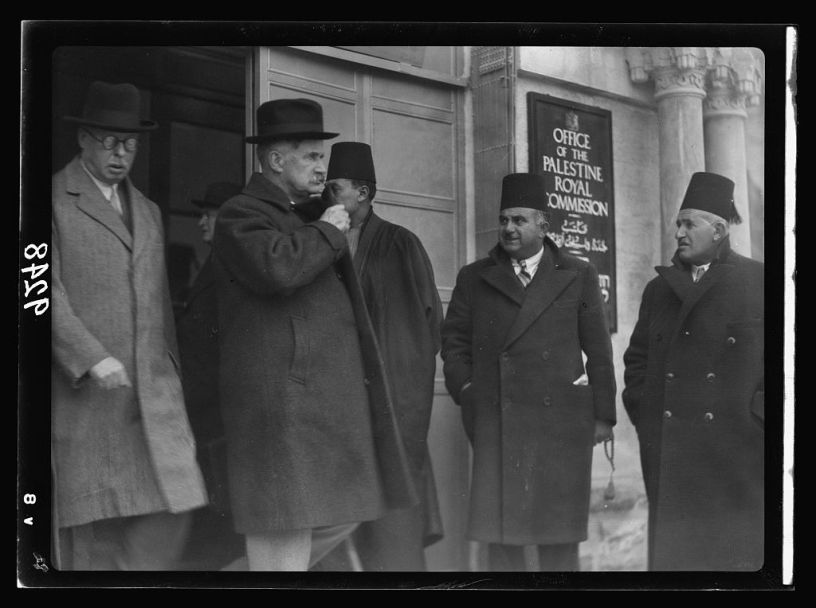
In July 1937, six British commissioners proposed creating a Jewish state in Palestine. Their report identified one formidable obstacle: approximately 225,000 Arabs already lived inside the territory they wanted to allocate to it. The commissioners did not merely draw lines on a map and hope the inhabitants would adapt. They raised the prospect of moving people across those lines—even against their wishes.
This was the Peel Commission, a British royal commission appointed to investigate the Arab Revolt against British rule and Zionist settlement. Its recommendations were never implemented. But they marked a watershed: a British government commission had put Jewish statehood, partition and the possible compulsory transfer of an indigenous population into the same official political programme.
An empire arrives to investigate a rebellion
The commissioners reached Palestine in November 1936. Months earlier, in April, Palestinian Arabs had launched a general strike that developed into a revolt against British rule and accelerating Jewish immigration. Palestinians demanded national independence and feared dispossession. At the same time, growing numbers of Jews were seeking refuge from European antisemitism, particularly the persecution unleashed by Nazi Germany. The emergency was real for both populations; their political demands were increasingly irreconcilable.
Britain had helped create the contradiction. Its 1917 Balfour Declaration supported the establishment of a Jewish national home in Palestine while promising not to prejudice the civil and religious rights of existing non-Jewish communities. Under the League of Nations Mandate, Britain was also responsible for governing a population whose Arab majority sought self-determination. The commission itself acknowledged the tension between British obligations.
Chaired by William Peel, Earl Peel, the six-man body included imperial administrators with careers in India and East Africa, the diplomat Sir Horace Rumbold, and Oxford historian Reginald Coupland. The men were accustomed to thinking about territories and populations as subjects of imperial administration. They arrived to investigate a rebellion; they departed recommending that the country be divided.
The numbers that made partition a population problem
The commission’s report, published on 7 July 1937, proposed ending the existing Mandate and establishing an Arab state linked to Transjordan and a Jewish state in northern and coastal Palestine. Britain would retain control of Jerusalem, Bethlehem and a connecting corridor, together with arrangements concerning other sensitive areas.
Then came the arithmetic. The report estimated about 225,000 Arabs in the proposed Jewish state, compared with only about 1,250 Jews in the territory allocated to the Arab state. These were contemporary estimates rather than census-perfect totals. But they exposed a political fact: it was impossible to draw the suggested borders without encompassing a substantial Palestinian Arab population.
The commissioners considered these minorities an impediment to their proposed settlement. Their preferred answer was not simply a guarantee of rights within the new states. It was what the report called an exchange of population. Its text invoked the compulsory Greek–Turkish population exchange that followed the 1922 war. It discussed possible resettlement sites in Transjordan, the Beersheba district and the Jordan Valley, dependent on irrigation and development, and envisaged British financial assistance to facilitate transfer, “voluntary or otherwise.”
Those last three words matter. The commission did not issue an order expelling every one of the 225,000 Arabs, and it recognised that sufficient resettlement land did not yet exist. But it made possible coerced transfer part of its imagined solution to partition. The practical question had shifted from whether people should be required to leave their homes to whether a sufficiently large territory could be prepared to receive them.
The map, and the conversations behind it
Partition was not worked out solely in public hearings. According to historian Laila Parsons, writing in the Interactive Encyclopedia of the Palestine Question, commissioners received both public testimony and confidential evidence. The Arab Higher Committee initially boycotted proceedings over Britain’s refusal to suspend Jewish immigration, but its representatives appeared publicly in January 1937. Zionist leaders also testified, including in private sessions.
Parsons reports that representatives of the Jewish Agency and Zionist Organization were consulted on the proposed boundaries before publication and successfully pressed for inclusion of areas they considered important, notably the Hula Valley. The report itself highlighted Hula’s potential for future development and Jewish settlement. Not every allegation about the map’s agricultural value can be established from this evidence, but the influence of confidential discussions on territorial decisions is a historically significant finding.
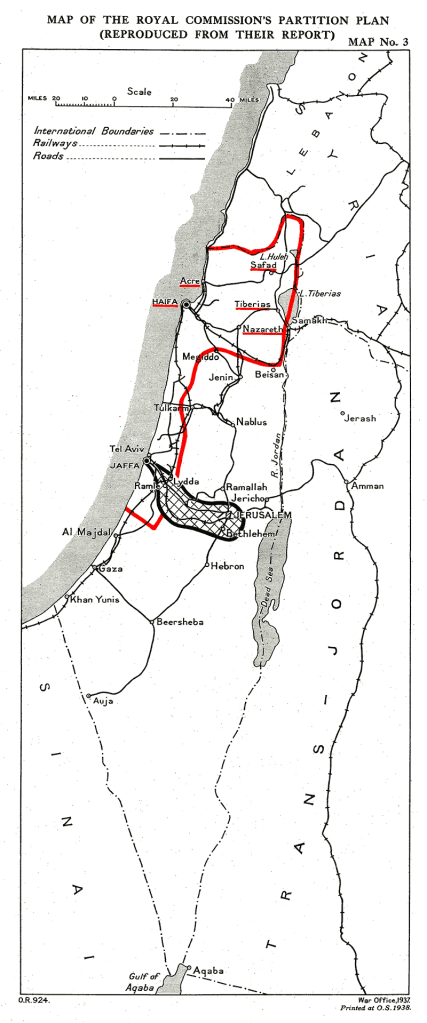
The Jewish leadership did not simply accept the plan as drawn. It was divided over the proposed boundaries and ultimately accepted partition as a principle without endorsing the precise Peel map. Palestinian Arab leaders rejected the idea that a homeland in which they formed the majority should be divided to accommodate a separate sovereign state.
Britain was investigating the revolt while crushing it
The inquiry took place against the background of fierce repression. British forces used collective punishment, detention and punitive house demolitions during the 1936–39 revolt. Historian Matthew Hughes, drawing on British military archives, has documented torture and atrocities in the campaign. The rebellion itself also included attacks on Jewish civilians and violence among Palestinian factions—facts that do not excuse the conduct of the colonial authorities.
Britain’s suppression of the uprising increasingly involved cooperation with Jewish security organisations. Jewish auxiliary police helped protect settlements and infrastructure. In 1938, after the Peel report, British officer Orde Wingate organised the Special Night Squads, joint British-Jewish units that fought Arab rebels and became notorious for harsh counterinsurgency tactics. They were not part of the commission’s recommendations, but they belonged to the same escalating confrontation between British power, the Palestinian uprising and an increasingly organised Zionist movement.
A plan abandoned—and an idea that survived
None of the proposed population exchange occurred under the Peel plan. The British government initially treated partition as a promising way forward, but it commissioned a further feasibility inquiry. In 1938, the Woodhead Commission judged the proposed partition arrangements unworkable. Britain subsequently abandoned partition as an immediate policy and pursued a different course.
That distinction matters because the history of 1948 cannot be reduced to a British plan mechanically executed eleven years later. The United Nations voted in November 1947 for a different partition plan, with different boundaries. It was not implemented as designed. Civil war began in Mandatory Palestine, Israel declared independence in May 1948, neighbouring Arab armies intervened, and the resulting war transformed the territorial situation.
During the war, more than 700,000 Palestinian Arabs lost their homes through a combination of expulsion, flight from fighting and fear of violence. The UN’s Economic Survey Mission later estimated 726,000 refugees; UNRWA initially assisted roughly 750,000. This catastrophe—the Nakba—was not a literal execution of the Peel Commission’s transfer proposal. Nor was it wholly disconnected from the preceding decades of competing nationalism, colonial rule and disputes over who would control the land.
What the Peel Commission tells us
The enduring significance of the report lies in the political assumptions recorded in its own pages. A European imperial power investigated a struggle for self-determination and proposed solving it by dividing the territory. Having drawn its borders, it treated the people already living on the wrong side of them as a problem to be moved.
There is no need to pretend that 1937 and 1948 were identical, or that every Zionist leader held precisely the same position, or that Jewish persecution in Europe was somehow unreal. The documentary record is consequential enough without those distortions. The Peel Commission brought population transfer into an official British blueprint for Palestine, and explicitly left room for coercion.
The question raised by that fact is larger than one commission or one map: when a political solution depends on removing people from their homes, whose peace is actually being designed?
Sources and further reading
- Palestine Royal Commission, 1937 — League of Nations summary, especially chapter XXII, section 10, “Exchange of Land and Population.”
- United Nations archive — full report of the Palestine Royal Commission (Cmd. 5479).
- Laila Parsons, “The Peel Commission, 1936–1937”, Interactive Encyclopedia of the Palestine Question.
- Matthew Hughes, “The Banality of Brutality”, English Historical Review (2009); and “Terror in Galilee” (2015).
- Yale Law School’s Avalon Project — historical account of the Woodhead Commission and abandonment of partition.
- International Court of Justice, 2024 advisory opinion summary (UN archive); UNRWA’s historical refugee figures.
- Featured photograph: Library of Congress, Matson Photograph Collection, 1937. Map: UK Government, via Wikimedia Commons.


