
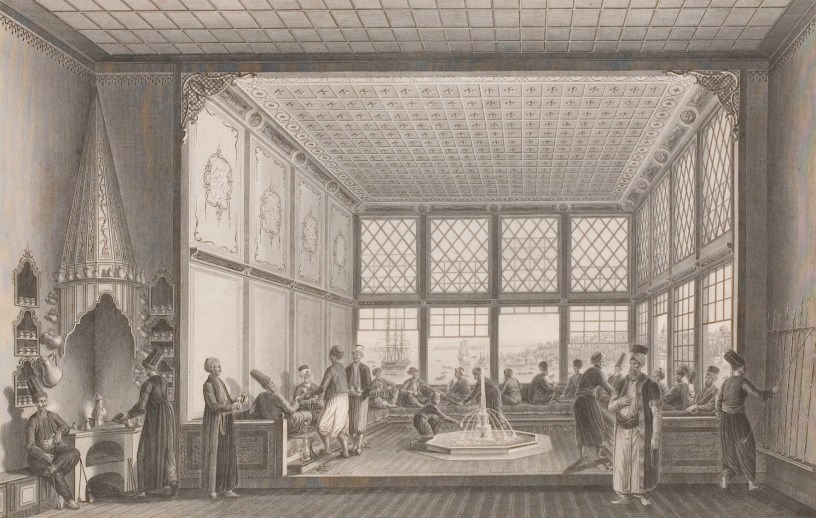
Before coffeehouses became fixtures of European cities, coffee drinking had taken root among Muslim communities in Yemen. In particular, Sufi devotional circles helped popularize a drink valued for keeping worshippers alert during nighttime religious practice.
The beans came from a plant native to the Ethiopian region, but Yemen became a crucial centre of cultivation, preparation and commercial distribution. From the Red Sea, coffee travelled into Ottoman cities and eventually into European urban life.
A drink for wakefulness
Accounts of coffee’s early history contain legends, and historians disagree about some details of its first adoption. What is much better established is that coffee was being consumed in Yemen by the fifteenth century and became associated with Sufi religious practice.
For worshippers engaged in prolonged recitation and remembrance, its stimulating properties were useful. Coffee then spread beyond devotional settings into everyday social and commercial life.
From Yemen to the Ottoman city
Coffee moved through trading networks connecting the Arabian Peninsula with the Red Sea, Egypt, Syria and the Ottoman heartlands. By the sixteenth century, coffeehouses were established in cities such as Cairo and Istanbul.
These establishments offered more than a beverage. Patrons met to converse, play games, exchange news and hear performances. Religious and political authorities sometimes regarded such gatherings with suspicion, and attempts to restrict coffee or coffeehouses occurred in different places and periods.
Coffeehouses were neither uniformly democratic nor open to everyone. Their clientele and social rules varied, and many were predominantly male spaces. Yet they created new opportunities for urban sociability outside the home and formal institutions.
Europe acquires a new meeting place
European merchants and travellers encountered coffee through Ottoman and Mediterranean networks. Coffeehouses appeared in several European cities during the seventeenth century, including London, where they became venues for news, business and debate.
Their role has sometimes been romanticized as the birthplace of modern democracy. The reality is more uneven: access was shaped by class, gender and local politics. Still, coffeehouses contributed to new habits of public conversation and commercial exchange.
The forgotten route in an ordinary cup
The modern coffeehouse has many origins, and Yemen was not the sole inventor of coffee drinking or café culture. But Yemeni cultivation and Sufi use were crucial stages in the drink’s spread, while Ottoman networks helped carry it toward Europe.
A cup associated with wakefulness during religious devotion became part of the daily rhythm of cities across the world. That transformation was not inevitable. It depended on farmers, merchants, ports, religious communities and the people who made gathering over coffee a social habit.
The next time a café serves as a place to talk, work or argue, part of its history leads back through Ottoman streets and Red Sea trade to Yemen.
Further reading
For a scholarly history, see Ralph S. Hattox, Coffee and Coffeehouses: The Origins of a Social Beverage in the Medieval Near East (University of Washington Press, 1985); and Brian Cowan, The Social Life of Coffee: The Emergence of the British Coffeehouse (Yale University Press, 2005).
Featured image: Antoine-Ignace Melling, depiction of an Ottoman coffeehouse (published 1819). Public domain. Wikimedia Commons.


