
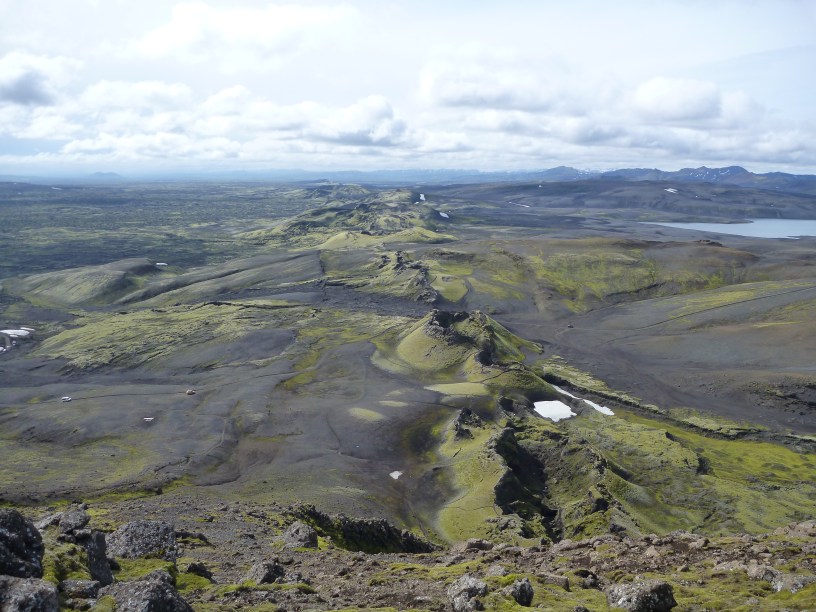
In June 1783, the ground split open in southern Iceland. Over the following eight months, the Laki fissure released vast quantities of lava and sulfur-rich gases. The eruption was a catastrophe for Iceland. Its effects also travelled far beyond the island—and one of the places they may have helped devastate was Egypt.
Thousands of kilometres away, Egyptian farmers waited for the Nile to rise. The annual flood was not merely a spectacle. It watered fields, replenished soils and helped determine whether families could grow enough food. In 1783 and 1784, the river rose inadequately. Hunger followed.
The Nile begins beyond Egypt
Much of the water responsible for the Nile’s annual flood comes from seasonal rainfall over the Ethiopian Highlands and the wider upstream basin. A family cultivating land in Egypt therefore depended on weather far beyond the country’s borders. The river connected their harvest to the African monsoon.
This is the geographical hinge of the story. An eruption in Iceland did not have to scatter ash over Cairo to harm Egyptians. It could affect atmospheric circulation, reduce rainfall in Africa, diminish the Nile’s flood and expose people to food shortages.
What Laki did to the atmosphere
Laki began erupting on 8 June 1783. Its sulfur dioxide emissions helped form atmospheric aerosols that changed how energy moved through the climate system. The effects were geographically uneven: the summer of 1783 was unusually warm in parts of western Europe even as other northern regions experienced pronounced cooling.
In a 2006 study published in Geophysical Research Letters, Luke Oman, Alan Robock, Georgiy Stenchikov and Thorvaldur Thordarson used climate simulations to investigate the consequences. They found that the eruption could produce substantial cooling across Northern Hemisphere land areas and weaken African and Indian monsoon circulation. Their simulations showed rainfall reductions of roughly 1–3 millimetres per day over parts of the Sahel.
Historical Nile records also show unusually low water levels in 1783 and 1784. The convergence of river observations and climate modelling makes the proposed link more than an imaginative coincidence.
The price of a failed flood
The French traveller Constantin-François de Volney, writing about Egypt in this period, described the inadequate flood of 1783, the inability to sow some fields, and another disappointing inundation in 1784. His account describes famine and disease in Cairo. He estimated that by January 1785 approximately one-sixth of Egypt’s population had died or left the country over the preceding two years.
That number should not be mistaken for a modern census result: it is a contemporary traveller’s estimate, and it combines death with departure. Yet the testimony conveys the magnitude of the suffering. The human reality behind a low river reading was grain that could not be grown, prices that households could not afford and communities forced to make desperate decisions.
A catastrophe with more than one cause
The evidence does not mean that Iceland alone caused Egypt’s famine. A low Nile flood was recorded in 1782, before Laki erupted. Egyptian society also faced political struggles, economic inequalities, disease and weaknesses in the systems through which food and resources were distributed. A volcanic disturbance could intensify an existing crisis without being its sole origin.
Historian Alan Mikhail’s 2015 study, Ottoman Iceland: A Climate History, uses this connection to rethink the boundaries of Middle Eastern history. Egypt was part of the Ottoman world, but its history was also entangled with the climate of distant places that its inhabitants might never see.
What the distance conceals
The eruption did not distinguish between the people who caused it and those who suffered its effects. No Egyptian farmer had any influence over Iceland’s volcanic fissures. Yet a change in the atmosphere could reach the river on which that farmer’s children depended.
That is the unsettling historical connection: the distance between two places does not measure the distance between their fates. Iceland’s eruption helped alter the conditions of life along the Nile. What happened next depended both on nature and on how human societies distributed risk, food and protection.
Sources
Constantin-François de Volney, Travels Through Syria and Egypt (English translation, 1788), as quoted and discussed by Oman and colleagues.
Featured image: Photograph of the Laki fissure crater row, Anne Schöpa (2015), via Wikimedia Commons, CC BY 3.0; unmodified. The photograph shows the landscape in 2015, not the 1783 eruption.


