
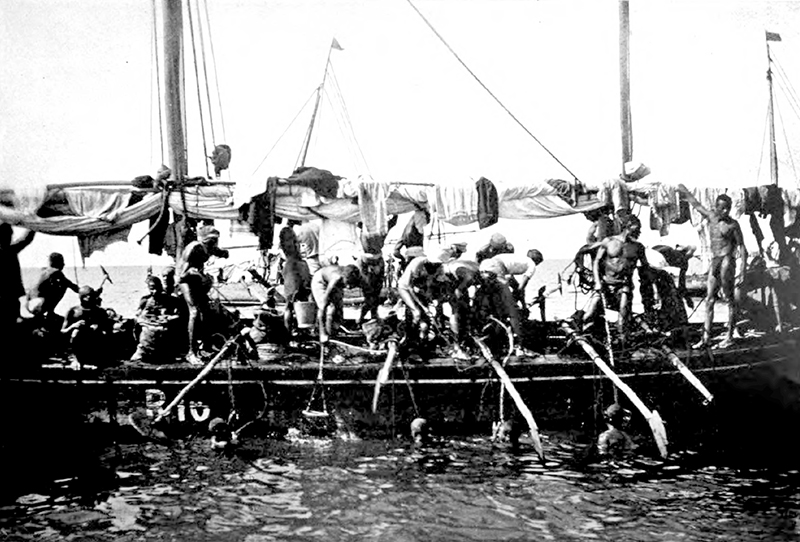
For generations, men along the Persian Gulf coast risked their lives beneath the sea in search of pearls. Before oil became the region’s defining export, natural pearls connected Bahrain, Qatar and neighbouring ports to merchants and luxury buyers across Asia and Europe.
Then, in the early twentieth century, a new source of pearls emerged thousands of kilometres away. Japanese entrepreneurs had learned to cultivate pearls inside oysters. Their success helped overturn the economics of an industry on which entire Gulf communities depended.
A livelihood beneath the water
Pearling required vessels, divers, rope handlers, captains, merchants and financiers. During the diving season, men descended repeatedly, often with simple equipment and considerable physical risk. Families on shore depended on uncertain catches and the prices merchants would pay.
The trade could enrich merchants, but divers often worked within systems of advances and debt that left them vulnerable even in good years. The industry was not simply a romantic heritage; it was dangerous labour embedded in unequal commercial relationships.
Japan changes the market
Japanese innovators, notably Kokichi Mikimoto and other researchers and producers, developed techniques for cultivating pearls around the turn of the twentieth century. Commercial production expanded over subsequent decades. Cultured pearls were real pearls formed by molluscs, but their production could be managed rather than left to the chance discovery of rare natural gems.
As cultured pearls entered international markets, they challenged the scarcity and prices on which the Gulf’s natural-pearl trade relied. Buyers could increasingly obtain attractive pearls from a more predictable supply.
The change was not instantaneous, nor was Japan the sole cause of the Gulf industry’s collapse. Falling luxury demand during the Great Depression, existing debts, environmental pressures and shifts in regional trade compounded the damage.
A crash before the oil boom
By the 1930s, pearling communities faced a severe contraction. Boats stopped sailing, incomes disappeared and people sought other work or migrated. The decline arrived before oil revenues could transform most households’ circumstances.
Bahrain discovered oil in 1932, and other Gulf states developed petroleum industries on different timelines. The familiar story of oil wealth can obscure the painful transition that preceded it: the disappearance of a maritime economy that had shaped coastal life for centuries.
What the pearls reveal
The history of Gulf pearling is a history of global interdependence. A technological breakthrough in Japan altered prices in distant markets, while an economic depression originating elsewhere intensified the losses borne by divers and their families.
It also illustrates a recurring historical pattern: innovation can make a luxury good more accessible while destroying livelihoods built around its previous scarcity.
Japanese cultured pearls did not single-handedly destroy Gulf pearling. But they helped change the market so profoundly that an older world of work could not survive unchanged.
Further reading
For archival material on Gulf pearling and its decline, see the Qatar Digital Library; for the history of Bahrain’s pearling economy, see UNESCO, Pearling, Testimony of an Island Economy.
Featured image: Arab pearl divers in the Persian Gulf, from George Frederick Kunz, The Book of the Pearl (1908). Public domain. Wikimedia Commons.


