
In October 1863, representatives of football clubs met in a London tavern and established the Football Association. Across the Atlantic, the American Civil War was entering its third year. In Lancashire, the conflict had helped plunge cotton towns into an economic emergency.
These events belong to the same historical moment. But did the war help create modern football? The evidence supports a more complicated—and more revealing—story.
An American war in English mills
Britain’s textile industry depended heavily on raw cotton grown in the slaveholding American South. When civil war broke out in 1861, the Union blockade and the wider disruption of trade helped cut supplies. A pre-existing glut of cotton goods and falling demand worsened the crisis.
Mills reduced production or closed. Workers lost wages. Families relied on relief committees and charity. The emergency became known as the Lancashire Cotton Famine, although it was fundamentally a crisis of employment and purchasing power, not a failure to grow food locally.
The conflict exposed a brutal connection: British industrial prosperity was entangled with cotton cultivated by enslaved people in America. A war over the future of slavery could throw English mill workers out of work.
Football already had a history
The Football Association was founded on 26 October 1863 at the Freemasons’ Tavern in London. Its purpose was to establish common rules among clubs that played different versions of the game.
Football was not invented at that meeting. Schools, towns and local clubs had played varieties of the game for decades. Sheffield FC was established in 1857, before the American Civil War began. The FA’s founders were primarily concerned with standardizing rules, not responding to the cotton famine.
There is no convincing historical evidence that Lancashire’s unemployment crisis caused the FA’s creation. The simultaneous dates make a striking coincidence, but coincidence is not causation.
How Lancashire became football country
Lancashire nevertheless became central to the transformation of football from an activity associated with schools and gentlemen’s clubs into a mass spectator sport with professional players.
The transformation took place largely after the cotton famine, especially during the 1870s and 1880s. Clubs grew in industrial communities, working men became increasingly prominent, and northern teams challenged the amateur ideals defended by parts of the southern football establishment.
Historian Peter Swain has shown that football and related sporting practices existed in Lancashire before the Civil War, while early organized clubs were often supported by the educated sons of industrial and commercial families. The story cannot be reduced to unemployed mill workers suddenly inventing football.
Lancashire’s dense towns, industrial wealth, transport links, existing recreational traditions and evolving working patterns all formed part of the game’s development. By the 1880s, the cotton towns around Blackburn, Bolton and Darwen were important centres of football’s emerging professional culture.
What the connection really tells us
The American Civil War did not create modern football. It did reveal the international dependencies of the industrial society in which English football would become a mass phenomenon.
Cotton linked enslaved labourers in the American South to mill workers in Lancashire. Industrialization concentrated people in towns and helped create the institutions, rivalries and audiences that later sustained organized sport. But those broad connections should not be mistaken for proof that one specific war caused a particular game to develop.
The more interesting historical question is not whether Abraham Lincoln inadvertently invented English football. He did not. It is how a region shaken by a crisis originating across the Atlantic later became one of the places where football changed from an elite pastime into a working-class institution.
Sources and further reading
The Football Association, “The History of The FA”; Peter Swain, “Football Club Formation and the Lancashire Leisure Class, 1857–1870”; Peter Swain, “Cultural Continuity and Football in Nineteenth-century Lancashire”; English Heritage, “The history of football in England”.
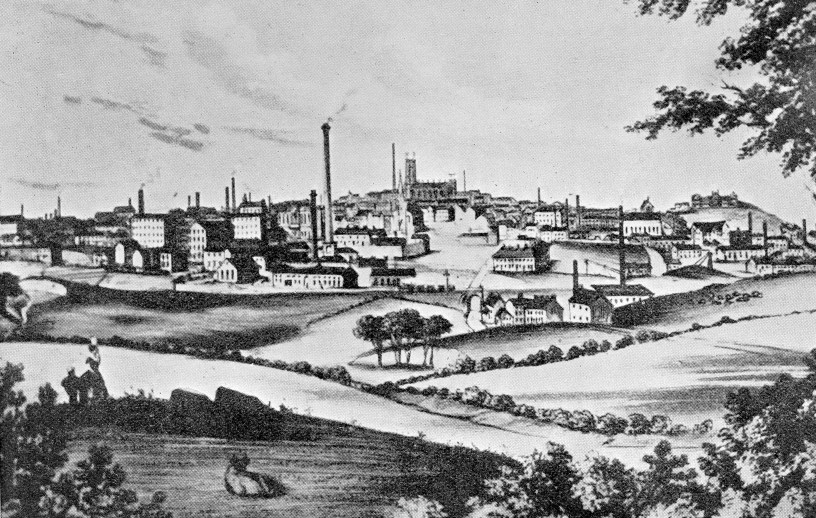
Featured image: Archival plate depicting cotton factory workers and industrial Lancashire. Wellcome Collection, M0003212, CC BY 4.0, via Wikimedia Commons.


