
How an eruption in Indonesia brought famine to Europe and helped inspire Frankenstein.
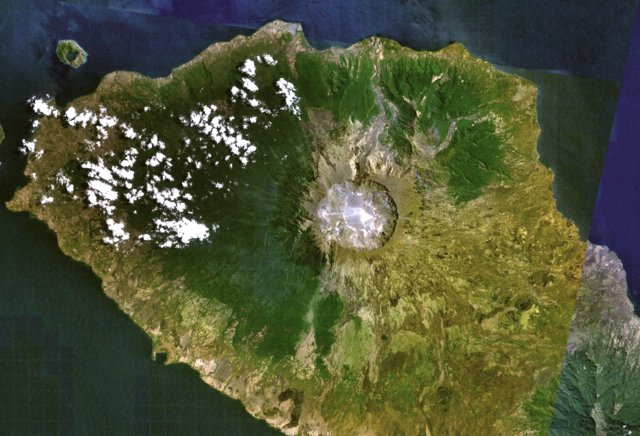
On 10 April 1815, Mount Tambora erupted on the Indonesian island of Sumbawa.
The explosion was among the most powerful volcanic eruptions in recorded history. It destroyed settlements, buried farmland and devastated communities. Tens of thousands of people died, many from starvation and disease in the aftermath.
But Tambora’s consequences extended far beyond Indonesia. The eruption altered the atmosphere, disrupted weather patterns and contributed to food crises thousands of kilometres away.
In 1816, much of the Northern Hemisphere experienced what became known as the Year Without a Summer.
When summer failed to arrive
Tambora propelled enormous quantities of sulfur dioxide into the stratosphere. There, the gas formed sulfate aerosols that reflected some incoming sunlight, cooling the Earth’s surface.
The eruption’s effects were amplified by existing climatic conditions and earlier volcanic activity.
In parts of Europe, persistent cold and rain damaged crops. In northeastern North America, June brought extraordinary frosts and even snowfall. Harvests suffered, grain prices rose and communities already vulnerable to food shortages faced severe hardship.
The consequences were not distributed equally. Wealthier households could often absorb rising food prices. Poor families, who spent much of their income on basic necessities, faced hunger, debt and displacement.
The crisis was particularly severe in parts of central and western Europe, where harvest failures contributed to the subsistence crisis of 1816–1817.
Most of those affected had no idea that an eruption in Southeast Asia had helped transform their weather.
The people closest to the volcano
The European consequences are well documented, but the greatest immediate devastation occurred around Tambora itself.
Entire settlements disappeared. Ash destroyed crops and contaminated water supplies. Survivors confronted hunger and disease after losing homes, agricultural land and livelihoods.
The precise death toll remains uncertain. Historical estimates commonly place the combined direct and indirect fatalities in the tens of thousands.
The disaster also reveals a fundamental inequality: environmental catastrophes do not strike societies with equal force. Geography determines exposure, while poverty, political institutions and access to resources influence who survives.
For the inhabitants of Sumbawa, Tambora was not an unusual summer. It was the destruction of their world.
A monster born during a dark summer
In June 1816, nineteen-year-old Mary Godwin, later Mary Shelley, stayed near Lake Geneva with Percy Bysshe Shelley, Lord Byron, John Polidori and others.
The weather was exceptionally wet and gloomy. During their stay, Byron proposed that members of the group write ghost stories. Mary began developing the idea that became Frankenstein, published in 1818.
Polidori’s The Vampyre, published in 1819, also emerged from that literary gathering.
The eruption did not create Frankenstein by itself. Mary Shelley’s imagination drew on contemporary scientific debates, literature and her own experiences. But the extraordinary weather helped shape the circumstances in which she conceived the novel.
The connection is astonishing: an eruption in Indonesia contributed to atmospheric conditions that helped bring together one of the most influential gatherings in the history of Gothic literature.
Did Tambora help defeat Napoleon?
Tambora erupted just 69 days before Napoleon’s defeat at Waterloo on 18 June 1815.
Heavy rain before the battle left the ground muddy, complicating the movement of artillery and contributing to Napoleon’s delayed attack.
Some accounts have suggested that Tambora influenced those conditions. The evidence, however, does not establish that the eruption caused the rainfall at Waterloo. Its best-documented climatic consequences developed later, particularly in 1816.
Napoleon’s defeat also depended on military decisions, Allied resistance and the arrival of Prussian reinforcements.
The claim that a volcano defeated Napoleon is a compelling story, not a demonstrated historical fact.
The invisible connections of history
Tambora reveals how deeply connected human societies were long before modern globalization.
An eruption in Indonesia helped change the climate across continents. Those changes contributed to agricultural failures and hunger, while also shaping the circumstances of an extraordinary literary creation.
But the same environmental disturbance produced profoundly different experiences: destruction for communities near the volcano, hardship for European farmers and creative inspiration for writers in Switzerland.
Natural events do not determine history on their own. Human institutions, inequality, individual decisions and chance shape their consequences.
That is what makes Tambora’s story more revealing than the tempting claim about Napoleon.
In 1815, a mountain erupted in Indonesia. In 1816, people across the world suffered consequences whose source they could scarcely have imagined.
Featured image: NASA Landsat image of Mount Tambora’s caldera, taken long after the 1815 eruption. Public domain. Wikimedia Commons.


