
America’s greatest territorial bargain was made possible, in part, by people whom the American republic refused to recognize as equals. In 1803, the United States bought Louisiana from Napoleon for $15 million, roughly doubling its territory. But the road to that sale ran through Saint-Domingue, where enslaved Africans and their descendants were dismantling France’s richest colonial possession.
In 1791, enslaved people in the French colony of Saint-Domingue rose against a plantation system built on coerced labor and extraordinary violence. The revolution became a prolonged struggle involving France, Spain, Britain, formerly enslaved soldiers, and rival political leaders. Toussaint Louverture emerged as its most formidable strategist. By 1801, he governed much of the colony, although its relationship with France remained contested.
Napoleon had a larger plan. France had recovered Louisiana from Spain through a secret agreement in 1800. He envisioned a revived French empire in the Americas: Saint-Domingue would again generate enormous wealth from sugar, while Louisiana would provide food, supplies, territory, and strategic depth. Without control of Saint-Domingue, the North American possession was far less useful.
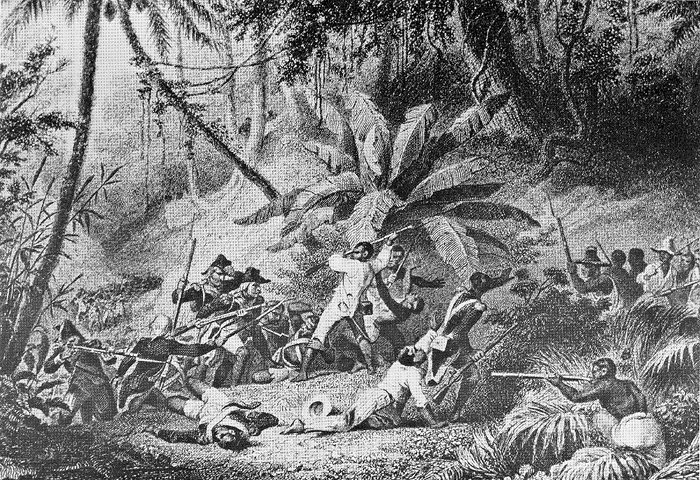
In 1802, Napoleon sent a massive expedition commanded by his brother-in-law Charles Leclerc to reassert French authority. Louverture was captured and deported to France, where he died in prison in April 1803. But capturing a leader did not end a revolution. Resistance continued under commanders including Jean-Jacques Dessalines. Yellow fever devastated French forces, and the effort to reconquer the colony collapsed.
Napoleon’s calculations changed. The failure in Saint-Domingue undermined the economic and military foundation of his American project. Renewed war with Britain threatened France’s ability to defend Louisiana, and Napoleon wanted money for European warfare. These causes worked together: the Haitian Revolution was a major factor in the sale, not the only factor.
Thomas Jefferson had initially sought to secure New Orleans and navigation on the Mississippi, not to acquire a territory stretching across the continent. Yet French negotiators offered all of Louisiana. On April 30, 1803, American representatives agreed to purchase roughly 828,000 square miles for $15 million. Haiti would formally declare independence only on January 1, 1804. The sale therefore preceded the revolution’s final victory, but followed the devastating failure of Napoleon’s reconquest.
The historical irony is difficult to overstate. Black revolutionaries fighting against enslavement helped destroy Napoleon’s imperial ambitions. That defeat facilitated the expansion of a republic in which slavery remained legal. The Louisiana Purchase opened enormous territory to American settlement, intensified conflicts over slavery’s expansion, and accelerated the dispossession of Indigenous nations whose homelands were treated as transferable imperial property.
Nor should the story be reduced to Napoleon’s defeat by disease. Yellow fever was catastrophic, but Haitian military resistance, political organization, and determination were indispensable. The revolutionaries were not passive beneficiaries of a European military disaster. They were historical actors who transformed the choices available to the most powerful rulers of their age.
Jefferson himself understood the connection. In January 1803 he wrote that Saint-Domingue was delaying French possession of Louisiana, while France was in urgent need of money. The opportunity American diplomacy exploited had been created partly by the struggle of people denied the freedom the United States claimed to champion.
One revolution thus produced two radically different consequences: an independent Black republic in the Caribbean and a vastly expanded slaveholding republic on the North American continent. Haiti did not simply change Haiti. Its revolution helped redraw the map of the United States.
Sources: Library of Congress, “The Louisiana Purchase” (https://www.loc.gov/collections/louisiana-european-explorations-and-the-louisiana-purchase/articles-and-essays/the-louisiana-purchase/); U.S. State Department, Office of the Historian, “Louisiana Purchase, 1803” (https://history.state.gov/milestones/1801-1829/louisiana-purchase); Philippe Girard, Bibliothèque nationale de France, “The 1802 Expedition to Saint-Domingue (Haiti) and the Louisiana Purchase” (https://heritage.bnf.fr/france-ameriques/en/1802-expedition-saint-domingue-haiti-and-louisiana-purchase); National Archives, “Jefferson Buys Louisiana Territory” (https://www.archives.gov/publications/prologue/2003/spring/louisiana-purchase.html); National Archives, “Louisiana Purchase Treaty” (https://www.archives.gov/milestone-documents/louisiana-purchase-treaty).
Featured image: Historical engraving of the Battle of Ravine-à-Couleuvres (1802), after Karl Girardet, engraved by Jean-Jacques Outhwaite. Public domain. Wikimedia Commons.


