
In most of Flanders, children eagerly await Sinterklaas on 6 December. In much of the English-speaking world, they wait for Santa Claus at Christmas.
In Aalst, Belgium, the biggest day for children’s presents is traditionally 11 November. The night before, shoes are put out. By morning, toys, chocolate, mandarins and speculaas have arrived. The visitor is not Sinterklaas, but Sint-Maarten — Saint Martin.
And Aalst is not alone. The same gift-giving custom survives in Lede and most of Erpe-Mere. Cross into nearby Ninove or Denderleeuw, however, and the presents generally come from Sinterklaas on 6 December. A few kilometres can determine which saint brings your childhood gifts.
A Roman soldier who gave away half his cloak
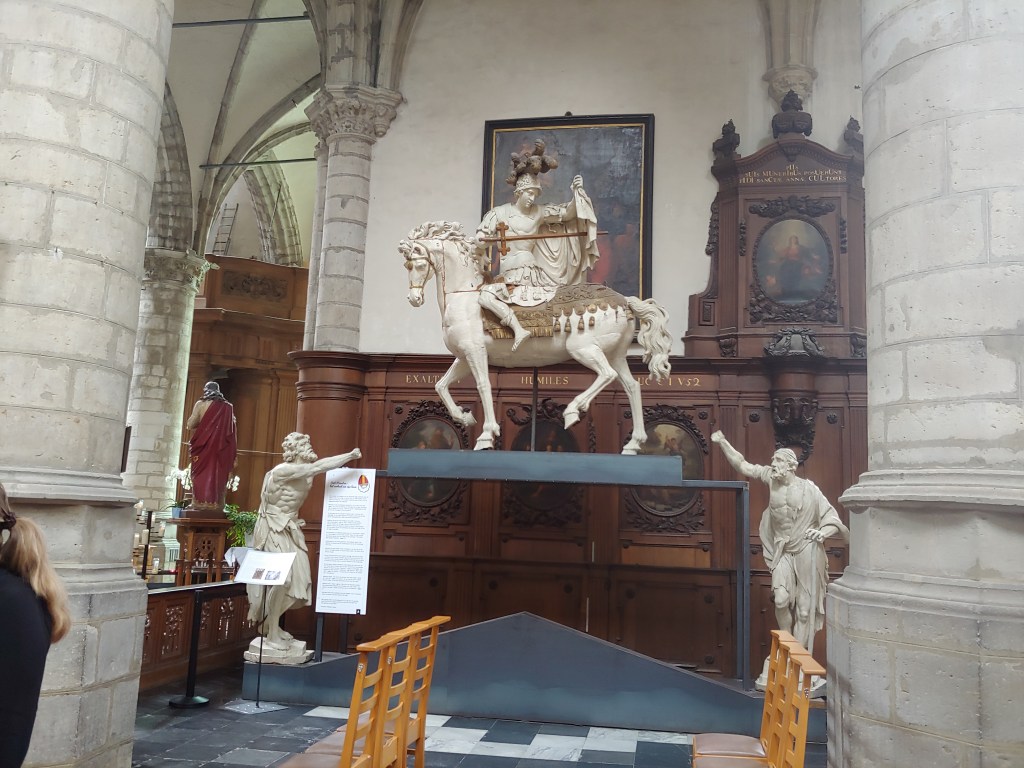
Martin of Tours was born in the fourth century in Roman Pannonia, in what is now Hungary. As a young soldier stationed in Gaul, he encountered a poorly clothed beggar outside Amiens. According to the famous story, he cut his military cloak in two and gave half to the man. He later became a monk and bishop of Tours. He died in 397 and was buried on 11 November, the date of his feast.
His association with generosity became the basis for centuries of autumn celebrations, gifts to the poor, children’s singing and seasonal fairs. The form varied by region. The connection to Aalst is particularly old: Sint-Martinus is the city’s patron saint, and its oldest parish church, dedicated to him, is recorded by 1183, with possible earlier roots.
Aalst’s Sint-Maarten celebration did not suddenly appear in the twentieth century. The church feast and autumn market were already established; a livestock fair was held around the middle of the nineteenth century. After the First World War, 11 November also became Armistice Day. The coincidence helped make the date an even more prominent public holiday, but did not create the much older Saint Martin tradition.
How Aalst turned an old feast into a grand arrival
In 1928, local merchant Pierre De Winter brought a costumed Sint-Maarten to his shop, Huis De Winter, for children to meet. In 1929, a more elaborate arrival took place, with the saint collected at the railway station and brought through town on horseback. The modern spectacle grew around a much older devotion.
Today there are arrivals, lantern processions and the Sint-Maartensjaarmarkt. In 2026, Aalst welcomed him by boat on 8 November, held its lantern parade on the 10th and its traditional market on the 11th. Behind the public celebration is the more intimate event: a child waking up to presents.
Why Sinterklaas elsewhere — and where Santa Claus came from
Sint-Maarten and Sinterklaas are two different saints. Nicholas was a fourth-century bishop of Myra, in today’s Türkiye, remembered for legends of secret generosity; his feast falls on 6 December. Across the Low Countries, local church dedications and distinct regional customs helped determine which saint became the children’s gift-bringer. There was no single decree that gave Aalst to Martin and the rest of Flanders to Nicholas.
The American Santa Claus grew partly from Dutch Sinterklaas, whose name travelled to New York. Nineteenth-century writers, the 1823 poem A Visit from St. Nicholas, and illustrator Thomas Nast gradually transformed the bishop into a sleigh-riding Christmas visitor with reindeer and a white beard. Coca-Cola advertising later popularised an already familiar red-suited figure; it did not invent him.
Three figures. Two fourth-century saints. One American reinvention. And in Aalst, the children still get their main annual visit from the one whose defining story was giving half of what he owned to someone who had nothing.
What makes it extra fun for children in Aalst is that the 11th of November is also Armistice Day, an official holiday in Belgium. The country celebrates the end of the first world war. So not only do children in Aalst find gifts in the morning, they do not have to go to school today. Belgium fighting on the winning side in World War 1 is also why to this day there is a German speaking minority in Belgium. Belgium got a piece of German territory as compensation for the substantial damage Belgium suffered. They are happy to be Belgian, have their own Parliament, produce chocolate and get to shop right across the border in Aachen.
Anyway, what is the probability the kids in Aalst will be eating French fries with mayonnaise today? As high as the hat of Saint Martin.
Sources
- Erfgoedcel Denderland — Sint-Maarten in Aalst, Lede and Erpe-Mere.
- Oilsjtgoistad — history of Aalst’s Sint-Maartensjaarmarkt and the 1928–1929 arrivals.
- Stad Aalst — 2026 Sint-Maarten festivities.
- Flemish heritage research — history of Aalst’s Sint-Martinuskerk.
- Museum of the City of New York — Santa and the City.
- Ohio State University Libraries — Thomas Nast and Santa Claus.


