
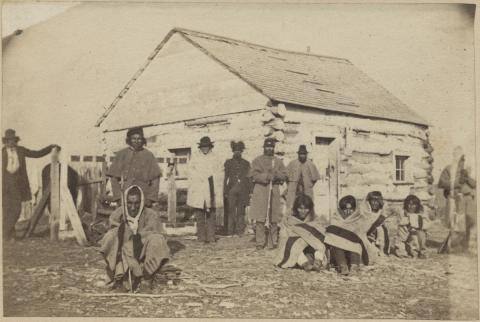
On 10 November 1862, Abraham Lincoln sent a telegram to Major General John Pope in Minnesota. Pope had forwarded the names of 300 Dakota men condemned to death. Lincoln demanded “the full and complete record of their convictions.” The general had sent a list of names. The president wanted the evidence.
The background was six weeks of war between Dakota fighters and the United States. Washington had taken enormous tracts of Dakota land through treaties, repeatedly failed to honour its obligations, and left people dependent on overdue payments for survival. By the summer of 1862, many Dakota families were starving. When war broke out, Dakota warriors killed hundreds of settlers, including civilians, and fought American soldiers. Other Dakota people refused to take part, and some helped protect settlers. A history of broken promises does not excuse the killing of civilians. Nor does the killing of civilians justify suspending justice for an entire people.
After the Dakota defeat, a military commission established by General Henry Sibley tried 392 men and sentenced 303 to death. Some proceedings lasted five minutes. Defendants lacked legal representation and faced a tribunal whose authority and procedures have been seriously questioned. Men could be condemned for having fought in battle, although participation in combat was not automatically murder when the combatants were Confederates.
The demand for executions was ferocious. On the very day Lincoln asked Pope for the records, Minnesota governor Alexander Ramsey urged the president to hang every man condemned. On November 11, Pope asserted that all the prisoners were guilty of terrible crimes and warned that an enraged population might attack Dakota prisoners, including women and children, if the executions did not proceed. Pope did not yet have the trial records in his headquarters. They arrived days later.
Lincoln did not authorize all 303 executions. He had officials examine the records and distinguish participation in battles from attacks on civilians. He approved 39 death sentences. One man received a last-minute reprieve.
On 26 December 1862, the remaining 38 Dakota men were led onto a scaffold at Mankato. Approximately 4,000 spectators gathered. The condemned men sang and held one another’s hands. A single release of the platform sent them all to their deaths. It was the largest mass execution in United States history. Their bodies were buried in a shallow grave. Before morning, physicians had taken many of the remains for dissection.
The failures were worse than the number 38 suggests. The Minnesota Historical Society records that two of the men were hanged by mistake, including one who had been acquitted. In a letter shortly before his execution, a condemned Dakota man named Hdainyanka maintained that he had harmed no white person and asked that his children be told what had happened to their father.
Nor did the catastrophe end at the scaffold. More than 1,600 Dakota noncombatants, overwhelmingly women, children and elderly people, were confined at Fort Snelling. An estimated 130 to 300 died there during the winter of 1862–63, mainly from disease and harsh conditions. The United States subsequently expelled the Dakota from Minnesota and abrogated their treaties.
The account of Lincoln as the man who spared most of the condemned is factually true. He commuted hundreds of death sentences. So is the account of Lincoln as the president who authorised the hanging of 38 Dakota men after grotesquely defective trials. One truth does not cancel the other.
On 10 November 1862, a president demanded evidence from his general. Forty-six days later, 38 men were dead. America was fighting a civil war over slavery and Union while dispossessing another people on its western frontier. You cannot understand the moral history of that country by remembering one struggle and leaving the other out.
Historical sources
- Official Records of the War of the Rebellion, Series I, volume XIII, page 787 — Lincoln’s 10 November 1862 telegram to Pope and Governor Ramsey’s same-day demand.
- John Pope to Abraham Lincoln, 11 November 1862, Abraham Lincoln Papers, Library of Congress — Pope’s arguments for immediate executions and his warnings about mob violence.
- Minnesota Historical Society, “The Trials & Hanging” — commission procedures, Lincoln’s decisions, executions and mistakes.
- Minnesota Historical Society, “The US-Dakota War of 1862” — history of treaties, the war, incarceration and deaths at Fort Snelling.
- Burrus M. Carnahan, “Lincoln & The 1862 Minnesota Sioux Trials,” The Rolland Center for Lincoln Research — documentary analysis of the correspondence and legal proceedings.
- Library of Congress — “Execution of the Thirty-Eight Sioux Indians,” 1883 historical lithograph — image and publication details.

