
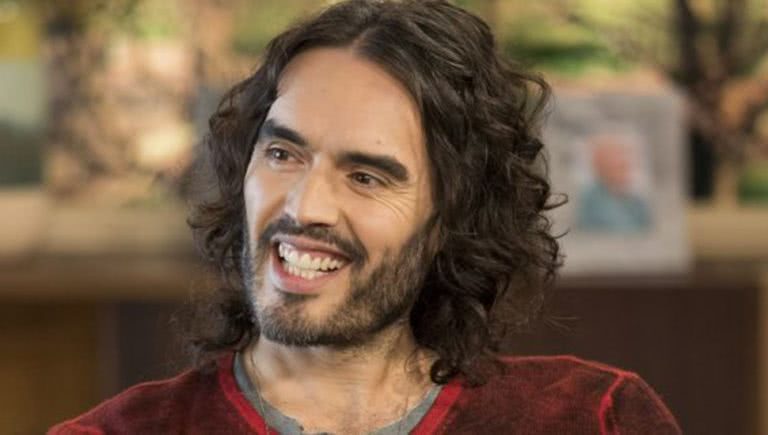
Russell Brand was born in Grays, Essex, in 1975. His father left when he was a baby, his mother repeatedly suffered cancer, and he grew up struggling with bulimia, drugs and a ferocious hunger for attention. A stand-up comedian and heroin addict, he entered rehabilitation in 2002, became a television celebrity, conquered Hollywood, made a fortune and married Katy Perry. Then came the political agitator, the author of Revolution, the interviewer of philosophers and trauma specialists, the critic of mass media and pharmaceutical companies, and, eventually, the outspoken Christian. In November 2026, he was convicted of rape and sexual assault and sentenced to imprisonment. His career traces an extraordinary sequence of public reinventions.
Across his books, interviews, stand-up, podcasts and online commentary, ten subjects recur with particular intensity. This is my assessment of his central preoccupations, not a measurement of total speaking minutes.
1. Addiction: Why people cannot stop doing what hurts them
Drugs, alcohol, sex, pornography, food, shopping, smartphones, celebrity and the pursuit of approval. Brand spent years arguing that addiction is not confined to substances. It is frequently an attempt to escape experiences people cannot bear to feel. His 2017 book Recovery: Freedom From Our Addictions extended twelve-step principles to compulsive behaviours far beyond alcoholism. The question beneath his work is deceptively simple: What is the pain we are trying to avoid?
2. The emptiness of fame, sex and material success
Brand publicly celebrated promiscuity, celebrity and excess. Later he described them as incapable of delivering lasting fulfilment. Money, attention and sexual opportunities could stimulate him, but they did not remove his dissatisfaction. In the New Statesman, he argued that comfort without meaning had imprisoned modern society. The difference between pleasure and fulfilment became one of his most persistent subjects.
3. Capitalism, inequality and the concentration of wealth
Before conservative and populist audiences embraced him, Brand was an outspoken critic of capitalism. His 2014 book Revolution attacked economic inequality, corporate influence and governments serving wealth rather than citizens. He drew on socialism, environmentalism and spirituality. One of his most revealing lines in the New Statesman was “Sharing is a spiritual principle.” He was asking not only who owns what, but what an economic system does to our character.
4. Political power and the illusion of democratic choice
His 2013 interview with Jeremy Paxman on BBC Newsnight transformed him into a major political commentator. Brand questioned whether elections offered genuine alternatives when major parties remained entangled with powerful financial interests. His memorable warning was “We no longer have the luxury of tradition.” He later changed political allegiances, but continued asking who actually exercises power and who benefits from it.
5. Mass media and the manufacture of public opinion
With The Trews, launched in 2014, Brand criticised newspaper framing, television coverage, selective use of experts and the influence of powerful media owners. Some criticisms concerned real institutional problems. Others developed into unsupported suggestions of coordinated manipulation. His escalating distrust of established journalism helped reshape his audience and eventually became central to his public defence against sexual-misconduct allegations.
6. Spirituality, meditation and consciousness
Long before his baptism, Brand explored meditation, yoga, Buddhism, Hindu traditions and the possibility that human consciousness extends beyond the restless stream of cravings and fears. Through Under the Skin, he interviewed Gabor Maté, Eckhart Tolle and other thinkers interested in trauma and transformation. He argued that social change would remain superficial unless people also changed the way they understood themselves.
7. Trauma, childhood and the origins of destructive behaviour
Brand repeatedly discussed his father’s absence, his mother’s illnesses and the psychological wounds of childhood. He gave considerable attention to Gabor Maté’s argument that apparently irrational behaviour can serve an emotional function. This is an important distinction, especially in light of Brand’s convictions: explaining a person’s destructive behaviour is not the same as excusing it.
8. Pharmaceutical companies, public health and COVID-19
During the pandemic, Brand devoted increasing attention to pharmaceutical profits, vaccines, government restrictions, regulatory capture and corporate lobbying. Some questions were legitimate; others involved misleading claims. In 2022, YouTube removed a video after Brand wrongly described an experimental ivermectin trial as an official treatment recommendation. He acknowledged the error and increasingly promoted Rumble as an alternative platform. His audience grew and his political identity changed with it.
9. Censorship, surveillance and the treatment of dissent
Brand examined surveillance, whistleblowers, online moderation and people such as Julian Assange and Edward Snowden. He increasingly presented himself as someone speaking truths powerful institutions wanted suppressed. After the accusations against him became public in September 2023, he suggested a coordinated attempt to silence him. Many supporters believe his controversial commentary is the real reason he was pursued. That suspicion is not substantiated by the available evidence. The Times and Sunday Times investigations began in January 2019, years before the allegations were published, and the criminal convictions followed evidence presented to a jury—not merely his opinions.
10. Christianity, sin and redemption
Brand was baptised as a Christian in April 2024. His discussions increasingly centred on Jesus, forgiveness, confession, prayer and the rejection of self-worship. Speaking to Tucker Carlson in September 2024, he said, “I wish I had known earlier.” The conversion continued themes already present in his recovery work: surrender, accountability and the possibility of change. But genuine redemption demands a difficult question: Can we claim transformation while refusing to confront the suffering we have caused?
The convictions, and the question of prison violence
On 5 November 2026, a jury at Southwark Crown Court convicted Russell Brand of one count of rape and three counts of sexual assault, involving four women. He was acquitted on two other rape charges and one attempted indecent assault charge. On 9 November 2026, he was sentenced to 10 years and six months in prison. These are established legal facts, not allegations.
A former inmate of HMP Wandsworth subsequently described Brand as a “marked man” and warned he could face violence inside. That is a reported assessment from a former prisoner, not proof of a specific threat. But the idea that a convicted person deserves to be beaten, terrorised or sexually assaulted is indefensible. Prison is the sentence. Violence by other prisoners is not an extra punishment authorised by the courts. His victims deserve justice. He remains entitled to safety.
David Walliams: A separate set of allegations
On 10 November 2026, a joint investigation by The Guardian and ITV News reported allegations against comedian and children’s author David Walliams. Several women said he had used his celebrity status to pursue or exploit them; two alleged he began grooming them when they were fifteen, and another alleged sexual assault. Walliams denies predatory conduct, sexual harassment and criminal wrongdoing. He has not been convicted in connection with these reported allegations. His legal position must not be confused with Brand’s.
The uncomfortable contradiction
Brand’s intellectual preoccupations were often the difference between what human beings claim to value and what they actually pursue: the addict who wants freedom, the celebrity who wants love, the politician who says he serves the public, the believer who talks about redemption.
The ideas deserve to be assessed on their merits. His convictions must be judged independently of their merits. A person can understand something important about human suffering while inflicting suffering on others.
That is perhaps the most uncomfortable contradiction in the Russell Brand story.
Sources and quotations
- Russell Brand, “On Revolution,” New Statesman, October 2013 — politics, inequality, spirituality and direct quotations.
- The Guardian interview with Russell Brand, October 2014 — fame, revolution and alienation.
- The Guardian, September 2017: recovery, addiction and his book.
- Deseret News, September 2024 — Brand’s Christian conversion and remarks to Tucker Carlson.
- TheWrap, September 2022 — YouTube and the COVID-19 misinformation warning.
- The Times, November 2026 — the investigation begun in 2019 and its corroboration.
- Crown Prosecution Service, 9 November 2026 — convictions and sentence.
- CBS News, 9 November 2026 — acquittals and trial details.
- Daily Mirror report via AOL, 9 November 2026 — the former prisoner’s “marked man” warning.
- The Guardian and ITV News investigation, 10 November 2026 — allegations against David Walliams and his response.
- The Brag, December 2019 — photograph and Recovery Live coverage.

