
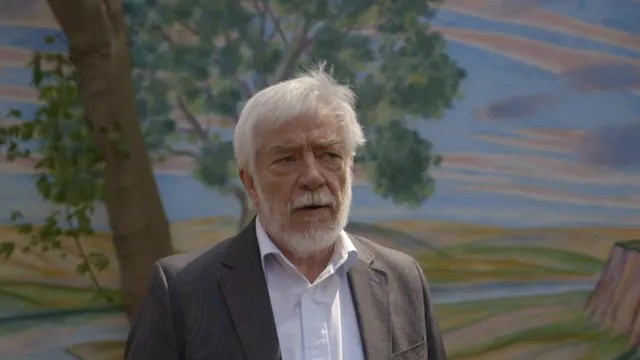
Hans-Joachim Maaz was born in 1943, grew up in communist East Germany and spent twenty-eight years as chief physician of the Psychotherapy and Psychosomatics Clinic in Halle. Under a regime demanding outward conformity, he examined what happened to people who learned to suppress their emotions, disguise their needs and adapt themselves to authority. His breakthrough book, Der Gefühlsstau (1990), explored the psychological consequences of life in the GDR. Later works, including Die narzisstische Gesellschaft, Das falsche Leben and Angstgesellschaft, extended that analysis to modern society. His book Hilfe! Psychotherapie, available in a 2026 edition, draws on more than forty years of clinical experience.
His central preoccupation has remained remarkably consistent: What happens to human beings when they spend their lives becoming acceptable to other people rather than becoming themselves?
Here are the five insights from his work that I find most relevant to humanity in 2026.
1. An entire society can become psychologically unhealthy while considering itself perfectly normal
Maaz uses the term Normopathie to describe a disturbing possibility: when enough people adopt psychologically harmful patterns of behaviour, those patterns cease to look abnormal.
Someone who constantly overworks, suppresses emotions, obeys expectations and measures personal worth through achievement may be praised as exceptionally well-adjusted. Someone who refuses those expectations may be considered difficult.
In 2026 we have sophisticated systems for measuring productivity, popularity, professional performance and physical attractiveness. But how often do we ask whether the person meeting all those expectations actually enjoys being alive?
The most successful adaptation to an unhealthy environment is not necessarily psychological health.
2. Feelings that are never expressed do not necessarily disappear. They accumulate
Gefühlsstau literally describes a blockage or accumulation of feelings. Maaz observed how people could learn to suppress anger, humiliation, grief and fear in order to remain acceptable within their families and society. The emotions did not simply cease to exist. They could emerge as psychosomatic symptoms, bitterness, damaged relationships or displaced aggression.
Consider someone who cannot express anger toward an intimidating parent, employer or spouse. That person may become remarkably angry about politics instead. Or the stranger driving too slowly. Or an anonymous person on the internet.
The connection is not automatic, but Maaz’s work asks us to investigate it. Sometimes the intensity of our reaction tells us as much about our own history as about the event provoking it.
3. What looks like ambition may be an attempt to compensate for never feeling loved
In Das falsche Leben, Maaz describes how early emotional experiences can contribute to the development of a false self. A child who feels valued primarily for obedience, performance or meeting parental expectations may gradually learn to organise life around earning approval.
The adult can become impressively successful. A prestigious job. An expensive car. An attractive partner. Thousands of admirers. Yet none of those achievements can reliably answer the question that may have existed since childhood: Would I still be lovable if I stopped performing?
Maaz associates some narcissistic behaviour with attempts to compensate for an insecure sense of self. That does not mean ambition is pathological or that successful people are secretly miserable. It means we should distinguish achievement pursued out of genuine interest from achievement pursued to silence a persistent sense of inadequacy.
4. People who cannot confront their own emotional conflicts may become especially eager to find enemies
Maaz’s more recent work explores the psychological mechanisms behind polarisation, scapegoating and hostility. One mechanism is projection. A person who cannot acknowledge their own aggression may experience the world as populated by uniquely aggressive others.
Someone frightened by uncertainty may become attracted to political movements promising absolute certainty. Someone struggling with shame may find relief in belonging to a group convinced of its own moral superiority.
In Das gespaltene Land and Friedensfähigkeit und Kriegslust, Maaz extends these questions to societies divided by historical grievances and political conflict.
We may sometimes be most certain of our moral superiority precisely when we are least willing to examine ourselves.
Political conflicts also have material causes, competing interests and genuine injustices. Psychology cannot explain them all away. But it may help explain why some people become emotionally incapable of recognising another human being’s perspective.
5. Human relationships cannot be repaired through intellectual understanding alone
Maaz’s work repeatedly returns to Beziehungskultur: the quality of our relationships. People may understand attachment theory, trauma, narcissism, repression and emotional regulation without becoming substantially better partners, parents or friends.
They may explain their childhood experiences with extraordinary precision while continuing to reproduce the same destructive patterns. His 2026 edition of Hilfe! Psychotherapie examines the therapeutic relationship, resistance, emotional expression and the transformation of symptoms into greater self-understanding.
A therapist’s task is not simply to deliver explanations. A patient must eventually experience, recognise and respond differently to the feelings and relational patterns that have governed their life.
The same problem exists outside therapy. You can read fifty books about love and remain incapable of receiving it. You can lecture people about empathy and respond with contempt when they disagree. You can understand how your parents hurt you and still hurt your own children.
Psychological knowledge becomes meaningful when it changes what happens between two human beings.
Where I think Maaz deserves to be challenged
Maaz’s decades of clinical practice give his observations depth. They do not turn every interpretation of society into an established scientific finding. His arguments about early childcare, political movements and pandemic policies have been controversial. He sometimes moves from the psychological dynamics of individuals to sweeping interpretations of entire populations.
Those larger claims require evidence beyond clinical experience. The terms Normopathie and Gefühlsstau can illuminate patterns without being independently validated psychiatric diagnoses that can simply be applied to entire societies.
But his strongest question survives those limitations: What if a substantial part of what we call personality is actually the collection of strategies we developed to avoid losing love, security and acceptance?
And what might remain if we no longer needed them?
Sources
- Choriner Institute — Hans-Joachim Maaz: professional biography.
- Seelenarbeit im Sozialismus (SiSaP) — Maaz’s role in psychotherapy in East Germany.
- C.H. Beck — books by Hans-Joachim Maaz, including Der Gefühlsstau, Das falsche Leben and Das gespaltene Land.
- C.H. Beck — Hilfe! Psychotherapie (2026 edition).
- Deutschlandfunk — Maaz on narcissism, self-worth and political culture (2013).
- Deutschlandfunk — retrospective analysis of Der Gefühlsstau (2010).
- Leipziger Zeitung — Maaz on projection, psychological divisions and protest (2016).
- VPRO Tegenlicht — Maaz interview and landscape photograph (2016).

