
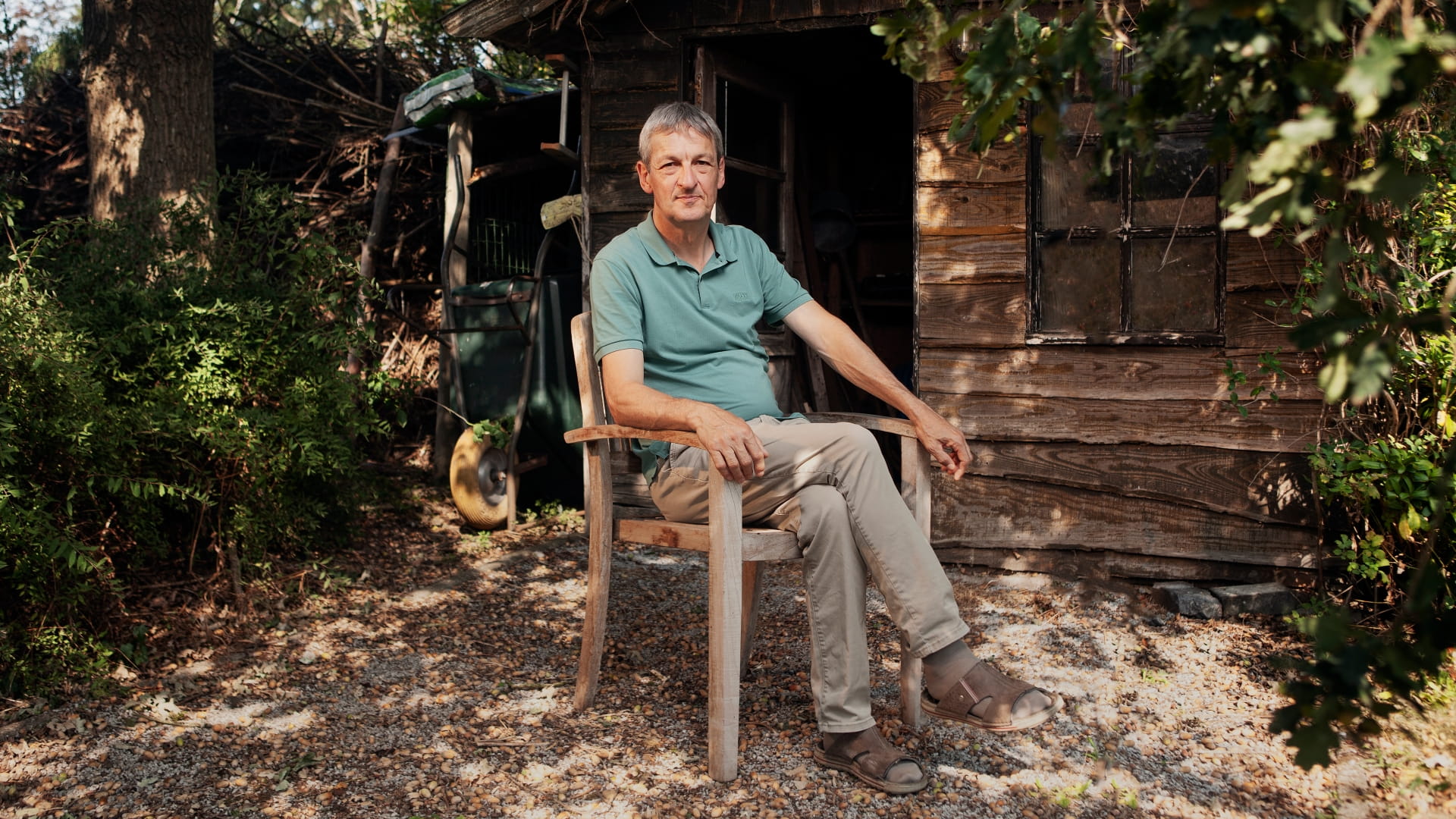
Paul Verhaeghe was born in Roeselare, Belgium, in 1955. Trained as a clinical psychologist and psychoanalyst, he spent decades teaching at Ghent University and treating patients, first writing about Freud, Lacan, sexuality and psychodiagnosis. Liefde in tijden van eenzaamheid (1998) reached readers well beyond academia. Then his focus widened: from the consulting room to the society that sends people into it. Identiteit (2012), published in English as What About Me? (2014), examined the psychological cost of a market-driven culture. Autoriteit (2015) asked what happens when authority loses legitimacy. Intimiteit (2018) investigated the uneasy relationship between closeness and independence. After retiring from his professorship in 2021, he wrote Onbehagen (2023), Wijsheid (2025) and, in September 2026, Grenzeloos.
His work keeps returning to one question: How much of what we call our personality belongs to us, and how much has been constructed by the people and society around us?
Here are the five insights I find most revealing about life in 2026. They are my selection, not a ranking Verhaeghe himself published.
1. You do not invent your identity. Other people help create it.
We like to imagine that there is an authentic self hidden somewhere inside us, waiting to be discovered. Verhaeghe offers a less comfortable picture. From childhood onward, we learn who we are through relationships, language, approval, rejection and imitation. We become somebody in the eyes of other people.
A child repeatedly called clever may learn to fear making mistakes. A child rewarded for being agreeable may lose the ability to say no. Adults are shaped too. A workplace, a relationship or an online audience can gradually teach us which versions of ourselves receive affection and which disappear.
Social media has made those mirrors measurable. Approval arrives as likes, followers and engagement. This does not mean the resulting identity is fake. It means that identity is relational, never merely an isolated private possession.
Sometimes the person you call “me” is partly the person you had to become in order to belong.
2. We have turned success into a moral duty, and failure into a personal defect.
In Identiteit, Verhaeghe argues that the language of markets has travelled far beyond economics. Schools compete for rankings. Employees become their own brands. People are encouraged to invest continuously in their attractiveness, employability, productivity and happiness.
The result is a peculiar moral code: success supposedly proves that you made the right choices, while failure suggests that something is wrong with you. Someone exhausted by impossible demands may be told to become more resilient. Someone lonely in an atomised society may be sent off to improve their social skills.
Psychiatric conditions are real and treatment can help. But Verhaeghe asks why so much attention falls on repairing individuals while the conditions under which they suffer remain unquestioned.
A person can be struggling to cope with an unhealthy environment without being the principal problem.
3. Authority is not the same thing as power.
In Autoriteit, Verhaeghe distinguishes between obedience secured by force and authority people recognise as legitimate. The old patriarchal model—because a father, teacher, priest or leader says so—has lost much of its unquestioned status. Trying to restore that world through intimidation produces more power, not necessarily more authority.
His alternative is authority supported by a group and by shared rules. A teacher has authority not just because the teacher can punish, but because students, parents and colleagues recognise a legitimate educational role. The same principle applies to institutions, workplaces and civic life.
In 2026, people can reject an expert, politician or institution with a swipe, while simultaneously craving leaders who promise certainty. Verhaeghe’s distinction helps explain why distrust and authoritarian temptations can grow together.
When trust disappears, increasing control may secure compliance without restoring respect.
4. Intimacy requires both closeness and the freedom to remain separate.
In Intimiteit, Verhaeghe explores a paradox. We want to be seen, touched, understood and loved. We also want to remain autonomous, with our own body, desires, silences and boundaries.
The person who demands constant reassurance may unintentionally make closeness suffocating. The person who treats independence as never needing anyone may make lasting love impossible. The difficulty is not solved by choosing one extreme. It lies in tolerating both needs without turning the other person into a servant of either.
Our era provides countless ways to connect and to retreat. We can maintain a relationship through messages while avoiding difficult conversations; we can display intimacy publicly while feeling unknown privately.
The test of a relationship is not whether two people eliminate distance, but whether they can remain close without erasing each other.
5. A life organised around “more” eventually needs the wisdom to say “enough”.
Verhaeghe’s newest book, Grenzeloos (2026), takes his critique of performance culture into the question of limits. Modern societies have become extraordinarily good at increasing output, speed and convenience. Yet growth creates its own constraints: more vehicles produce congestion; more consumption consumes resources; more demands on attention can mean less time to live.
His previous book, Wijsheid, distinguishes knowledge from wisdom. Knowledge can tell us how to achieve something. Wisdom asks whether it is worth achieving, and what we sacrifice to get there.
That question reaches into ordinary lives. How much money is enough? How much recognition? How many working hours? How many commitments can a parent accept before the child gets the exhausted remainder?
Limits are not automatically deprivation. Sometimes they are what allow love, friendship, health and attention to survive.
We have learned to ask how to get more. We are much less practised at asking what deserves less of our life.
Where I think Verhaeghe needs to be challenged
Verhaeghe is unusually good at connecting individual distress with the institutions and incentives surrounding it. But his criticism of neoliberalism can sometimes sound like a master explanation for very different problems. Mental illness, loneliness and burnout also have biological, personal and historical causes; their prevalence and causes must be studied rather than assumed. Psychoanalytic concepts can illuminate experience without always meeting the evidentiary standards of a tested causal theory.
His criticism of diagnostic labels also needs a distinction: diagnoses can stigmatise or oversimplify, but they can also help people obtain effective treatment and support. The question is not whether society matters or biology matters. It is what each contributes in a particular case.
That qualification makes his strongest insight more valuable, not less: before asking what is wrong with a person, examine the conditions in which that person is expected to live.
Sources
Paul Verhaeghe — author’s own biography and bibliography
Ghent University — academic profile
De Bezige Bij — Autoriteit (bibliographic overview)
Paul Verhaeghe — Grenzeloos, September 2026

