
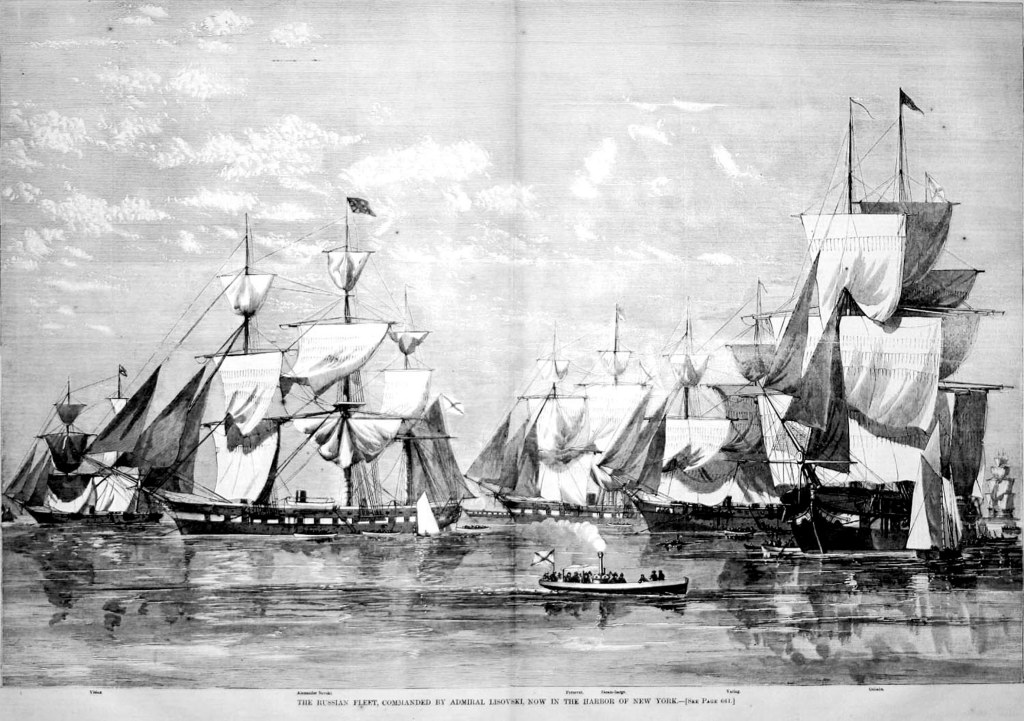
In September 1863, as the United States fought for its survival, Russian warships appeared in New York Harbor. Another Russian squadron reached San Francisco weeks later. Crowds cheered. American newspapers celebrated. Secretary of the Navy Gideon Welles wrote three extraordinary words in his diary: “God bless the Russians.”
Today, Russia and the United States are commonly described as geopolitical adversaries. In the American Civil War, they were friendly powers with a common interest in preventing Britain and France from deciding the future of North America. Russia helped the Union in a way that mattered. But the popular claim that the tsar sent his fleet specifically to save Abraham Lincoln is not what the evidence shows. The actual story is stranger, and more revealing.
The Confederacy’s greatest hope was not just victory on the battlefield
The Confederate States of America, founded in 1861 to preserve a slaveholding order threatened by Lincoln’s election, needed more than military survival. Its leaders wanted Britain and France to recognise it as an independent country. International recognition could improve access to credit, arms and diplomacy. Recognition, however, was not identical to a promise of military intervention.
Southern leaders also believed Europe’s dependence on American cotton would force governments to help them. Confederate planters and authorities initially withheld exports in an informal attempt at cotton diplomacy. Then the Union blockade became progressively more effective. Mills suffered; industrial workers lost jobs; European merchants searched for cotton in Egypt, India and elsewhere.
The calculation was simple. If powerful European governments concluded the Union could not defeat the Confederacy, they might broker an armistice, acknowledge Southern independence or, in the most dangerous scenario, intervene. Each possibility presented a different degree of risk.
Britain: The country Lincoln had most reason to fear
Britain declared neutrality in May 1861. It recognised the Confederacy as a belligerent, which meant Confederate forces gained certain rights under international law. Britain did not recognise it as an independent nation. The distinction infuriated Washington, which regarded secession as rebellion.
Prime Minister Lord Palmerston and other prominent politicians were sympathetic to the Southern position or doubtful that the Union could be restored. British shipyards built vessels that entered Confederate service, most notoriously the commerce raider Alabama. The dispute over two British-built ironclad warships, known as the Laird rams, became particularly dangerous before the British government detained them in 1863.
The two countries had already approached war during the Trent Affair in late 1861, when an American warship removed Confederate envoys from a British mail steamer. Lincoln’s government released the envoys, helping defuse the confrontation.
In autumn 1862, British ministers seriously debated offering mediation or an armistice. An armistice could have frozen the war while the Confederacy still held much of the territory it claimed. But Britain’s cabinet never agreed to recognise the South or send the Royal Navy to fight for it. Opposition to slavery, concern about war with the Union, competing strategic priorities and uncertainty about Confederate prospects all weighed against intervention.
France: Napoleon III wanted mediation, but wanted Britain beside him
France also proclaimed neutrality. Emperor Napoleon III entertained Confederate approaches, met the Southern envoy John Slidell and considered recognition. His government suffered from the cotton crisis, and he had another imperial ambition: establishing French influence in Mexico.
In November 1862, Napoleon formally proposed that Britain, France and Russia jointly offer mediation in the American war. His intervention in Mexico complicated his claim to be acting solely as a disinterested peacemaker. Above all, he was reluctant to move against Washington without Britain. London declined the proposed initiative. The plan went nowhere.
Belgium: A king who tried to organise European intervention
Belgium’s role is one of the least remembered parts of this history—and one of the most remarkable.
In a study published in the Belgian Journal of Contemporary History, historian Francis Balace documented how King Leopold I used his connections to British prime minister Palmerston and Napoleon III to encourage European mediation. Leopold proposed ideas to Napoleon in October 1862, while the Confederate envoy Ambrose Dudley Mann worked in Brussels seeking to exploit the king’s influence.
Leopold’s interests were not purely humanitarian. The king had family interests tied to the Mexican adventure of his son-in-law Maximilian, who would become emperor of Mexico with French backing. Influential Belgian circles also sympathised with the Confederacy.
But the Belgian king was not the Belgian government. In January 1863, Mann sought formal diplomatic recognition of the Confederacy from Belgium. Foreign minister Charles Rogier refused. Britain and France had discouraged Belgium from taking that step. Leopold was disappointed that his mediation plans had collapsed.
Think about the implication: a Belgian king was personally involved in conversations that might have shaped whether the United States remained one country.
Spain: Sympathy, Cuba and calculated neutrality
Spain declared neutrality and extended belligerent rights to the Confederacy, but did not recognise Southern independence. Parts of the Spanish military and political elite sympathised with the South. Spanish authorities allowed Confederate blockade-runners access to ports, including in Cuba, and Spanish officials had reasons to favour a weaker United States that could not so easily threaten their Caribbean interests.
Cuba remained a Spanish slaveholding colony. Madrid also had diplomatic and military commitments in Santo Domingo and Mexico. Spain joined Britain and France in their initial 1861 intervention in Mexico over debts, but withdrew when Napoleon’s larger ambitions became apparent.
A divided United States might have benefited Spanish interests. Yet the Spanish government ultimately avoided military involvement in the American Civil War. Spain was a potential complication for Lincoln, not a country that committed itself to fighting for Confederate independence.
Russia: The one major European power openly friendly to the Union
From the opening of the war, Tsar Alexander II and his foreign minister Alexander Gorchakov supported the preservation of the American Union. Russia regarded a strong United States as a useful counterweight to British and French power. Washington, in turn, declined to join European pressure on Russia during the Polish uprising of 1863. The two governments shared interests, despite the obvious contradiction between the American republic and the Russian autocracy.
When France sought joint mediation in November 1862, Russia made an important distinction: it was willing to support friendly appeals for peace, but opposed mediation imposed on the American belligerents. A contemporary Russian argument, preserved in U.S. diplomatic records dated 11 November 1862, warned that European powers had no right to force mediation on the United States. The United States wanted no international conference that might treat the Confederacy as an equal sovereign nation.
Russia’s diplomatic position denied Napoleon the unanimity he sought. It did not make European intervention impossible, but it removed one potential source of legitimacy for the French plan.
Then the Russian fleets arrived. What were they really doing?
The Russian frigate Osliabia entered New York Harbor in September 1863. Other warships followed, under Rear Admiral Stepan Lisovski. Across the continent, a Russian squadron commanded by Rear Admiral Andrey Popov arrived in San Francisco. The Union public treated the visits as magnificent demonstrations of solidarity.
The ships were real. So was the friendship. But the Russian orders had another purpose.
With Britain and France pressing St. Petersburg over Poland, Russia feared that war in Europe might trap its naval forces in their home ports. By moving squadrons into the Atlantic and Pacific, the tsar kept them available for action against enemy commerce if fighting broke out. American harbours provided friendly bases outside the immediate reach of a European blockade.
That arrangement suited both governments. Russia protected its naval options; the Union gained a spectacular public show of friendship at a time when international recognition mattered enormously. There was no formal Russian-American military alliance, and the ships had not been dispatched under orders to fight for Lincoln.
The timing matters even more. The Russian arrivals followed the Union victories at Gettysburg and Vicksburg in July 1863. By then, the critical British and French mediation debates of autumn 1862 had already failed. The Russian fleet therefore cannot be credited with stopping a European intervention that had already been rejected.
How close did the United States come to European intervention?
There were three genuine danger points. The Trent Affair in 1861 risked an Anglo-American war. In autumn 1862, British ministers weighed mediation while Napoleon III actively pursued it, and Leopold I tried to encourage European cooperation. In 1863, British-built Confederate ironclads threatened to provoke another confrontation.
The autumn of 1862 was the closest the Confederacy came to obtaining the diplomatic breakthrough its leaders desired. A decisive Southern victory on Northern soil might have changed the debate, but Robert E. Lee’s Maryland campaign ended at Antietam. Lincoln’s preliminary Emancipation Proclamation followed, making Union victory increasingly inseparable from the destruction of slavery and making overt support for the Confederacy politically harder in Britain.
Yet serious discussion is not the same thing as an imminent multinational invasion. No British cabinet approved recognition, no Anglo-French intervention force was authorised, and no European government formally recognised Confederate independence. The U.S. State Department’s historical assessment identifies military events, Union diplomacy and European anti-slavery sentiment as decisive barriers to recognition.
So did Russia help save the United States?
Yes, in the limited but important sense that Russia supported the Union diplomatically, resisted coercive European mediation and made its friendship spectacularly visible with the fleet visits. Those actions strengthened Washington’s international position and may have complicated the calculations of potential interveners. How much the fleet visits independently deterred London or Paris cannot be established.
No, if the claim is that Russian warships were ordered to defend the Union and single-handedly prevented its permanent breakup. That version ignores Russian strategy in Poland, the earlier failure of European mediation, the importance of Britain’s own decisions and, above all, American battlefields.
And there is an additional historical irony. Alexander II had emancipated Russia’s serfs in 1861. Lincoln would emancipate enslaved people in rebellious Confederate territory in 1863. The two emancipations were profoundly different, and the Russian Empire remained an autocracy brutally suppressing Polish independence. Yet in this particular conflict, an autocratic empire became one of the strongest diplomatic friends of a republic fighting a rebellion built to protect slavery.
History rarely offers heroes without contradictions. For a few crucial years, Russia and the United States found that keeping the American Union together served both their interests. Europe did not intervene. The Confederacy never secured foreign recognition. And the United States survived—still one country.
Historical sources
- U.S. Department of State, Office of the Historian — Preventing Diplomatic Recognition of the Confederacy, 1861–1865 — why European recognition failed.
- National Museum of American Diplomacy — The Trent Affair — the Anglo-American diplomatic crisis.
- Fondation Napoléon — The Second Empire and the American Civil War — the French position and proposed mediation.
- Francis Balace, “Léopold Ier et l’intervention européenne dans la guerre de Sécession,” Belgian Journal of Contemporary History (1969) — Leopold’s diplomacy, Confederate lobbying in Brussels and Rogier’s refusal.
- James W. Cortada, Spain and the American Civil War: Relations at Mid-Century, 1855–1868, American Philosophical Society (1980) — Spanish policy and its colonial interests.
- U.S. Department of State — French Intervention in Mexico and the American Civil War.
- U.S. Department of State, diplomatic correspondence of 11 November 1862 — Russian response to the proposed European mediation.
- Andrew C. A. Jampoler, “A Civil War Visit by the Tsar’s Navy,” Naval History (2011) — fleet orders, Poland and diplomatic context.
- C. Douglas Kroll, Friends in Peace and War: The Russian Navy’s Landmark Visit to Civil War San Francisco (2007).
- “The Intervention Crisis of 1862: A British Diplomatic Dilemma?” American Nineteenth Century History (2014) — British cabinet debate.
- Harper’s Weekly engraving of the Russian fleet in New York Harbor, 1863 — public-domain illustration.


