
Israel crushed its enemies in six days in 1967. Then spent six years believing military superiority could do the work of peace.
It had conquered Egypt’s Sinai Peninsula, Syria’s Golan Heights, the West Bank, East Jerusalem and Gaza. It controlled territory that could be exchanged for diplomatic recognition and security arrangements. It also controlled the lives of Palestinians who had no say in being occupied.
Then something happened that is almost absent from the popular version of this history.
There were opportunities for peace. And Israel helped bury them.
In The Bride and the Dowry, historian Avi Raz reconstructs the two years after the 1967 war from Israeli, American, British and United Nations archives. His conclusion is devastating: King Hussein of Jordan and Palestinian leaders in the occupied West Bank were prepared to explore accommodation, but Israel’s diplomacy was often deliberately designed to lead nowhere.
It wanted to keep the land, while reassuring Washington that it was looking for peace. Raz shows how the supposedly generous Israeli cabinet decision of June 19, 1967, which has repeatedly been described as an offer to trade territory with Egypt and Syria, was never actually conveyed to them as such an offer.
There was a cruel metaphor behind the book’s title. The territory was the dowry. The Palestinians living on it were the bride. Israeli leaders desired the former without accepting the political implications of the latter.
Israel wanted the dowry. But not the bride.
Then came Egypt.
In February 1971, President Anwar Sadat proposed an interim arrangement: Israel would pull back from the Suez Canal, the canal would reopen, and the parties would move toward further withdrawals. He also signalled willingness to end belligerency in exchange for full Israeli withdrawal to the international border. This was no unconditional surrender by either side. It was a serious diplomatic opening.
The United States Department of State’s own historical account records Israeli opposition to the initiative and the lack of meaningful support it received from Nixon and Kissinger.
In February 1973, Sadat secretly submitted another proposal, this time for a comprehensive settlement, through Henry Kissinger. Historian Uri Bar-Joseph, drawing on archival records, argues that it satisfied most of Israel’s stated peace requirements but was rejected by Golda Meir because she would not give up the territories captured in 1967.
One cannot prove that accepting a particular proposal would have prevented every later war. The parties disagreed over borders, security, sequence and trust. But that is precisely why these lost opportunities matter: diplomacy is not what happens when everyone already agrees.
1973 was not peaceful until October 6.
On February 21, Israeli fighter jets shot down Libyan Arab Airlines Flight 114 after the civilian plane strayed into Israeli-occupied Sinai. 108 people died. The International Civil Aviation Organization condemned the action and found no justification for destroying the aircraft.
On April 9–10, Israeli commandos attacked targets in Beirut and Sidon, killing Palestinian leaders and other people. In September, Israeli and Syrian aircraft fought a deadly aerial battle. The region was already living with raids, reprisals and escalating military confrontations.
None of this changes who launched the October war. On October 6, 1973, Egypt and Syria began the coordinated offensive against Israeli forces in the Sinai and on the Golan Heights. Israel did not launch a pre-emptive strike that morning.
But the fact that Egypt and Syria attacked first on October 6 does not mean the political story began on October 6.
Then the cost arrived.
Egyptian infantry crossed the Suez Canal and broke through Israeli positions. Syrian forces attacked on the Golan Heights. The image of Israeli invincibility, forged in six extraordinary days in 1967, cracked under the weight of a war Israel had convinced itself its adversaries would not dare to fight.
Israel eventually recovered militarily. Its troops crossed to the western side of the Suez Canal and pushed Syrian forces back. But the price was staggering. Approximately 2,700 Israeli soldiers died, alongside many thousands of Egyptians, Syrians and other combatants.
A battlefield victory did not repair the original political failure.
In 1979, Israel and Egypt signed a peace treaty. Israel subsequently completed its withdrawal from Sinai in 1982.
The land that had seemed too precious to surrender before the war was returned after the war.
And this is the question that should haunt anyone looking back at 1973: How many men had to die before leaders did what diplomacy might have allowed them to do years earlier?
The tragedy of 1973 was not simply that military leaders misread an approaching offensive. It was that political leaders mistook their ability to hold territory for an ability to hold history still.
Sources and further reading
- Avi Raz, The Bride and the Dowry, Yale University Press
- Avi Raz, “The Generous Peace Offer that was Never Offered,” Diplomatic History
- U.S. Department of State, Office of the Historian: The 1973 Arab–Israeli War
- Uri Bar-Joseph, “Last Chance to Avoid War: Sadat’s Peace Initiative of February 1973 and its Failure”
- Israel Defense Forces account of the April 1973 Beirut raid
- Brookings Institution: Israel’s intelligence failure in 1973
- U.S. Department of State: Camp David and the Israel–Egypt peace treaty
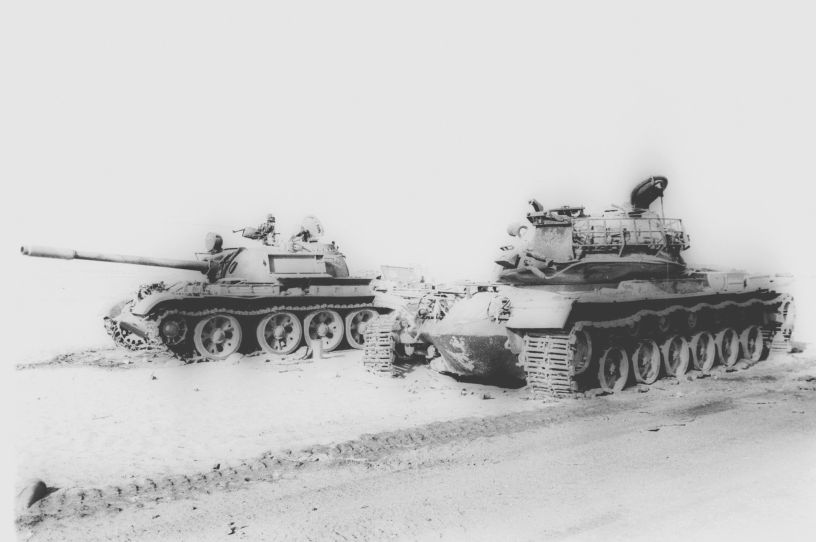
Featured photograph: Damaged tanks near the Suez Canal, October 11, 1973. Josef Jackson / Israel Press and Photo Agency / Dan Hadani Collection, National Library of Israel. CC BY 4.0. Original image and attribution.


