
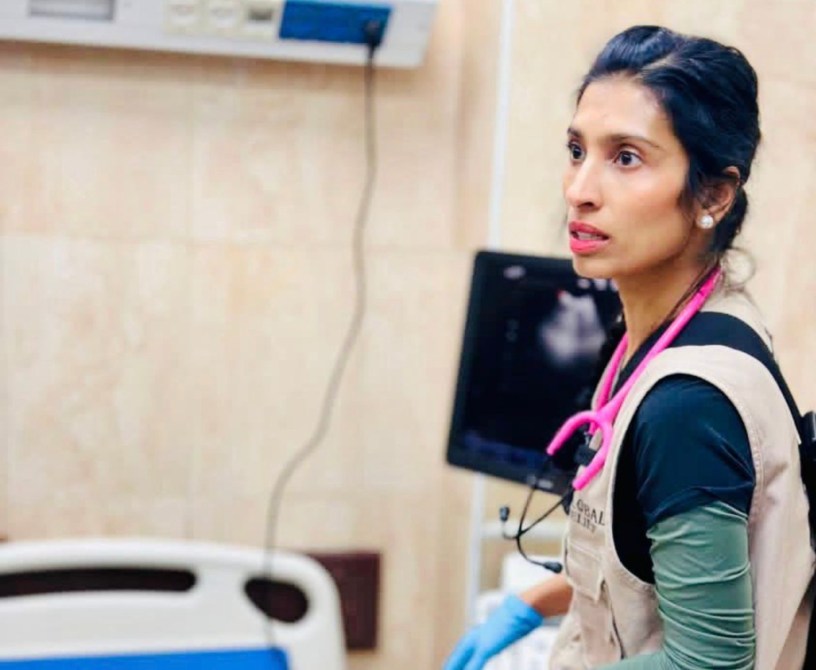
The American doctor returned from Gaza with Palestinian blood on her shoes.
On December 31, 2024, Dr Mimi Syed was back in Amman, Jordan. Someone took her to a beautiful restaurant. There was warmth, safety, clean water, food. She could barely eat. The shoes on her feet still carried blood from the people she had treated in Gaza.
She had left behind Palestinian colleagues who did not get to leave. Children she had cared for were still there. A border separated the world in which she could eat dinner from the one in which those children were trying to stay alive.
Dr Mahmooda “Mimi” Syed is an American emergency physician and mother of three. She volunteered in Gaza twice in 2024, working at Nasser Hospital in Khan Younis and Al-Aqsa Hospital in Deir al-Balah. What follows is drawn from her diary, interviews and recorded testimony, not invented scenes.
1. Eighteen children shot in the head or chest
After her first four-week mission in August and September 2024, Syed reviewed her notes. She had recorded at least eighteen children younger than twelve with gunshot wounds to the head or chest. Those were only the cases she had managed to document while treating the wounded.
A single bullet wound in a small child’s head or chest can raise grave questions about deliberate targeting. Syed and other doctors believe the pattern they witnessed warrants investigation. The medical findings alone, however, cannot establish who fired every shot, the circumstances or the intent in each case.
2. A four-year-old named Mira
Mira al-Darini arrived at Nasser Hospital with a gunshot wound to her head. According to the account relayed by her family, she had been shot near the family’s tent in an area civilians had been told was safe. Staff doubted she could survive.
Syed could see that the little girl was still moving. She intubated her, obtained a brain scan, and found a bullet lodged in her head. A neurosurgeon operated. Mira survived. Later, she began to speak again.
Every person trying to reduce this war to an argument about statistics should know her name.
3. The emergency equipment she had to carry into Gaza
Syed told de Volkskrant that she concealed two laryngoscopes under her clothing to get them into Gaza. A laryngoscope helps a clinician place a breathing tube. She said that one normally disposable device was cleaned and reused on at least fifty patients.
It was one of these instruments that helped her keep Mira breathing. An ordinary medical tool had become something a doctor feared she might be prevented from bringing in.
4. A seven-year-old who never came home
On August 14, 2024, Syed wrote about a seven-year-old girl who arrived with a gunshot wound to the chest. The girl was already dead. The emergency department had been overwhelmed by casualties; there were too few cots, and people lay on the floor.
Syed recorded that she almost slipped in blood, then struggled to eat for two days. She wondered whether she would ever feel normal again.
5. The children who reached the hospital too late
Mira survived. Many other children with injuries resembling hers did not. Syed told the investigative programme Reveal that some arrived dead before the medical team could even obtain a scan.
The difference between a child’s survival and death could be measured in minutes, in whether a surgeon was available, or in whether the hospital still possessed the equipment needed to help.
6. Small wounds, catastrophic internal bleeding
Syed also described children injured by tiny, dense fragments of shrapnel, sometimes after attacks near places where people were gathered. Some had been outside playing football or flying kites. She reported wounds that looked small on the surface but hid severe internal injury.
Her testimony concerns what she treated and what families and colleagues told her. Determining the precise weapon and the circumstances of each strike requires separate investigation.
7. Babies fed sugar water
During her December mission, Syed encountered the effects of hunger on mothers and infants. She reported learning of families feeding babies sugar water because they had nothing suitable to give them. She described malnourished mothers unable to breastfeed, as well as children with signs of serious nutritional deprivation.
Hunger does not make the sound of a bomb. It can destroy a child’s development just as surely.
8. Children wishing for death because their families were gone
In a later interview, Syed described children who said they would rather be dead because they believed they could then join relatives they had lost, and escape the hunger, fear and ruined schools around them.
This is testimony to the depth of their distress. A child imagining death as reunion with family is not expressing an ordinary childhood wish. It is a measure of the psychological devastation that war can leave behind.
9. She carried the evidence out with her
Syed took notes, photographs and recordings. Her testimony became part of de Volkskrant‘s wider investigation, in which seventeen visiting doctors were asked about children with single gunshot wounds to the head or chest. Fifteen reported seeing such cases. Together they described 114 children aged fifteen or younger.
These are clinicians’ reported observations, not a completed forensic investigation. Their consistency makes independent investigation more urgent, not less.
10. Then she had to return to an ordinary life
After her second mission, Syed recorded a voice note from Jordan. She was in a restaurant, still wearing shoes marked with Palestinian blood. She felt guilty being safe while her colleagues and patients remained in Gaza.
She subsequently spoke publicly, including through investigative reporting and international advocacy. She did not pretend the fact of speaking could rescue the children she had left behind. But silence would have meant abandoning them a second time.
The most terrible part of Mimi Syed’s testimony is not a number. It is the gulf between what she saw with her own eyes and how easily everyone else can carry on with their day.
One girl survived because a doctor refused to look away. Eighteen other case notes were written down. How many stories were never recorded at all?
Sources: firsthand testimony and investigations
- de Volkskrant investigation, “What the wounds are telling us,” reproduced by the European Press Prize (2026 award) — interviews with Syed and sixteen other international doctors; her diary and the case of Mira.
- Reveal, “Kids Under Fire in Gaza,” May 24, 2025 — Syed’s documented eighteen cases, her interviews and the wider investigation.
- Al Jazeera Fault Lines, “Kids Under Fire,” March 27, 2025 — documentary about Mira al-Darini and the doctors’ testimony.
- The Polis Project, “Dr. Mimi Syed on Witnessing the Genocide in Gaza,” September 24, 2025 — extensive first-person interview about gunshot wounds, shrapnel injuries, hunger and children’s trauma.
- NPR interview, January 26, 2025 — Syed’s recorded account of leaving Gaza and returning to Amman.
- Al Jazeera Centre Stage, “Bearing witness: A doctor’s reckoning with Gaza,” September 4, 2025 — further firsthand interview.
Editorial note: The dates and cases above describe Syed’s visits in 2024 and her subsequent published testimony. Allegations that children were deliberately shot require independent, case-specific investigation. The article identifies medical observations and reported witness accounts separately from conclusions about who was responsible.

