
September 29, 1864. Outside Richmond, Virginia.
There was a swamp to cross. Then tangled barricades of felled trees. Beyond them, Confederate soldiers waited behind earthworks, with rifles and artillery trained on the open ground.
Into this position marched Black Union soldiers of the United States Colored Troops. Men fighting to destroy a rebellion built to preserve slavery, in a country that still refused to treat them as equals.
It was the Battle of New Market Heights, part of the fighting around Chaffin’s Farm. And the charge became a slaughter.
Among the attackers was Christian Abraham Fleetwood, a 24-year-old sergeant major of the 4th United States Colored Infantry. Born free in Baltimore, educated, and formerly involved in publishing a Black newspaper, he had joined the army in 1863.
His regiment had entered the attack with a color guard of twelve men. Eleven were shot down.
When one flag bearer fell, Sergeant Alfred B. Hilton took up the flags. He, too, was hit. As he went down, he called for the colors to be saved. Corporal Charles Veal seized the regimental flag. Fleetwood took the American flag.
These flags were not ornaments. In the smoke and confusion they showed soldiers where their unit still stood. Carrying one made a man an obvious target.
Fleetwood carried it through the fight.
The attacking Black brigades suffered more than 800 casualties, including over 130 dead. Fourteen Black soldiers received the Medal of Honor for their actions that day — more than in any other single battle of the Civil War.
And what did Fleetwood write in his diary?
Charged with the 6th at daylight and got used up. Saved colors.
Christian A. Fleetwood, diary entry, September 29, 1864
Got used up.
Men had been torn apart trying to take a position that others had decided must be taken. Eleven of the twelve men in one color guard had fallen. And this is how he put it into a pocket diary.
Saved colors.
Fleetwood was awarded the Medal of Honor. Yet when officers of his regiment later supported his promotion to commissioned officer, the War Department refused.
A nation could decorate him for his courage without granting him the standing his comrades believed he deserved.
History often remembers the generals, the maps and the ground gained. Fleetwood remembered the men who went down, and the flag that did not.
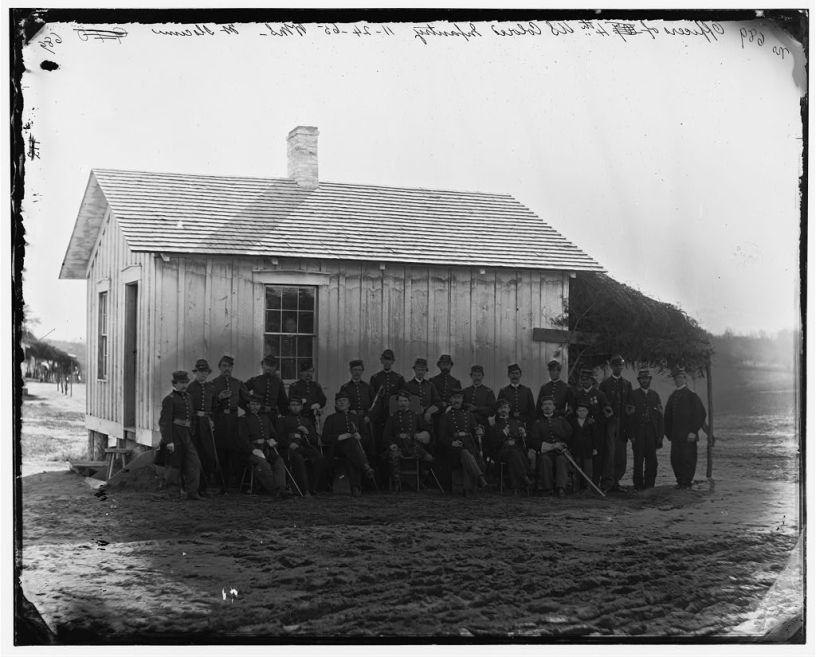
Featured photograph: Officers of the 4th U.S. Colored Infantry at Fort Slocum, December 1865. Christian Fleetwood is fourth from the right. William Morris Smith / Library of Congress. This photograph was taken after the battle, not during it.

