
He was twelve. Shrapnel had struck his head and abdomen. Doctors put him on life support, performed emergency surgery, and waited for him to recover.
By the following morning, the boy was brain-dead. Outside the hospital, communication networks had gone down. The doctors could not telephone his family.
Dr Zaher Sahloul, a Syrian-American intensive-care specialist, remembered the death certificate as something he needed to preserve. He photographed it, later explaining that he wanted the people making decisions about Gaza to see one child’s name instead of another number.
In his October 9, 2025, first-person account for New Lines Magazine, Sahloul calls the boy Khalil. In separate interviews published in 2024, he described a similar twelve-year-old named Mohammad and an eleven-year-old named Ahmad Abu Shahla. The accounts overlap, but do not provide enough identifying information to establish definitively whether all refer to one child. The article therefore follows the detailed first-person account rather than combining names as though they were verified aliases.
Sahloul is president and co-founder of MedGlobal. He had already undertaken extensive humanitarian work in Syria, Ukraine and other conflict zones before returning to Gaza in January 2024. His assignment included MedGlobal’s overcrowded primary-care clinic in Rafah and the intensive-care unit at Nasser Hospital in Khan Younis.
He was not a surgeon arriving to describe one spectacular operating-room injury. He was an intensive-care doctor witnessing how easily a child could die after a shelling, or because clean water, an anaesthetic, a laboratory or a telephone call had become unavailable.
1. A twelve-year-old died before his family could be contacted
During a mass-casualty emergency at Nasser Hospital, a boy with severe head trauma and abdominal shrapnel wounds was intubated and taken into surgery. Sahloul examined him again in intensive care the following day. The brain injury had proved unsurvivable.
He had been one of dozens of casualties brought to the emergency room after an explosion in the surrounding area. Hospital communications were down, so the staff could not reach his relatives. Sahloul kept a photograph of the death certificate and later brought it to Washington.
The boy was not a metaphor. The doctor had watched him die.
2. Two children needed chest tubes. There was no anaesthetic left.
In the same emergency, Sahloul inserted tubes into the chests of two severely injured children to drain air or blood and allow their lungs to function. Both children were unconscious; he said there was no anaesthetic available.
A chest tube is an invasive procedure, even when the patient is unresponsive. The shortage meant the team was deprived of medicines ordinarily required for such interventions. Sahloul did not provide verified long-term outcomes for those two children.
3. Abdallah lost an eye while gathering firewood. His wound was dressed without local pain relief.
At a school in Rafah converted into a shelter, Sahloul visited a Palestinian paediatrician, Dr Rachid Al-Qanoue, who was running a makeshift clinic. He encountered twelve-year-old Abdallah, who had lost his right eye and sustained shrapnel wounds while gathering wood.
Abdallah had been brought by donkey cart. Al-Qanoue changed his dressings without lidocaine, the local anaesthetic normally used to reduce pain. The boy struggled not to cry out.
The Palestinian doctor treating Abdallah was himself displaced, living in a classroom with dozens of relatives. Sahloul documented this encounter; he did not claim to have performed the dressing.
4. Fourteen-year-old Sarah developed hepatitis after her family was forced into a tent.
Sarah had been displaced from Gaza City to Rafah and was living in a crowded tent with her parents and siblings. She arrived at the new clinic with symptoms that Sahloul diagnosed clinically as hepatitis A, together with dehydration.
The clinic had no laboratory capacity to confirm the diagnosis. The team gave her intravenous fluids. She returned the following day looking noticeably better. Not every account ends in death: this one shows how ordinary medical treatment could still help when supplies were available.
5. A little girl became ill because there was no clean water.
Sahloul recalled a girl suffering from bloody diarrhoea and dehydration while living with approximately fifteen family members in a tent. In a February 2024 ABC News report, she was identified as four-year-old Lama, and his colleague Dr John Kahler was described as examining her and administering oral rehydration solution. In an October 2024 Anadolu interview, he referred to a five-year-old called Alma.
Those sources differ on name and age. What they consistently describe is a sick child living without adequate sanitation, and a treatable condition that had become dangerously common. The care in the ABC account was provided by Kahler, not Sahloul.
6. A child answered a question about his future with a question of his own.
Sahloul had a habit of asking children what they wanted to be when they grew up. Many told him they wanted to become doctors. They had seen how much their community needed medical care.
At a shelter for displaced people, he asked another child the same question. This boy, plainly traumatised, answered: “What future?”
Sahloul told that story during a March 2024 NPR report on doctors meeting American officials. It was not the answer of a boy seeking to shock his listener. It was the answer of a child who could no longer imagine a life beyond the next few days.
7. A young woman spent twenty days struggling to breathe. One small device helped her.
At the Rafah clinic, Sahloul treated a twenty-four-year-old woman with asthma. Smoke from fires used to heat the family’s tent, together with the cold conditions, had aggravated her breathing problems.
He gave her a bronchodilator through a handheld nebuliser he had brought from Chicago. Her breathing improved. This was an ordinary, treatable asthma exacerbation transformed into a prolonged ordeal by displacement and the loss of reliable medical care.
Sahloul’s experience showed how a small, functioning piece of equipment could change the immediate future of a patient.
8. A Palestinian paediatrician cared for other families while his own lived in a classroom.
Dr Rachid Al-Qanoue had been displaced from Jabalia and was sheltering in a school with around fifty family members. He told Sahloul that ten relatives had been killed. Despite those losses, he ran a medical station at the school with two nurses, treating around 180 patients a day and performing dozens of wound dressings.
Sahloul saw Al-Qanoue using makeshift supplies and improvising when medicine was unavailable. The story is not about a visiting physician rescuing an otherwise helpless medical system. It is about a Palestinian doctor doing most of the work while living through the same catastrophe as his patients.
9. At Nasser Hospital, dialysis patients had already died from the absence of treatment.
Nasser Hospital had previously offered services that required sophisticated equipment and sustained supplies, including dialysis, cancer care and neonatal intensive care. In January 2024, Sahloul found major parts of that capacity suspended.
He wrote that hospital staff reported twenty-eight kidney patients had died after dialysis services were interrupted. This was an institutional figure relayed in his account, not a set of twenty-eight deaths he personally witnessed or independently audited.
It is a reminder that an interrupted treatment can be fatal even when no shrapnel wound exists. The loss of a working hospital kills in ways that rarely produce photographs.
10. In 2025, MedGlobal reported children dying from severe malnutrition.
Sahloul’s involvement did not end when he left Gaza in January 2024. He continued coordinating MedGlobal’s response and receiving reports from its Palestinian medical teams.
In July 2025 reporting by ABC News, he said nineteen children had recently been admitted to MedGlobal-supported clinics with severe acute malnutrition. Five of them, between three months and four and a half years old, had reportedly died over a seventy-two-hour period.
These were cases reported by his organisation, not deaths he observed personally at the bedside. Their inclusion shows the changing nature of the crisis: doctors were fighting not only blast injuries, but the failure to get sufficient food into the bodies of infants and small children.
He took a child’s death certificate to the White House.
On April 3, 2024, Sahloul joined physicians meeting U.S. President Joe Biden and senior administration officials. In his later written recollection, he says he showed the president photographs and a death certificate to give a human identity to Gaza’s child casualties.
Sahloul also recalled presenting the story of seven-year-old Hiyam, who had died of severe burns following an attack on her family’s home. The published essay does not establish that Sahloul personally treated Hiyam; he used her case to communicate what his medical colleagues had witnessed.
The doctor’s political demands included more humanitarian aid, protection for hospitals and an immediate ceasefire. His views on the conduct of the war are his own. His direct observations, the patients he treated, and the accounts supplied by his colleagues must be evaluated with their different evidentiary weight.
There is something particularly revealing in Sahloul’s testimony. He had spent years preparing doctors for the injuries caused by bombs, missiles and chemical weapons. Yet the scenes that endure are not only those of catastrophic trauma.
They are a child too ill to drink contaminated water. A teenager longing for her old school. A physician changing a boy’s dressings without local anaesthetic. A small asthma inhalation treatment that should never have been difficult to obtain.
And a twelve-year-old whose death certificate could travel farther than he ever would.
The doctors had done the surgery. The boy had died. The telephone lines were down. Nobody could call his family.
Sources: medical testimony and supporting reporting
- Zaher Sahloul, New Lines Magazine, October 9, 2025 — extensive first-person account of his January 2024 mission, including Khalil, Sarah, Abdallah and the White House meeting
- The New Humanitarian, February 22, 2024 — recorded interview and transcript with Sahloul on Gaza’s hospitals, children and the limits of medical neutrality
- NPR / Maine Public, March 23, 2024 — Sahloul’s conversation with a displaced child who could not picture his future
- ABC News, February 28, 2024 — the girl reported as Lama, contaminated water and Dr John Kahler’s treatment
- Anadolu Agency, October 18, 2024 — the boy reported as Ahmad Abu Shahla and the girl reported as Alma, plus Sahloul’s account of the medical mission
- ABC News, July 2025 — MedGlobal’s reported rise in severe childhood malnutrition and five recent deaths
- Scripps News / WRTV, January 31, 2024 — Sahloul’s first interviews after returning from the Gaza mission
- Open letter from U.S. healthcare professionals who worked in Gaza, October 2024 — Sahloul’s clinical role and deployment dates, January 9–25, 2024
- MedGlobal — Sahloul’s medical humanitarian organisation
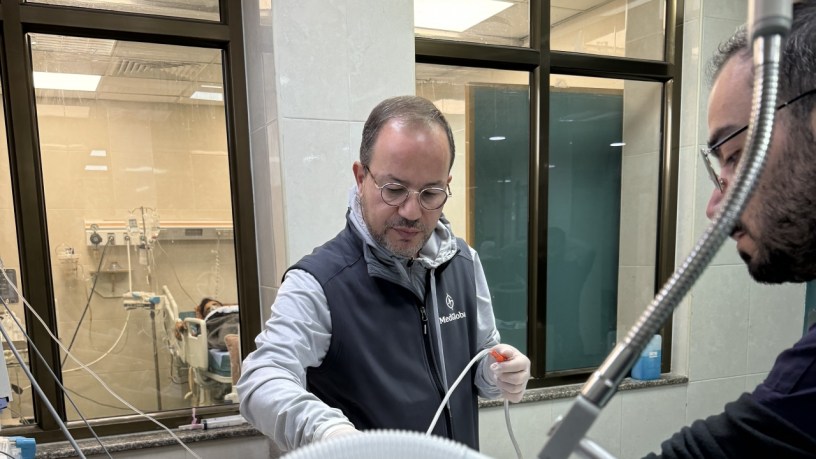
Featured photograph: Dr Zaher Sahloul working during his January 2024 Gaza mission, published by Scripps News, January 31, 2024. The image does not depict the child whose death is described in the headline. Reuse rights have not been independently confirmed.
Editorial note: Firsthand treatment, encounters witnessed by Sahloul, and reports received from colleagues are distinguished throughout. His descriptions of the critically injured boy and the dehydrated girl vary in identifying details between interviews; the article does not treat those names as definitively interchangeable. All clinical incidents described from the January mission occurred in January 2024; the malnutrition cases reported by MedGlobal were in July 2025.

