
She was eight years old. She was still breathing. She was alone on a trolley, hidden behind a curtain in a Gaza emergency department. The doctor knew she needed help. He also knew there was no longer enough hospital left to save everyone.
It was July 24, 2024, at Nasser Hospital in Khan Younis. After another crushing influx of wounded people, emergency physician Dr Javid Abdelmoneim walked back through the department to check whether anyone had been overlooked.
He found a girl still alive. No relative stood with her. He did not know who she belonged to. In an MSF account published the following week, he said the overwhelmed staff had been forced to leave her, expecting she would die. He believed she could have survived in a functioning healthcare system.
She was not dead when he found her. Her subsequent fate is not established in the published account. The cruelty is that a doctor encountered a dying child and understood that the hospital no longer had the means to provide the care she needed.
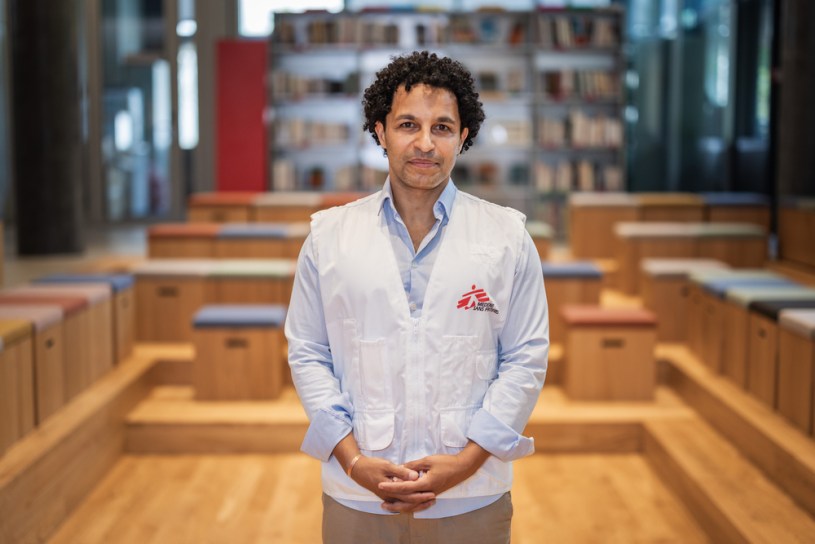
Abdelmoneim is a British emergency physician with years of experience in humanitarian emergencies, from Ebola to wars in Syria and Sudan. He worked as medical team leader for Médecins Sans Frontières (MSF) at Nasser Hospital from June 6 through July 31, 2024. He later became MSF’s international president in September 2025.
His own description of Gaza is not of a hospital that simply became busy. It is of the point at which emergency medicine loses its most basic premise: that the critically wounded patient who reaches a hospital will have a realistic chance of treatment.
Here are ten experiences from his 2024 mission, supported by MSF’s published eyewitness accounts, recorded interviews and his later testimony. The patients are not fictional reconstructions.
1. He found an eight-year-old girl dying behind a curtain.
After the July 22 mass-casualty influx, Abdelmoneim returned to the emergency department. Behind a curtain was a little girl, roughly eight years old, breathing but gravely injured, with no family member present.
He described her in a July 30, 2024 MSF statement, reflecting on what he had seen the previous day. The emergency department had become too overwhelmed to care for every patient. His account was not that someone had decided the girl’s life was unimportant. It was that a hospital built to save lives had run out of capacity to do so.
No name, no parent, no clinical follow-up, no confirmed outcome. Merely a child still breathing on a trolley.
2. A three-year-old looked straight at him. Her thigh was open down to the bone.
On July 13, 2024, a major strike near Khan Younis sent hundreds of wounded people toward Nasser Hospital. Abdelmoneim entered the emergency department and approached a little girl, about three years old.
She was awake. Her parents were standing close to her. At first he thought her alertness was reassuring. Then he lifted the dressing on her leg. The skin and tissue of her left thigh had been torn away, exposing the underlying bone.
The doctor’s firsthand MSF account preserves the terrifying distance between a child looking at you and the injuries hidden beneath a dressing. He had to turn to the next patient before establishing or recording the child’s long-term outcome.
3. A woman was speaking normally. Then her intestines emerged from the wound.
Next to the child was a woman covered with dust. She could look at Abdelmoneim, breathe and respond to him. He could not see any major bleeding.
When he moved the dressing, he found an extensive abdominal injury with bowel protruding through the wound. He remembered the surreal moment of realising that a patient who appeared stable could be gravely wounded.
He had no time to dwell on it. Other patients were already coming through the doors.
4. A teenage boy was not breathing. A nurse told the team to move on.
Four or five more patients arrived in rapid succession, including first responders. A boy in his early teens lay without signs of breathing. The medical team began attempting resuscitation.
A nurse confronted the hardest question of mass-casualty triage: why continue trying to resuscitate someone who appeared dead when other people who could still be saved were waiting?
The team struggled to stop. He was a child. Somewhere, someone was waiting for him. But with new patients coming in faster than staff could reach them, the doctors had to move to the living.
In his October 2025 testimony, Abdelmoneim described the boy as lying dead on the floor. It was not the result of a comfortable clinical decision; it was triage under extreme scarcity.
5. Burned faces, shattered limbs and patients lying in pools of blood.
During the same July emergency, he recorded a boy whose face was almost entirely burned; a woman with extensive burns across her back, shrapnel and clothing melted into the wounds; and a man whose lower leg had been mangled.
He also described having to kneel on the floor beside casualties because the available beds were already occupied. Blood soaked his knees as he assessed the people sprawled around him.
These were not ten separate wars. They were different bodies brought into the same hospital in one day. Surgeons and nurses could not treat them sequentially because the next surge began before the first had ended.
6. His anaesthetist was looking for his daughters and nephews among the wounded.
During the July 13 mass-casualty influx, Abdelmoneim spotted an MSF anaesthetist in the emergency department. He asked why the colleague was not in the operating theatre.
The man told him his house had been destroyed and his daughters and nephews might be among the casualties being brought into the hospital.
Later, according to Abdelmoneim, one of the anaesthetist’s nephews was confirmed dead, and another suffered a spinal injury that left him paralysed. The clinician had come to work to treat the injured, only to find himself searching the same emergency ward for his own family.
Other colleagues also lost children and relatives while continuing to care for the next patients. The foreign medical teams were able to rotate out. Their Palestinian colleagues continued treating patients amid their own bereavement and displacement.
7. A boy remained in hospital for forty-two days after the Nuseirat operation.
On June 8, 2024, Israeli forces carried out an operation in Nuseirat to rescue four hostages held in Gaza. A large number of Palestinian civilians were killed and wounded during the operation, and area hospitals received a severe influx of casualties.
Abdelmoneim later testified that Nasser Hospital’s trauma unit took in nineteen patients transferred from Al-Aqsa Hospital. Among them was a boy around ten years old who stayed for forty-two days.
The child had lost his left forearm. He had a brain injury causing seizures and memory problems, and a metal frame stabilised an injured femur. Abdelmoneim said that this was the last child from the operation to leave the ward.
That distinction matters: not every survivor walks out of the hospital when a battle ends. One day’s violence can consume six weeks of a child’s life before he can even be discharged, and leave disabilities that last far longer.
8. He says he watched two fishermen shot as they ran from the shore.
In testimony delivered in October 2025, Abdelmoneim described an incident from his June 2024 visit: two fishermen on the Gaza shore, approximately two kilometres from a restricted zone, were shot from behind while running away. He said one was struck in the neck and the other in the heart.
He also said Israeli authorities did not allow his team to retrieve the men or provide aid. Friends eventually carried the bodies away, one of the men still holding a fishing net.
This is Abdelmoneim’s eyewitness allegation. The exact circumstances, the shooters and the military’s account were not independently established in the public testimony cited here. It should be investigated with the seriousness the allegation warrants, rather than being treated as a verified forensic reconstruction.
9. Four mass-casualty incidents filled the hospital in nine days.
At the Gaza civil-society tribunal in October 2025, Abdelmoneim gave a tally from Nasser’s emergency-room records for four attacks over nine days in July 2024: 162 people recorded as killed and 568 as injured. That is a hospital intake figure, not a complete count of every death and injury from the attacks.
He described one event in which first responders themselves arrived injured after going to help victims of an earlier strike. He had treated people who still wore their ambulance and responder uniforms.
In his August 2024 ITV interview, he compared this to the London terrorist attacks whose casualties he had treated as an NHS emergency doctor. A single mass-casualty disaster was profoundly challenging. At Nasser, he said, major emergencies kept happening again and again while supplies, beds and staff were already depleted.
10. Six operations were cancelled in a single day because there was no electricity.
The hospital was running out of more than beds. Fuel shortages interrupted electricity, water, sterilisation and operating theatres. Abdelmoneim later testified that six operations had been cancelled on one July 2024 day because staff could not operate without power.
He said MSF lacked basic items including ibuprofen, wheelchairs, crutches, surgical gowns and mattresses. In the midst of a mass-casualty emergency, even a successful operation can become impossible when equipment cannot be sterilised and power cannot be maintained.
Medical shortages are often described abstractly. But what does it mean to a child bleeding after an explosion that the operating room has no power? It means the surgeon’s training is suddenly of no use at all.
A hospital is not merely a building.
In July 2024, Abdelmoneim watched families move injured relatives on hospital beds from one facility to another after evacuation orders and closures. Nasser was one of the last places in southern Gaza still capable of providing comprehensive emergency surgery.
In his 2025 tribunal speech, he made wider allegations about Israel’s destruction of healthcare infrastructure, restrictions on supplies and intentional harm to civilians. Those are his and MSF’s conclusions, and some questions of intent and legal culpability remain disputed. Israel has repeatedly stated that it targets Hamas and that its military operations are subject to rules intended to avoid civilian harm; critics and humanitarian organisations challenge the conduct and consequences of those operations.
The firsthand cases, though, have a narrower and devastating clarity. A girl’s thigh open to the bone. A woman whose bowel has been torn out. A nurse telling a team that it must stop trying to save a boy and move to someone who can still breathe. An anaesthetist searching for his own injured family.
And, after all that, an eight-year-old girl alone behind a curtain.
She was not an anonymous number to the doctor who found her. She was a patient. She was alive.
And Gaza had reached a point where being alive in a hospital was no longer enough to be rescued.
Sources: firsthand accounts and supporting reporting
- Médecins Sans Frontières, July 30, 2024 — Abdelmoneim on finding an eight-year-old girl dying alone at Nasser Hospital
- MSF South Asia, July 24, 2024 — his firsthand account of the three-year-old girl, the woman with exposed bowel, the boy and the anaesthetist’s family
- MSF Canada, July 19, 2024 — eyewitness testimony about the July 13 mass-casualty emergency
- ITV News, August 17, 2024 — Abdelmoneim on mass-casualty events, emergency triage and the medical team’s exhaustion
- MSF, October 27, 2025 — full Gaza tribunal testimony, including the injured Nuseirat boy, fishermen, emergency-room casualty records and cancelled operations
- MSF, Gaza: Life in a Death Trap, December 2024 — detailed humanitarian and healthcare documentation
- MSF UK, August 21, 2024 — links to Abdelmoneim’s recorded CNN and ITV interviews
- MSF, September 3, 2025 — Abdelmoneim’s professional biography and appointment as international president
- MSF, April 3, 2024 — documented conditions and attacks affecting Nasser Hospital before Abdelmoneim’s 2024 mission
Featured photograph: Dr Javid Abdelmoneim, photographed in September 2025 by Pierre-Yves Bernard for Médecins Sans Frontières. Original press photograph, © MSF. It is a portrait taken after his June–July 2024 Gaza deployment, not a photograph of the patients described in this article.
Editorial note: The ten numbered sections refer to separate patients or operational circumstances witnessed during Abdelmoneim’s June–July 2024 deployment, while later testimony from October 2025 is explicitly identified. The eight-year-old girl was alive when he saw her; her subsequent fate was not documented. Allegations about the fishermen, the identity of shooters and deliberate intent are presented as testimony requiring further investigation, not independently established findings.

