
She was three years old. A projectile had damaged an artery in her neck. The surgeon had one device left that might keep blood flowing to her brain.
Professor Nizam Mamode used it. It was the last vascular shunt available at Nasser Hospital in Gaza. The little girl survived the initial operation. Three or four days later, she died from an infection.
The surgeon told this story under questioning by members of the United Kingdom’s International Development Committee on November 12, 2024. He was not recalling a rumour. He had operated on the girl.
The shunt is a tiny tube placed inside a damaged blood vessel to allow blood to pass while the artery is repaired. For this three-year-old, a sophisticated piece of emergency vascular surgery was possible. What was not possible was to give her the safe recovery environment that a child needs afterward.
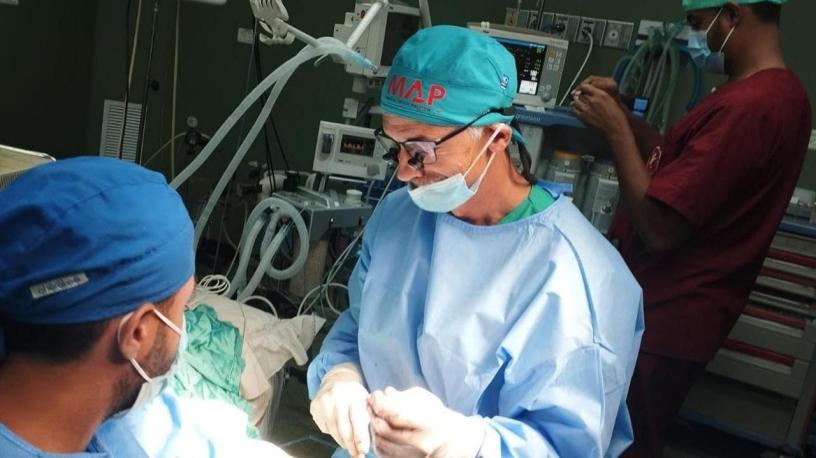
Mamode was a retired British transplant and vascular surgeon, formerly a clinical lead at Guy’s and St Thomas’ Hospital in London. He had worked in other conflict and disaster zones, including Rwanda. From mid-August to mid-September 2024, he volunteered for Medical Aid for Palestinians at Nasser Hospital in Khan Younis.
He returned with testimony so disturbing that, while addressing British MPs, he had to stop speaking to compose himself.
These are ten events and conditions he personally described. The primary source is his official parliamentary evidence; other details are drawn from interviews with the BBC, The National and Medical Aid for Palestinians. Where a patient’s story was told to him rather than independently witnessed, that distinction matters.
1. A three-year-old girl died after surgery using the last vascular shunt
Mamode said the youngest patient he operated on with severe projectile injuries was a girl aged three. Her neck artery was so badly damaged that keeping blood moving to her brain required the last shunt remaining at the hospital.
The surgeons managed the immediate injury. The infection that followed was fatal. Mamode reported her death three or four days later.
He discussed this case while explaining wounds he associated with small cuboid projectiles fired by quadcopter drones. The physical injury and his surgery are his firsthand observations; the precise weapon, shooter and intent in this individual case were not independently forensically established in the public testimony.
2. Seven-year-old Amir survived an attack that tore through his internal organs
A seven-year-old boy whom Mamode called Amir told him that he had been lying on the ground after a nearby bombing when a drone came down, hovered and shot him. The surgeon treated him afterward.
From a small entry wound in the child’s side, the projectile caused extensive damage to the liver, spleen, bowel and blood vessels. Mamode said internal tissue had been displaced so badly that part of the stomach was protruding toward the chest.
The team operated. Amir survived. He was discharged about a week later.
Mamode did not know his subsequent fate. In an interview with The National, he recounted the boy’s description of the drone and the extraordinary damage inside the abdomen.
3. An eight-year-old was bleeding to death when the swabs ran out
One Saturday night, Mamode operated on an eight-year-old who was bleeding heavily. He reached for a surgical swab: the basic absorbent material used to soak up blood and help the team see the operative field.
There were none left. He was told the supply was exhausted.
A surgeon with decades of experience could still perform complex vascular repairs. But the hospital had run out of a basic item that any properly stocked operating room would take for granted. Mamode did not provide the child’s final outcome.
4. Another little girl lost three limbs and an eye. She died twelve hours after surgery
In his interview with The National, Mamode recalled a girl with devastating blast injuries: both legs and one arm had been destroyed, an eye was catastrophically damaged and her abdomen was severely wounded.
She nearly died during surgery. The team managed to bring her out of the operating theatre alive. She survived for approximately twelve more hours before dying.
Her name and age were not given in the interview. It would add nothing to the truth to invent them.
5. Children came in with single gunshot wounds to their heads
Mamode said the hospital repeatedly received children with one gunshot wound to the head and no other apparent injuries. He believed this pattern was consistent with deliberate sniper targeting.
That is a grave professional assessment based on the wounds he examined. An entry wound can reveal the injury and sometimes the projectile, but it cannot by itself establish the identity of the shooter, the position of every person involved or their intention.
Mamode’s accusation deserves a serious, independent investigation of the medical records, witness testimony and firing incidents. His observation of the children and their injuries should not disappear simply because questions of perpetrator and intent remain contested.
6. A doctor in his thirties died from hepatitis in his own intensive-care unit
The failure of sanitation was killing more than patients admitted after bombings. Mamode told MPs about an intensive-care doctor in his thirties who developed hepatitis A, an infection commonly spread through contaminated food or water.
The physician became a patient in the same intensive-care unit where he had worked. His colleagues asked for him to be evacuated and treated elsewhere. Mamode said the evacuation did not happen. The doctor died there.
Hepatitis A is preventable through vaccination. Mamode noted that he himself had been vaccinated, while his Palestinian colleague had no such protection.
7. A colleague removed maggots from a child’s throat
Mamode described wounds infected because of filthy conditions and lack of basic sanitation. Flies entered operating rooms and landed on exposed injuries. He had seen many patients with maggots in their wounds.
One of his colleagues had even removed maggots from the throat of a child in intensive care. Mamode was careful to attribute this specific procedure to the colleague, not to himself.
The infection risk continued after technically successful surgery. Mamode could not give an exact count of postoperative infection deaths, but said the number was large.
8. Amputees received paracetamol as their only postoperative pain relief
During the parliamentary hearing, Mamode said he had performed amputations on patients who afterward had little more than paracetamol for pain.
Paracetamol can ease mild to moderate pain. It is not an adequate replacement for the stronger analgesia ordinarily needed after major limb surgery. These were patients whose injuries required some of the most demanding operations a surgeon performs, recovering with the medication one might use for an ordinary headache.
Mamode did not say every patient underwent surgery without anaesthesia. The specific allegation here concerns the severe shortage of pain relief after operations, a distinction too important to erase.
9. An ambulance arrived with bullet holes in its windscreen
The hospital’s crisis began before patients reached the emergency department. Mamode said an ambulance that had gone to collect wounded people was shot at; he saw several bullet holes in its windscreen.
Some casualties arrived carried in the arms of relatives or brought by donkey carts because vehicles could not reach them. In the emergency department, patients lay on the floor amid blood and debris while doctors tried to establish who was alive, who might survive an operation and who could wait.
Mamode described one or two mass-casualty influxes on an average day, sometimes bringing ten to twenty dead people and twenty to forty seriously injured. He estimated that around sixty to seventy percent of the patients treated were women and children.
Those numbers were his working estimates, not audited totals of all casualties across Gaza.
10. A Palestinian doctor ran from his ward round to move his wife and babies again
One morning Mamode was making his rounds alongside a Palestinian colleague when the doctor’s phone warned that his family’s tent was in an area subject to an evacuation order.
The colleague immediately left. His wife, father and two young children were sheltering there, the youngest only a year and a half old. They had to dismantle their temporary home and walk miles to another place while worrying that bombing might begin.
The colleague would return to a hospital full of injured strangers, after spending his own morning trying to protect his family.
This is a kind of labour that the phrase ‘healthcare system’ rarely captures: a Palestinian doctor carrying the terror of his own family into an operating theatre where other families’ children are dying.
What the surgeon was trying to tell Parliament
Mamode said the medical emergency extended beyond blast wounds. Diabetics arrived with life-threatening ketoacidosis because they could not obtain or refrigerate insulin. Patients with bowel cancer could undergo limited operations but had no access to the chemotherapy or radiotherapy required for comprehensive treatment.
He also explained that detailed patient records were becoming difficult to maintain. Discharge notes could amount to little scraps of paper. Some deaths were visible in a surgical ward; others would never enter a complete record.
The retired surgeon accused Israel of deliberately striking civilians and restricting medical aid. Israel has maintained that its forces target Hamas and not civilians, disputes allegations of deliberate attacks on children, and has cited security reasons for restrictions on some supplies. The question of unlawful attacks or intent in individual incidents requires evidence beyond a doctor’s clinical observations.
Yet the central medical testimony is concrete: the damaged neck artery, the last shunt, the child who died of infection; the boy who survived a devastating abdominal injury; the exhausted swabs; the colleague who died from a preventable infection.
The contrast is almost too simple to bear. A surgeon knew how to save a child’s life. He had the skill. He had the hands. For one desperate operation, he even had the last device he needed.
And still the three-year-old girl died.
She lived through the operation. She did not live through the conditions in which she was expected to recover.
Sources: official evidence and contemporaneous reporting
- UK House of Commons International Development Committee, November 12, 2024 — complete oral evidence from Professor Nizam Mamode (Q1–Q28)
- UK Parliament record of the November 12 hearing, including transcript and downloadable files
- The National, November 12, 2024 — Mamode’s interview: Amir, the injured girl who died, medical shortages and the drone allegations
- BBC News, October 4, 2024 — Mamode on operating at Nasser Hospital, daily mass casualties, and photographs supplied by the surgeon
- BBC News, November 13, 2024 — Mamode’s testimony on children injured by drones
- Medical Aid for Palestinians, November 14, 2024 — account of Mamode’s evidence and the charity’s submission
- International Development Committee chair’s response to Mamode’s evidence, November 12, 2024
- ITV News, October 4, 2024 — interviews with Mamode and Ammar Darwish after their Gaza missions
- The Guardian, October 7, 2024 — British volunteer surgeons on the conditions at Nasser Hospital
Featured image: Professor Nizam Mamode performing surgery at Nasser Hospital during his August–September 2024 deployment. Photograph supplied by Mamode to BBC News on October 4, 2024. This is an authentic image of the surgeon at work, not an image of the three-year-old girl described in the headline. Permission to republish has not been independently confirmed.
Editorial note: The children’s names, ages, outcomes and dates are reported only where supported by the cited testimony and interviews. Mamode’s allegations about drone and sniper attacks are identified as his accounts and professional interpretations; the public material does not independently establish every shooter’s identity or intent. The girl in the headline died of an infection three or four days after an emergency operation, according to his parliamentary evidence.

