
Her name was Fatima. She was eleven years old. When the surgeons opened her abdomen, they found a child who had already lost almost all her blood.
For hours, they fought to stop the bleeding. They operated, stabilised her, operated again, and eventually removed her spleen. One operation was not enough. Neither was another. Her small body had suffered too much.
On the last day of his medical mission in Gaza in April 2024, British-Palestinian surgeon Dr Khaled Dawas learned that Fatima had died.
She and two other children had been wounded in an attack on a school where they were sheltering, according to the account given to the hospital team. Her seven-year-old brother was injured. A ten-year-old boy had shrapnel damage deep in his pelvis. Dawas operated on them while trying to save Fatima.
The surgeon recorded these episodes in an eleven-day diary published by The Telegraph in April 2024. His university subsequently highlighted the testimony, and he discussed Fatima by name with EUobserver in May.
Dawas is a consultant gastrointestinal surgeon at University College London Hospitals, with Palestinian parents. He went to Gaza with emergency medical teams organised by Medical Aid for Palestinians and the International Rescue Committee in winter 2023–24 and again in April 2024.
He kept a diary because people were dying without their names ever reaching the wider world. He wanted to preserve what happened to individual patients, including those whose first surgery succeeded but whose recovery became impossible.
The following ten episodes come from that diary and a longer recorded interview in May 2024. Where a patient described what happened outside the hospital, the article identifies it as the patient’s account, not a scene Dawas personally witnessed.
1. Eleven-year-old Fatima lost most of her blood. She died.
One morning toward the end of his April deployment, a paediatric surgeon rushed to the room where the international medical team was resting. Three children had arrived after an attack on a school shelter.
Fatima was the most critically injured. Dawas recorded that she had lost roughly eighty percent of her blood volume. Surgeons took her into theatre, explored her abdomen, tried to control the bleeding and returned to operate again when it continued.
The team removed her spleen in a further attempt to stop blood loss. Even after surgery, her clotting was severely impaired. They had done what they could in the circumstances.
On his last day in the hospital, Fatima died. In his May 27 interview, Dawas said plainly that she had died the day he left Gaza.
2. A ten-year-old boy was bleeding through a wound in his pelvis.
During Fatima’s operations, Dawas also operated on one of the boys injured in the attack on the school. Shrapnel had entered through his buttock and damaged blood vessels deep inside his pelvis, causing severe bleeding through his rectum.
The operation lasted about ninety minutes. Dawas reported that his team managed to stop the bleeding and stabilise the boy. The pain afterward was severe, and suitable analgesics were scarce.
In his later account to EUobserver, he said this child survived. That matters. A record of war should include the people who lived, and the work that kept them alive.
3. Fatima’s seven-year-old brother was brought to the same emergency department.
The third child in the school-shelter emergency was Fatima’s brother, aged seven. The surgeon’s account establishes that he needed urgent medical attention as part of the same incoming group.
It does not supply a clear subsequent outcome for the brother, and there is no reason to invent one. The documented scene is a hospital team trying to care for two siblings and another child, while one of those siblings was haemorrhaging.
4. Nineteen-year-old Anas had a hole in the largest artery leaving his heart.
Another patient, Anas, aged nineteen, arrived after shrapnel struck his chest. According to the patient’s account, he had been collecting belongings from his family’s ruined home in Al-Zahra when an attack occurred.
He developed cardiac tamponade, a dangerous accumulation of blood around the heart that prevents it from pumping effectively. The hospital had no cardiac surgeon available.
Dawas performed emergency chest surgery. The team found a tear in the aorta, the body’s largest artery. They repaired the vessel, closed his chest and waited to see whether he would survive the aftermath.
Toward the end of the diary, Anas was recovering, sitting up and smiling in his bed. Dawas did not give a verified long-term outcome, but the young man had survived a life-threatening injury and an operation carried out without the specialist resources that would ordinarily be available.
5. Bassam survived bowel surgery. Then he died without anyone knowing exactly why.
On the first day of the April mission, Dawas treated Bassam, a forty-five-year-old man with advanced bowel cancer. The tumour had blocked his intestine. He had not been able to pass stool for days and his abdomen was painfully swollen.
There was no functioning CT scanner to map the obstruction properly. The team operated, removed a section of bowel and created a colostomy. Bassam needed intensive care afterward, but no suitable bed was available.
Instead he was moved into a small side room with other patients. His family repeatedly asked for pain relief and help. The hospital did not have sufficient fluids, antibiotics or appropriate nutritional support.
Three days into the diary, Dawas learned that Bassam had died. The exact cause was unknown. A pulmonary embolism, dehydration or sepsis were possibilities, not diagnoses the surgeon could confirm.
Bassam had not been injured by a missile. He was a cancer patient who had fallen into a healthcare system in which even the ordinary complications of surgery were becoming deadly.
6. Mohammed had lost both legs. His open abdomen would not heal.
Dawas met another patient in his twenties named Mohammed. An explosion had cost him both legs. After several unsuccessful attempts to close his injured abdomen, his intestines remained exposed.
Worse, he had developed an intestinal fistula: a persistent opening through which bowel contents leaked onto the surrounding skin. His father stood beside him, trying to help.
The surgical team had to change complex dressings under anaesthesia. There is no published definitive outcome for Mohammed in the diary. The wound itself demonstrates why the initial operation was often only the beginning of a prolonged and dangerous struggle.
7. A fourteen-year-old had a chest infection that had become an emergency.
Dawas operated on or treated patients whose illnesses had nothing to do with shrapnel. He described a fourteen-year-old girl whose chest infection had deteriorated until her lungs were affected by a serious build-up of pus.
What might have been treated far earlier with appropriate antibiotics, diagnostic tests and timely intervention had progressed into a major illness. Her final outcome was not established.
The hospital’s patients were not only those wounded in the latest attacks. They were people whose ordinary medical needs could no longer be met.
8. Three patients arrived with gunshot wounds they attributed to drones.
In his diary, Dawas recorded examining three patients with gunshot wounds: a man of about seventy-five with cognitive impairment, a man around forty and a woman aged twenty-five.
The patients attributed their injuries to armed quadcopter drones operating near displaced-person camps. Dawas could verify and treat their wounds, but the public account does not include a forensic determination establishing which weapon fired each projectile or who controlled it.
He later spoke about the repeated patterns of bullet and shrapnel injuries he saw. The allegations deserve investigation. The distinction between a clinician observing a wound and identifying a shooter remains essential.
9. A nineteen-year-old was wrapping the dead in the hospital mortuary.
Dawas met a nineteen-year-old whose work was to wrap the bodies brought to the morgue. The young man described the remains of people killed in attacks, including members of the same family arriving together, and others recovered from rubble days after death.
The surgeon reported being struck by the ease with which the worker now discussed tasks that would overwhelm most adults. These mortuary scenes were recounted to Dawas by the young man, rather than personally observed in their entirety by him.
A teenager should not have to become accustomed to handling the dead as a normal part of his working life.
10. He treated a wheelchair user with wounds that exposed the bones at his hips.
In a recorded May 2024 interview, Dawas described a patient with a longstanding spinal condition who used a wheelchair. The man’s hips had developed extremely severe pressure sores, exposing underlying bone.
The patient told Dawas that Israeli forces had taken him from another hospital and kept him handcuffed and blindfolded during detention for weeks. Dawas personally saw and helped dress the pressure wounds. He did not witness the detention itself.
A second former detainee showed Dawas X-ray images that the surgeon said revealed multiple rib fractures and swelling around the wrists. That patient reported being beaten with metal bars during approximately fifty days of detention and said he had seen other wounded patients dragged by external fixation devices attached to their fractured limbs.
Those claims about the conditions and conduct of detention are the men’s testimony, relayed by Dawas. The injuries are what he examined. They warrant independent investigation rather than embellishment.
The wards were full of people whom surgery had not finished saving.
When Dawas returned for his second mission, he found Palestinian medical colleagues visibly changed. Some had lost between five and twenty kilograms, according to the International Rescue Committee’s May 27 statement. They were exhausted and often malnourished themselves.
The hospital was reusing single-use medical instruments as many as twenty times. Staff improvised sterile coverings from ordinary garments because surgical drapes were insufficient. There were too few wound dressings, insufficient antibiotics and little postoperative pain medication.
The difference between seeing a man with a torn aorta survive and seeing Bassam die after bowel surgery was not that one injury mattered more than another. It was that even an excellent surgeon could not control what happened afterward: whether a wound became infected, whether fluid and nutrition were available, whether a patient could access intensive care.
Dawas spoke as a physician with Palestinian family roots who knew what he was walking into. Nevertheless, the patients unsettled him. Children were cared for by neighbours because their families had been killed. Young men had lost limbs. Patients with chronic illnesses were dying because they could not get routine treatment.
He left the hospital after eleven diary entries. On his last day, Fatima died.
His account is therefore not simply about death in the instant of an explosion. It is about people who made it through the explosion, reached a surgeon, survived the first operation—and then discovered that survival was still not guaranteed.
Fatima had reached the hospital alive. Doctors spent hours trying to keep her that way. She died on the day the surgeon went home.
Sources: the diary and supporting testimony
- Khaled Dawas, The Telegraph, April 22, 2024 — original eleven-day diary from Al-Aqsa Hospital
- University College London, April 24, 2024 — academic institution’s account of Dawas’s published diary
- EUobserver, May 27, 2024 — interview confirming Fatima’s death, the three injured children and the outcome of the ten-year-old boy
- Dr Khaled Dawas, recorded interview with Musa Qureshi, May 24, 2024 — clinical injuries, orphaned children and the former detainees he examined
- International Rescue Committee and Medical Aid for Palestinians, May 27, 2024 — Dawas’s statement about severe medicine shortages and his colleagues’ malnutrition
- Der Tagesspiegel, April 27, 2024 — extended interview on two Gaza missions and the severe risk of postoperative infections
- University of Oxford, April 29, 2024 — recorded lecture, “Healthcare Within a Humanitarian Crisis: Experiences from Gaza”
- AFP interview, published by Dawn, May 28, 2024 — Dawas on hospital conditions resembling medieval medicine
- International Rescue Committee, January 18, 2024 — missile damage to the visiting medical team’s compound during Dawas’s earlier deployment period
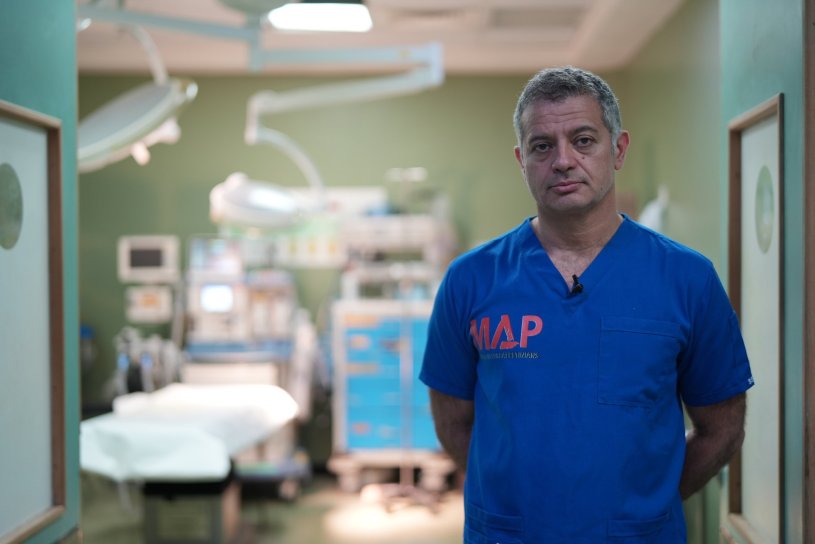
Featured photograph: Dr Khaled Dawas on his humanitarian medical deployment, published by EUobserver, May 27, 2024. Photograph: Palm Media for the International Rescue Committee. It is a portrait of the surgeon, not an image of Fatima or the other patients. Reuse rights have not been independently verified.
Editorial note: Most patient stories concern Dawas’s April 2024 deployment to Al-Aqsa Hospital. The former detainees were described in a separate May 2024 recorded interview; Dawas examined their injuries but did not personally witness their detention. Accounts of attacks or weapons attributed to patients are identified as such. Fatima’s death, the survival of the ten-year-old boy, and Anas’s initial recovery are reported only as far as the sources establish.

