
His son had been killed outside the hospital. Inside, babies needed oxygen, wounded people needed surgery, and the remaining doctors were running out of everything.
Dr Hussam Abu Safiya, the Palestinian paediatrician directing Kamal Adwan Hospital in northern Gaza, buried his son Ibrahim close to the hospital wall. Then he returned to his patients.
He later told journalist Ruwaida Amer that he had seen Ibrahim die near the hospital’s entrance. Abu Safiya believed the Israeli military killed his son to punish him for refusing to evacuate. The Israeli military disputed that interpretation, alleging the young man was engaged in militant activity. Those allegations and the question of intent have not been independently resolved. The November 5, 2024, +972 Magazine interview records both accounts.
A few weeks later, Abu Safiya himself was wounded. His colleagues continued working while bombardments damaged the hospital’s oxygen system, water supply and intensive-care unit. He sent increasingly desperate voice notes and messages about injured children, trapped families and the impossibility of treating patients without surgical specialists.
On December 27, 2024, the doctor was photographed in a white coat walking alone toward Israeli armored vehicles across a devastated street. He was taken into Israeli custody that day.
Nearly two years later, he still had not been charged or tried. An October 21, 2026 statement by CIVICUS and Physicians for Human Rights–Israel called for his release. On November 5, the British government confirmed it had raised his case with Israeli officials.
What makes Abu Safiya different from visiting foreign surgeons is not that his testimony matters more. It is that he lived inside the hospital’s collapse. He was the doctor, the hospital director, the bereaved father, a wounded patient and finally a prisoner.
The ten episodes below follow his own dated messages, contemporary interviews and outside reporting. They are a chronology of what happened to a hospital and the people who depended on it, rather than ten invented patient biographies.
1. October 25: An oxygen failure, two dead infants, and a hospital raid
During the Israeli raid of October 25, 2024, shells damaged the hospital and the medical oxygen generator. According to the contemporaneous +972 report, two infants in intensive care died after oxygen supplies were interrupted.
The same raid damaged a dialysis unit and recently delivered medical supplies. Staff members were detained, depriving the hospital of professionals needed to operate its wards.
Those deaths were reported by hospital staff and the journalist who interviewed Abu Safiya. The public article does not provide full independent medical records for either infant.
2. October 26: His son Ibrahim was killed at the entrance
Ibrahim, one of Abu Safiya’s sons, was killed during the Israeli military operation around the hospital. His father led funeral prayers in the courtyard and buried him near the building.
Reports have given differing ages for Ibrahim, so this article does not assign him a precise age. His death and the funeral were documented contemporaneously, including by +972 Magazine and later by ABC News.
Abu Safiya accused the military of deliberately targeting the boy because he would not leave. In a response to +972, the Israeli military asserted that Ibrahim had been involved in activity against Israeli forces. The publicly cited material does not establish the underlying facts necessary to determine whether either claim about motive or conduct is correct.
A doctor buried his son beside the hospital where he had committed himself to remaining. That is not an inference. It is the event at the heart of his story.
3. October 28: Two paediatricians remained to treat severely wounded adults
After the raid and arrests, Abu Safiya reported that only he and one other doctor were left. Both specialised in children’s medicine. Yet more than a hundred patients needed care, including people who required surgery.
In a set of messages later published by the Free Dr Hussam Abu Safiya campaign, he explained that there were no functioning ambulances available to collect the injured from northern Gaza, and no specialist surgical team to operate.
He feared that wounded patients would die while waiting for treatment the remaining staff were not equipped to provide. This was not a paediatrician deciding to become a trauma surgeon. It was a hospital where the trauma surgeons had been taken away.
4. November 3: A thirteen-year-old girl was wounded in the children’s ward
Abu Safiya told +972 Magazine that the hospital continued to come under fire after the late-October raid. During a November 3 World Health Organization visit, artillery fire struck the paediatric ward, wounding a thirteen-year-old girl and others, according to the reporting available at the time.
The hospital was simultaneously trying to receive medical supplies and evacuate patients with assistance from visiting international teams.
The precise trajectory of the projectile and the intent behind that strike were not established by the doctor’s interview. The reported injury of a girl inside the children’s ward is the clinical and humanitarian fact being documented.
5. November 9–11: People called from beneath rubble. The hospital had no ambulances
The director described telephone calls from people trapped in bombed homes. He could hear appeals for help but had no ambulance capable of reaching them.
In a November 11 message, he said some callers could no longer be reached the next day. The fear was that they had died in the ruins before rescue arrived. He also reported that patients and medical workers had too little food even to receive regular meals.
These are distress calls relayed by Abu Safiya, not individual deaths independently verified in this article. His inability to send help, however, is documented in his own messages.
6. November 20: Seventeen malnourished children came to the emergency room
On November 20, he reported that seventeen children had arrived at Kamal Adwan’s emergency department showing signs of malnutrition. The previous day, according to his message, an elderly man had died from severe dehydration.
He asked for nutritional supplies including infant formula, therapeutic milk and food, as well as access for ambulances and surgical teams. A lack of food was no longer merely a condition outside the hospital; it had become part of the hospital’s caseload.
He also described an appeal from the al-Kahlout family, whose home had been struck. Abu Safiya said he could not dispatch rescuers to reach those still trapped. He did not publish a complete independently confirmed list of the family’s victims.
7. November 22: The hospital entrance was struck, its oxygen system damaged
At 9:49 in the morning on November 22, Abu Safiya reported explosions at the emergency reception entrance and injuries among medical staff. He said the hospital courtyard, where its electricity generators stood, had also been struck; the oxygen infrastructure was damaged.
His contemporaneous tally was precise: 85 injured patients, with eight in intensive care, fourteen in the paediatric ward and four newborns in neonatal intensive care.
Later the same day, he reported another attack on the entrance and injuries to additional staff. Two days of receiving casualties were now complicated by the loss of the very systems needed to keep them alive.
The figures come from the doctor’s dated messages, reproduced by the campaign preserving his communiqués. They are a hospital census from that moment, not a casualty total for all northern Gaza.
8. November 23: The doctor himself was wounded by shrapnel
On November 23, Abu Safiya was struck by fragments during an attack at the hospital. MedGlobal and other contemporary accounts reported shrapnel wounds to his thigh and substantial bleeding.
He received treatment, then insisted he would return to caring for patients as soon as he could. He was not claiming immunity from the violence outside his operating rooms. His own body had become part of the hospital’s emergency workload.
His family also reported further injuries within the household around this period. Reporting on the incident, including Al Jazeera’s December profile, records that he refused to leave afterward.
9. December 18: Staff fought a fire in the ICU with blankets and their hands
The hospital’s water supply had been interrupted for days. Abu Safiya said the team had exhausted its fire extinguishers. When fire broke out after attacks on and around Kamal Adwan, staff had to improvise.
He described intensive-care patients on ventilators being evacuated as the western ICU burned. Personnel tried to extinguish flames with blankets and their hands. The isolation area was also badly damaged.
The extraordinary detail was independently reported through Mada Masr’s December 18 interview and the contemporaneous WAFA report. The director said the hospital had been trying for weeks to obtain international protection and assistance.
On that date he reported seventy-one patients in serious condition at the facility. That is not the number who died in the fire; no such death toll is established by the two sources cited here.
10. December 22–27: The babies could not be moved safely. Then the doctor was taken
On December 22, Israeli authorities again ordered the hospital evacuated. In a text message to Reuters, Abu Safiya said there were almost four hundred civilians inside, including premature babies who depended on incubators and oxygen. He said staff lacked the ambulances, equipment and time necessary to evacuate them safely.
Israel told Reuters it had facilitated earlier patient transfers and supplied fuel and food; the hospital director said the proposed evacuation was still dangerous and could not be completed safely.
Five days later, on December 27, Israeli troops entered the hospital. Abu Safiya was filmed walking through the rubble toward Israeli armored vehicles. He was taken into custody. The Al Jazeera Fault Lines investigation and subsequent interviews with staff reconstructed the final hours of the hospital.
The identity and eventual fate of every patient inside on December 27 are not completely documented by these sources. The director’s detention, however, is not in dispute.
Why he is still imprisoned
The Israeli military says Abu Safiya was suspected of Hamas involvement and maintains that militants used Kamal Adwan Hospital for military purposes. A February 2026 report in The Times of Israel described a resurfaced 2016 photograph showing him in the uniform of Hamas’s Military Medical Services and reported that he had been referred to as a colonel. That service is distinct from Hamas’s armed wing, though the report also alleged connections between the organisations. His family and lawyers dispute that he engaged in terrorist activity.
Those allegations deserve examination; they do not replace due process or eliminate the protections afforded to sick and wounded people and medical facilities under international humanitarian law. As of the latest reporting reviewed for this article, Abu Safiya has not been criminally charged or brought to trial.
On June 16, 2026, Israel’s Supreme Court upheld another detention order. In July the UN Human Rights Office called for urgent medical care and either his release or prompt charges and a fair trial. His lawyer reported injuries, serious weakness and mistreatment; the Israel Prison Service rejected abuse allegations. An Amnesty International statement described the risk to his life.
On October 21, 2026, CIVICUS and Physicians for Human Rights–Israel again demanded his release. On November 5, the British foreign ministry confirmed diplomatic representations on his case. There has been no verified release in the sources reviewed through November 10, 2026.
The final image
Most of the doctors in this series eventually left Gaza and gave interviews about what they had seen. Abu Safiya stayed. His contemporaneous messages describe a hospital reduced one piece at a time: surgeons removed, ambulances destroyed, oxygen interrupted, children malnourished, intensive-care beds on fire.
He did not see the work of paediatrics as separate from his duty to protect the people in his hospital. He kept a medical service open under circumstances that foreign doctors later described as almost unimaginable.
And when the tanks finally arrived, the last image of him at Kamal Adwan was not a press conference or an operating room.
It was one doctor in a white coat, walking toward armoured vehicles.
Behind him stood the hospital where he had buried his son.
Sources: direct testimony and independent reporting
- +972 Magazine, November 5, 2024 — Ruwaida Amer’s contemporaneous interview with Dr Hussam Abu Safiya, including the death of Ibrahim and the Israeli military’s response
- Free Dr Hussam Abu Safiya campaign — dated October–December 2024 voice notes and messages preserved with the recipients’ permission
- Mada Masr, December 18, 2024 — direct interview on the fire in the ICU and the hospital’s surviving patients
- WAFA, December 18, 2024 — filmed hospital director’s statements about extinguishing the ICU fire without water and fire extinguishers
- Reuters, December 22, 2024 — Abu Safiya’s messages about incubator-dependent babies and the Israeli order to evacuate
- Al Jazeera, December 27, 2025 — interviews with family and fellow doctors about the hospital’s final days and detention
- Al Jazeera Fault Lines, September 18, 2025 — documentary investigation of the final Kamal Adwan raid and the doctor’s detention
- ABC News, June 20, 2026 — interviews with Abu Safiya’s family, the IDF and medical-rights advocates
- The Times of Israel, February 1, 2026 — reporting on the military-medical-services photograph and Hamas affiliation allegation
- UN Human Rights Office, July 8, 2026 — detention, due process and urgent medical care
- Amnesty International, June 30, 2026 — appeal and details of the Israeli Supreme Court decision
- CIVICUS / Physicians for Human Rights–Israel, October 21, 2026 — current detention status
- UK Parliament, answer dated November 5, 2026 — latest diplomatic representations concerning Abu Safiya
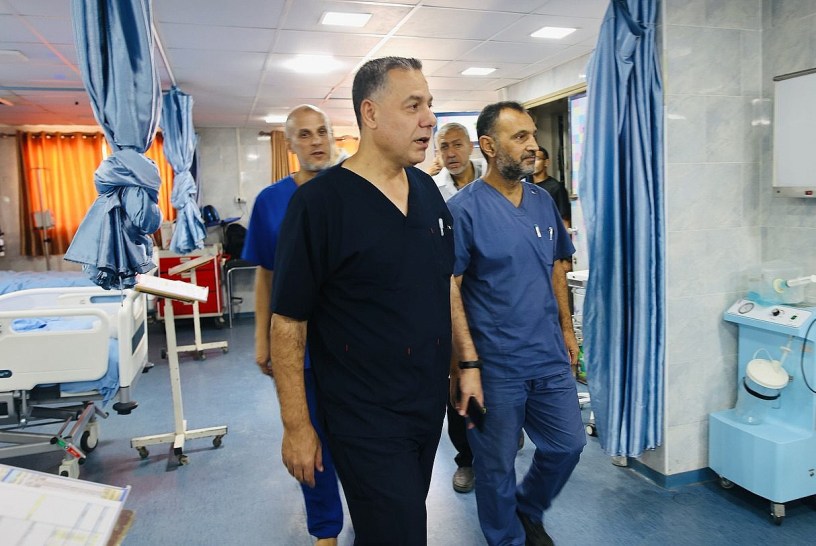
Featured image: Dr Hussam Abu Safiya with medical colleagues at Kamal Adwan Hospital in 2024. Published by +972 Magazine on November 5, 2024 and credited there as “Courtesy.” The image is of the medical team at work, not the December 27 detention. Image reuse permission has not been independently verified.
Editorial note: The ten sections follow dated messages and reported incidents, not ten uniquely identified patients. They distinguish the doctor’s clinical observations, contemporaneous reports, and allegations about perpetrators or intentions. The age of Ibrahim varies between published accounts and is not specified here. As of November 10, 2026, no verified public report of Abu Safiya’s release was found.

