
A father carried his three daughters into the emergency department of Nasser Hospital in Gaza after their home was bombed during the night. He pleaded with the doctors to do something. It had only been a few minutes, he said. Surely they could still help.
Dr Thaer Ahmad knelt on the floor beside the girls. He put his stethoscope against them and listened, even though he could already see that they were dead.
Their father stood over him. Ahmad could not bring himself to look up. A Palestinian colleague finally told the man what the doctor had found: none of his three daughters had a heartbeat.
The American emergency physician recounted the incident in an August 2025 interview with WBEZ and the Chicago Sun-Times. He did not name the daughters or give their ages. The girls’ deaths are his firsthand testimony; no individual hospital records were published with the interview.
Ahmad is a Palestinian-American doctor from the Chicago area who has worked in humanitarian medicine for many years. In January 2024, he entered Gaza as part of a World Health Organization emergency medical mission involving MedGlobal and worked in the resuscitation area at Nasser Hospital in Khan Younis. His childhood and family connection to Palestine informed his reasons for going; his work in the hospital gave those reasons a new and terrible specificity.
He has since spoken before journalists, lawmakers and international bodies. But his most revealing accounts concern the moments in which a physician knew exactly what medicine should do and was unable to do it.
These ten episodes are drawn from Ahmad’s first-person accounts, recorded interviews and independently reported cases he encountered. Some patients he treated himself. Others he learned about from Palestinian colleagues; the difference is kept visible throughout.
1. He listened for the heartbeats of three daughters who had already died
The father had brought all three girls to Nasser after their house was hit. He insisted there had been almost no delay. The doctors had to try.
Ahmad laid out his stethoscope and checked each child. He said in the WBEZ interview that he knew no heartbeat would be found. He nevertheless continued searching while the father watched.
A Palestinian doctor had to explain that all three girls were dead. Ahmad recalled that he could not meet the father’s eyes.
The incident captures a particular kind of suffering. The father’s instinct was to bring his children to a hospital. The hospital could receive them. It could not give them back.
2. On his first day, a young man died on the floor in front of his family
In a lengthy recorded interview with Refugees International in May 2026, Ahmad described walking into the hospital’s resuscitation area shortly after arriving in January 2024.
Four or five wounded people were lying on the floor. He saw a young man who appeared close to death, knelt beside him and began working with a Palestinian physician named Dr Majdi. Ahmad had not even introduced himself.
The young man died. Only afterward did Ahmad realise that the patient’s mother, father and younger sister had been watching. Dr Majdi spoke to them in Arabic, using words of faith and consolation to tell them their son was gone.
The family gathered other relatives to help carry his body away for burial near the hospital compound. Another group of casualties was already on its way.
3. Twenty members of one family arrived after their house was bombed
In a May 2026 first-person interview with Borderless Magazine, Ahmad described a family of twenty brought to Nasser after an attack on their home.
Six people were already dead. Three more were at immediate risk of dying unless doctors intervened. The resuscitation team had enough resources to concentrate on only one of those three critically wounded people.
He did not describe a neat calculation of whose life was more valuable. He described scarcity turning one emergency into a series of impossible decisions. The public account does not establish which patient was chosen or the ultimate outcome of each of the three.
Ahmad said Palestinian clinicians were facing variations of this dilemma constantly, not just during one exceptional mass-casualty event.
4. Twelve-year-old Dunia wanted to become a doctor. A shell killed her in hospital
In January 2024, a nurse named Shehab took Ahmad through the paediatric ward. The rooms were so crowded that they generally held four sick children and their caretakers. One space beside a window was empty. The wall there was damaged.
Shehab explained that the bed had belonged to Dunia Abu Mohsen, also spelled Dounia. The twelve-year-old had survived an earlier attack on her home that killed members of her family and cost her a leg. She wanted to travel abroad for a prosthesis. She wanted to grow up and become a doctor.
On December 17, 2023, before Ahmad arrived in Gaza, a tank shell struck the paediatric area of Nasser Hospital and killed her. ABC News reported her death the next day; her story was also documented in a video interview by Defence for Children International–Palestine.
Ahmad did not personally treat Dunia and did not witness the strike that killed her. He saw the damaged space where she had been, listened to the nurse’s account and later wrote about her in the Chicago Sun-Times. The child’s story is independently documented and is one of the reasons he was determined to keep speaking.
The boy or girl who dreams of becoming a doctor is a familiar human possibility. Dunia had already decided that the people treating her were the kind of people she wanted to be.
5. Eight premature babies could become an emergency because formula ran out
In the same May 2026 Borderless interview, Ahmad described a hospital lurching from one preventable shortage to another.
At one point, the neonatal unit needed formula for eight premature babies. The missing supply became an urgent concern because those infants could not wait for the kind of delivery delays that governments and aid agencies ordinarily discuss in meetings.
When the team found a little formula, another crisis immediately demanded attention. The power generators were running low on fuel.
This was not a matter of running a hospital efficiently. It was a matter of discovering, several times a day, a new way that patients might die unless somebody found a small quantity of something essential.
6. The hospital had roughly twenty-four hours of generator fuel left
Ahmad told Refugees International about the day Nasser’s administration warned that the generators could run out of fuel within twenty-four hours.
The implications were immediate. Patients on ventilators depend on electrically powered machines to breathe. Intensive-care units, incubators, radiology equipment and surgical anaesthesia all require reliable power. A blackout is not an inconvenience in such a building; it can become a medical catastrophe.
He recalled staff scrambling to obtain enough fuel to keep working for another few days, only to turn at once to new shortages, including antibiotics. Some patients could survive an explosion and surgery yet still die from an infection when there were not enough medicines to complete their treatment.
The warning was a firsthand account of how close the hospital came to losing power, not a claim that the electricity actually failed completely on that particular day.
7. A vial of sedative became an argument about what a child deserves
After returning to the United States, Ahmad showed journalists a small vial of sedative medication during a March 2024 United Nations press briefing. He explained that a similar amount could help a patient endure a painful procedure, such as setting a fracture or cleaning a burn.
The vial was small enough to hold between his fingers. In the hospital he had left, even these ordinary medicines were scarce.
He and his colleagues improvised splints with available household materials and made tourniquets from strings and wires. The February 2024 WBBM Newsradio interview documented how much he depended on the ingenuity of Palestinian doctors and nurses.
He did not claim that every painful procedure was carried out without anaesthesia. The specific point was that doctors could no longer count on having standard medicines when they needed them.
8. An anaesthetist asked him to take his two sons if the foreigners escaped
As the fighting approached Nasser in January 2024, Ahmad described hearing nearby shelling and seeing tanks through hospital windows. Smoke entered the building. He and colleagues placed mattresses against windows out of fear that fragments would come through.
One night, a Palestinian anaesthetist knocked on Ahmad’s door. The man believed foreign doctors might be warned or evacuated before local staff. He asked Ahmad to take his two boys with him if he got the chance to leave.
The father did not know where the children would go or who would care for them. He knew only that he feared what would happen if they remained in the hospital.
Ahmad described this encounter in the Refugees International interview. It was a plea he heard directly, not an account reconstructed from footage.
9. He left a hospital whose Palestinian staff could not simply leave with him
The foreign medical team eventually departed as the pressure on the hospital intensified. Ahmad remembered looking back at colleagues and patients who could not travel out of the hospital, much less out of Gaza.
In his March 2024 first-person essay, he recalled Dr Nahed, the surgical director, coming to reassure him while explosions shook the building. Nahed wanted Ahmad to get home safely. The Palestinian medical staff, however, had no equivalent route to safety.
In his later Refugees International interview Ahmad described his departure as a defeat. He had been able to provide emergency care but could not protect the system and colleagues who had made that care possible.
A distinction of dates matters here. Ahmad’s mission ended in January 2024. The major Israeli military raid on Nasser Hospital occurred in mid-February 2024, after he had left. His firsthand observations concern the preceding bombardment and encirclement; the subsequent raid is documented separately by Médecins Sans Frontières.
10. He carried an eight-year-old orphan’s letter to the American president
On April 2, 2024, after returning to Chicago, Ahmad attended a White House meeting with President Joe Biden and other American Muslim community representatives.
He brought a letter from Hadeel, an eight-year-old girl orphaned by the war and sheltering in Rafah. She feared another military assault and asked the president to help stop it. Ahmad handed Biden the letter and a photograph.
He then walked out of the meeting, explaining that he could not remain and treat the administration’s support for Israel’s campaign as an ordinary policy disagreement. Democracy Now! interviewed Ahmad on April 4; ABC News and other outlets corroborated the meeting and the letter.
Hadeel was not a child Ahmad said he had treated at Nasser. Her testimony reached him through the people caring for displaced children, and he used his access to the White House to deliver it.
The scene completes a journey from a hospital floor in Khan Younis to a meeting room in Washington. Inside the hospital, he could not bring himself to look at the father of three dead girls. Outside Gaza, he insisted that the people who could change the policy had to look.
What this doctor could do — and what he could not
Ahmad’s accounts do not establish the identity of the attacker in every individual case. His descriptions of gunshot, blast and shrapnel wounds are clinical testimony; his assessments of Israel’s military conduct and government policy are arguments he has made as a witness and advocate. Israel says its operations target Hamas and that controls on access and supplies are imposed for security reasons. The legality of particular attacks and restrictions requires examination of evidence specific to them.
That care with evidence matters. It does not require pretending that the dead children, the overcrowded floor, the empty formula containers or the father at the emergency-room door are abstractions.
There is another truth running through these accounts. Again and again, Ahmad directs admiration away from visiting foreigners and toward the Palestinian staff who remained when the visiting doctors departed. It was a Palestinian physician who steadied him when his first patient died. Palestinian clinicians improvised when supplies failed. An anaesthetist worried about his sons. A surgical director reassured the visitor that he would get home.
The last of these fifteen medical testimonies should not end by treating the international doctor as the story’s hero. It should end where the doctor himself tells us to look: at the patients and at the Palestinian professionals who kept working.
And at the father who carried three daughters into a hospital because that is what fathers do when their children are hurt.
A doctor knelt with a stethoscope. He listened for three heartbeats.
There were none.
Sources: first-person medical accounts and independent reporting
- WBEZ / Chicago Sun-Times, August 26, 2025 — Ahmad’s firsthand account of the father carrying his three daughters into Nasser Hospital
- Refugees International, May 2026 — complete recorded interview and transcript: first day at Nasser, Dr Majdi, the anaesthetist’s sons, generator fuel and the approach of the siege
- Borderless Magazine, May 15, 2026 — extensive first-person interview about the family of twenty, the neonatal formula shortage and emergency triage
- Thaer Ahmad, Chicago Sun-Times, March 19, 2024 — the empty paediatric bed, nurse Shehab and Dunia Abu Mohsen
- ABC News, December 18, 2023 — independently reported death of twelve-year-old Dunia Abu Mohsen in a strike on the paediatric ward of Nasser Hospital
- WBBM Newsradio, February 7, 2024 — Ahmad’s account of improvised splints, tourniquets and the skill of Palestinian clinicians
- RTÉ / Reuters, March 19, 2024 — Ahmad showing journalists scarce medical supplies, including sedative medication
- Thaer Ahmad, first-person essay, March 7, 2024 — his departure from Nasser Hospital and Dr Nahed’s reassurance
- Médecins Sans Frontières, April 3, 2024 — detailed chronology of Nasser Hospital’s siege and February raid, which took place after Ahmad’s mission
- Democracy Now!, April 4, 2024 — Ahmad explains the White House meeting and eight-year-old Hadeel’s letter
- ABC News, April 2024 — independent reporting on the White House meeting and Hadeel’s letter
- Dr Thaer Ahmad — official professional biography and humanitarian medical history
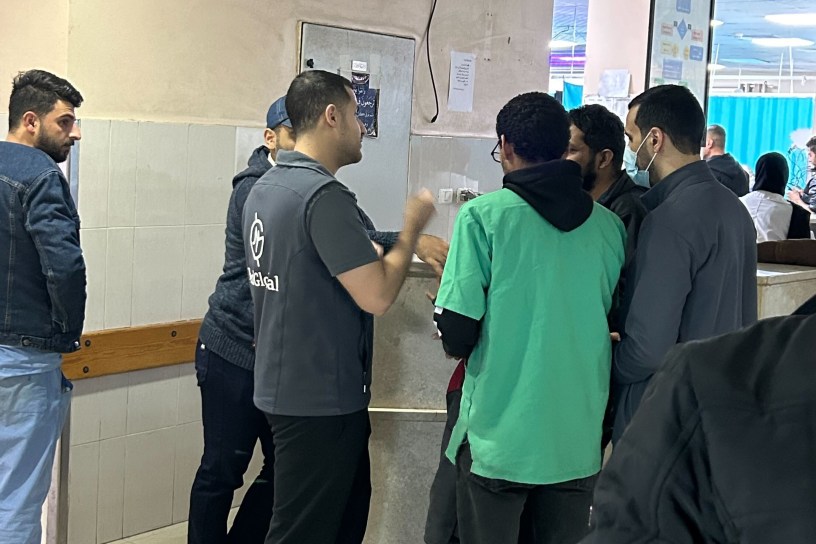
Featured photograph: Dr Thaer Ahmad working alongside medical colleagues at Nasser Hospital in Khan Younis, 2024. Image supplied to WBEZ / Chicago Sun-Times; original page credits the photograph as “Provided.” This photograph does not show the three girls or their father. Permission to reproduce the image has not been independently established.
Editorial note: The deaths of the three girls and the first-day patient were witnessed and described by Ahmad. He learned about Dunia Abu Mohsen after her December 2023 death from nurse Shehab; that incident predates his January 2024 mission. Other hospital accounts are attributed to his direct experience, while medical evacuation and political testimony are separately identified. His departure preceded the February 2024 raid on Nasser Hospital.

