
Two little brothers were brought into a Gaza operating room after an explosion. One needed an emergency leg amputation. The other had lost skin over half his body. The surgeons believed both could be saved.
Then the blood ran out.
The Palestinian anaesthesiologist called the blood bank and begged for more. There was none. One boy died on the operating table. His brother died the next day.
This was not a rumour relayed to a visiting doctor. Dr Samer Attar, an American orthopaedic surgeon, was working with the team. He recounted the brothers’ deaths in a CBS 60 Minutes interview broadcast April 6, 2025. The shortage of blood, in his judgment, turned potentially survivable injuries into two deaths.
The Palestinian anaesthesiologist collapsed crying. He said too many children had died for want of the simple transfusions they needed.
Attar teaches orthopaedic surgery at Northwestern University in Chicago. His family comes from Syria; he has treated casualties in Syria and Ukraine as well as Gaza. By April 2025 he had completed five missions to Gaza, with a sixth mission underway later that month. He worked alongside Palestinian clinicians, not instead of them.
Across recorded interviews with 60 Minutes, CNN, and the BBC, Attar described the following ten incidents and experiences. Some occurred in northern Gaza in spring 2024; others were witnessed on his 2025 return. The distinction matters, as do the individual people behind the accounts.
1. Two little brothers died for lack of blood
During a severe mass-casualty emergency in June 2024, one boy had an injury so serious that the surgeons amputated through his hip. His brother was being treated in the next operating room, with extensive burns and skin loss.
Attar said the surgical teams could not obtain enough transfusion blood. One child died during his operation; the other died the following day. The doctors thought the boys could have survived with adequate supplies.
In his October 29, 2024, CNN interview with Christiane Amanpour, Attar described the emergency as part of three days in which the teams performed approximately sixty surgeries. Many Palestinian staff slept on the operating-room floor.
The cause of the brothers’ injuries was an explosion. The reason Attar gave for their deaths was a shortage of blood. They are separate, equally terrible facts.
2. Karem was dead. His mother kept showing the doctor videos of him alive.
In Attar’s 60 Minutes account, a boy named Karem was in intensive care with severe malnutrition. His family had lacked sufficient food and water. Karem’s mother asked Attar to come and meet her son.
As he spoke with the mother, a nurse told him the boy had already been dead for more than an hour. His mother would not let the staff take the body away.
She showed Attar videos of the child before his illness: the way he played, smiled and interacted with other people. She wanted the doctor to understand who her son had been.
An earlier CNN report in April 2024 described a mother refusing to leave the body of her roughly ten-year-old child who had died of malnutrition and dehydration. The published reports do not establish whether that child was Karem, so they should not be counted as two separate patients.
3. Seven-year-old Jenna Ayyad was wasting away, while her mother showed him a birthday video.
During Attar’s spring 2024 mission to northern Gaza, he encountered Jenna Ayyad, a seven-year-old with cystic fibrosis. The chronic illness already made adequate nutrition and medical care essential. War, hunger, displacement and restricted access to treatment worsened her condition.
Her mother Nisma showed Attar footage from Jenna’s birthday before the crisis, contrasting a lively little girl with the pale, withdrawn child in the hospital bed.
As Attar’s convoy prepared to depart, the mother believed her daughter might be evacuated with the foreign medical team. But their permission to cross had not included carrying patients. The doctors completed transfer paperwork and tried to arrange a medical evacuation. The BBC’s April 28, 2024, account did not establish whether Jenna was ultimately evacuated.
The doctors had been allowed to leave. Jenna could not leave with them.
4. A double amputee begged for help as maggots emerged from his wounds.
Attar remembered a man in his fifties who had lost both legs, his children and grandchildren, and his home. The patient was alone in a dark room, with maggots infesting his wounds.
The man begged for treatment, saying that the worms were consuming him. Attar described the encounter in his BBC interview with Fergal Keane.
The scene later entered an entirely different forum: in May 2024, a barrister quoted the doctor’s testimony during South Africa’s proceedings before the International Court of Justice. It was an account originally given by Attar, not a judicial finding about the patient’s particular injuries.
Attar could leave the hospital and return to Chicago. The man remained there.
5. A thirty-two-year-old mother died from severe malnutrition.
In the same 2024 BBC account, Attar described resuscitating a woman in her early thirties suffering from serious malnutrition. Her child and both her parents were present.
The medical team attempted cardiopulmonary resuscitation but could not save her. Attar was the doctor who made the decision to stop.
He remembered her mother’s grief and the stillness of the woman’s body afterward. The scene was different from a blast injury, but no less devastating: a hospital facing the effects of deprivation alongside the injuries from weapons.
6. A little girl beat her fists against the floor, refusing to believe her mother was dead.
In his April 2025 60 Minutes interview, Attar described a little girl overwhelmed by the death of her mother. The child pounded her fists on the emergency-room floor.
Staff eventually had to move her because more wounded people were arriving and there was no space. Attar did not give the girl’s name or specify the eventual outcome of her injuries, if any.
Imagine being small enough to think that refusing the news might somehow make it untrue. Then imagine the adults around you having to move you because someone else is dying where you are sitting.
7. A thirteen-year-old had lost his parents. Surgeons amputated his leg.
On CNN in October 2024, Attar recalled a teenager treated immediately after the three-day surgical emergency in June. He was about thirteen, had lost both parents in an explosion and suffered devastating wounds, including an injury that required leg amputation.
The boy’s face had been burned. Shrapnel had entered his body. Attar remembered the smell of burned tissue as the surgical team operated.
The available interview did not establish his eventual recovery. It did establish what the surgeons had been asked to do after three sleepless days and dozens of operations.
8. A wounded paramedic’s heart restarted. Nobody knew whether he lived.
In footage shown on 60 Minutes, Attar worked to resuscitate a paramedic whose ambulance had been near an explosion that killed his partner.
The paramedic’s heart restarted. Attar still did not know the man’s ultimate fate when he was interviewed. In a hospital overrun by new arrivals, a clinician could succeed in the immediate emergency and then lose contact with the patient entirely.
It is one of the cruel limitations of Attar’s testimony: he remembers the faces of the wounded but cannot always tell us how their stories ended.
9. At Al-Ahli Hospital in April 2025, an eight-year-old died with his brothers beside him.
In a live CNN interview on April 15, 2025, Attar described an earlier mass-casualty incident at Al-Ahli Arab Hospital in Gaza City. Among the injured was a boy of approximately eight whose abdomen was open after an explosion.
The hospital was overwhelmed. Attar said staff could not offer the boy a lifesaving operation because other incoming casualties had to be triaged and there was not enough capacity to treat everyone. They asked his two brothers to stay beside him and hold his hands while he died.
The child was not presented as a victim of the subsequent strike on the hospital itself. The story concerns an earlier emergency that Attar recalled while explaining the loss of Al-Ahli’s trauma services.
A boy arrived needing surgery. His brothers were asked to do what the hospital no longer could: stay with him.
10. The hospital was struck. Patients were pushed through rubble on their beds.
On April 13, 2025, an Israeli strike damaged Al-Ahli Hospital’s emergency department and other facilities. The Israeli military said it had targeted a Hamas command facility. Hospital staff described an emergency evacuation.
Attar was inside. A nurse woke him and told him to run. He stayed with several dozen patients who could not easily move. In his interview two days later, he described families pushing the wounded through dark, rubble-strewn streets on wheeled beds, sometimes for half an hour or longer, to find another hospital.
He said one oxygen-dependent child died during evacuation after losing oxygen support. That detail is his firsthand recollection of information from the evacuation, not an independently reconstructed clinical record.
The hospital had been treating people with open fractures, exposed bone and complicated wounds requiring repeated operations. When the emergency facilities were damaged, the capacity to care for the next wave of casualties contracted again.
The equipment failed. The doctors kept working.
Also in his April 2025 CNN interview, Attar described operating while surgical gowns, gloves, medications and anaesthetic supplies were rationed. Some orthopaedic procedures were being performed with gloves but without full surgical clothing and drapes. Drill bits were dull, equipment failed, and operations that should have taken twenty or thirty minutes could stretch toward two hours.
The medical teams were not less skilled than doctors elsewhere. They were working with fewer instruments, fewer blood products, fewer opportunities to maintain sterile conditions, and more critically wounded people arriving than they could reasonably treat.
Attar also spoke of Palestinian colleagues whose grief sometimes broke through during surgery, and of colleagues he could no longer contact. His temporary missions took him in and out of the Strip. The Palestinian medical workers remained.
What this testimony tells us — and what it cannot prove
Attar’s interviews are evidence of what he says he personally saw, operated on and was told by staff and patients. Some particular medical cases have been independently recorded by major news organisations through interviews or video. They are not, by themselves, a full forensic reconstruction of the attacks or a finding of legal responsibility for each patient’s injuries.
Israel has said that military operations target Hamas and that it facilitates humanitarian aid, and it has blamed distribution problems on other parties. United Nations agencies and humanitarian organisations have reported devastating shortages, attacks affecting healthcare and grave risks to civilians. Those disputes should be investigated, not resolved by careless assertion.
But none of them makes the brothers on the operating tables disappear.
There was a doctor. There were two little boys. There was an operation that might have saved them.
And there was no more blood to give.
Sources and recorded testimony
- CBS 60 Minutes, April 6, 2025 — Samer Attar on the two brothers, Karem, emergency care and the wounded paramedic
- CNN Amanpour, October 29, 2024 — Attar on June 2024 surgery, the brothers, the thirteen-year-old and Palestinian healthcare workers
- BBC News, April 28, 2024 — “The US doctor who cannot forget what he saw in Gaza” by Fergal Keane
- CNN Newsroom, April 10, 2024 — Kamal Adwan Hospital and the deaths from dehydration and malnutrition
- CNN Connect the World, April 15, 2025 — Attar inside Al-Ahli following the strike, the dying eight-year-old and surgical supply failures
- CBS News, April 6, 2025 — Attar’s humanitarian missions in Gaza, Syria and Ukraine
- The New York Times Opinion, May 21, 2024 — “Two Weeks Inside Gaza’s Ruined Hospitals,” Attar’s filmed report
- South Africa’s submission to the International Court of Justice, May 16, 2024 — citation of Attar’s testimony about the double amputee
- Northwestern University Feinberg School of Medicine — professional biography of Dr Samer Attar
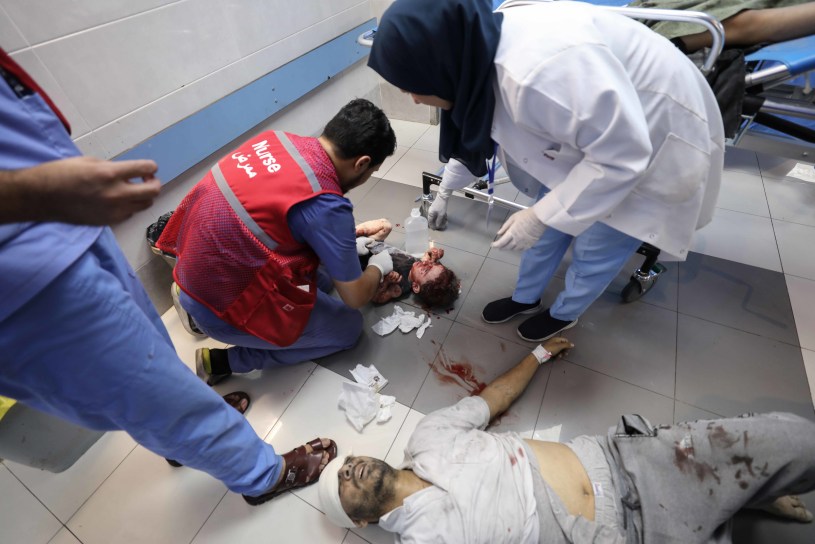
Featured photograph: Wounded Palestinians receiving treatment on the floor at Al-Shifa Hospital in Gaza City, October 11, 2023. WAFA / APAimages, CC BY-SA 3.0; original photograph. The photo predates Dr Attar’s missions and does not depict the two brothers or any specific patient in this account. The image is used unaltered.
Editorial note: These are accounts from different visits in 2024 and 2025. Medical outcomes are attributed to Attar’s firsthand testimony where no separate case records are public. Patients who could not be independently matched across interviews are not artificially counted as different people. Cause and intent in individual attacks require investigation beyond the operating room.


