
One day. Six children. An eighteen-month-old baby with burns. A three-year-old with burns across more than a third of his body. A five-year-old whose arm had been torn apart. Her sister with injuries to her cheek and shoulder. A seven-year-old whose knee was gone. A thirteen-year-old whose ankle was gone.
This was not a statistic assembled from months of violence. It was one operating list in May 2025 at Nasser Hospital in Khan Younis, Gaza.
The woman remembering it was Dr Victoria Rose, a British consultant plastic and reconstructive surgeon who had spent years helping Palestinian surgeons build a specialist reconstruction service. She had returned to Gaza on medical missions in March and August 2024, and again in May 2025.
In testimony to the Gaza Tribunal in London in September 2025, later broadcast by Democracy Now! on August 12, 2026, she recited the ages and injuries of the six children she operated on that day. It is a sequence worth preserving in full, without inventing names, deaths or endings her testimony did not establish.
1. The first patient was eighteen months old
The operation began with a child just eighteen months old who had burns covering fifteen percent of the body. Rose told the tribunal that this was not even the youngest child she had treated in Gaza.
For an adult, that extent of burning is serious. For an infant, it threatens fluid balance, body temperature and the protective barrier of the skin, with infection an ever-present danger. At Nasser, the team had to manage burns while medicines and supplies were running low.
The child’s name and eventual outcome were not disclosed in the testimony.
2. The next was a three-year-old boy burned across thirty-five percent of his body
Thirty-five percent of a three-year-old’s body. That was Rose’s second case of the day.
She explained that in Britain an injury of that severity would be managed in one of only a small number of specialist paediatric burns units; she assessed that the boy might have had only about a fifty-fifty chance of survival even there. That was her clinical estimate, not a reported outcome for this particular child.
In Gaza, he was treated in a hospital also receiving a constant flow of blast injuries, with antibiotics and pain relief becoming scarce.
3. A five-year-old girl arrived with an arm almost destroyed
The third patient was a girl of five. Rose told the tribunal that the child’s arm had been blown off. She was on the operating list for an amputation.
The team saved part of it. Rose said they were able to preserve approximately half the girl’s hand and most of her forearm and shoulder. This was not an easy reversal of the injury: it was a fragile attempt to give a child some function and possibility of reconstruction instead of removing everything.
Rose’s testimony does not establish how much function the girl ultimately regained. It establishes that the surgeons resisted what initially appeared to be an unavoidable amputation.
4. Her sister had lost tissue from her left cheek and shoulder
The next patient was the little girl’s sister, injured in the same family catastrophe. Rose said part of her left cheek and shoulder had been blown away. Rose operated on the sister while colleagues worked on their mother in the operating theatre next door.
There is no reason to invent what that mother knew, said or felt. The documented reality is severe enough: two injured sisters undergoing operations, with their mother being operated on nearby.
The ages and subsequent outcomes of the sister and mother were not specified in that account.
5. A seven-year-old girl was missing her knee
The fifth patient in Rose’s tribunal account was a seven-year-old girl whose knee had been torn away.
In a separate June 2025 interview with Al Jazeera, Rose described treating a seven-year-old girl with a knee so badly damaged that she could see the rear of the leg where bone should have been. The team cleaned the wound, removed dead tissue and tried through repeated operations to save the leg. Ultimately, that child’s limb was amputated.
The age and injury suggest these may be accounts of the same case, but the published sources do not explicitly establish that identification. We should not collapse two accounts into one as a proven fact. Both demonstrate the scale of injury the surgical team was confronting.
6. The last was a thirteen-year-old boy whose left ankle had been blown off
The sixth patient that day was thirteen, with a devastating injury to his left ankle. His brother was undergoing an operation in an adjacent theatre.
The sequence Rose recalled therefore ended as it had unfolded throughout the day: not one isolated child, but whole families coming through the operating rooms.
Six cases. One day. Her actual operating schedule, not six anecdotes collected across an entire career.
7. Eleven-year-old Adam al-Najjar survived a strike that killed his siblings
During the May 2025 mission, Rose also treated Adam al-Najjar, the eleven-year-old surviving child of Dr Alaa al-Najjar. The doctor’s nine other children were killed in a strike on their home in Khan Younis. The children’s father, Dr Hamdi al-Najjar, was also severely injured and later died.
Rose described the boy’s injuries in her June 9 interview. Her surgical role was to treat the surviving child. The fuller circumstances of the strike were documented separately in reporting on the al-Najjar family.
A surgeon can preserve a limb or repair a wound. There is no operation that gives a boy his nine siblings back.
8. Eight-year-old Aziza was found alone in the streets
Rose also remembered an eight-year-old girl named Aziza who had been orphaned. She had burns on her face and shoulder. According to Rose, someone found her walking through the streets and brought her to the hospital.
She arrived without the ordinary protection of a parent who can say what happened, explain what hurts and remain beside a child through treatment.
Rose treated the injury. The account does not provide a verified long-term outcome, and it would be wrong to manufacture one.
9. Two brothers, Yakoob and Mohammed, came without the rest of their family
Rose recalled two brothers named Yakoob and Mohammed, both with severe lower-limb injuries. In her account, they were the only surviving members of their family.
Surgery might help reconstruct damaged legs. It could not reconstruct the family from which the boys had emerged.
In the same June interview, she spoke of the extraordinary number of otherwise healthy civilians admitted to hospital with parts of limbs missing. These were not routine conditions appearing in a surgical clinic; they were catastrophic injuries to people who, shortly before, had been living ordinary lives.
10. In August 2024, a seven-year-old had much of his nose destroyed
Rose’s earlier experience shows that these injuries were not confined to her May 2025 mission. In a September 2024 interview after working at Nasser Hospital, she described a seven-year-old boy who had lost much of his nose and suffered a large wound through his lip.
She also remembered a girl whose forehead had lost skin down to the underlying bone. Around four-fifths of the patients she treated during the August 2024 visit were under sixteen, according to that interview.
The patient cases described across the 2024 and 2025 missions are not all from the same day or hospital. Rose’s six-child operating list above specifically concerns a single day in May 2025 at Nasser.
Then came another kind of horror: children waking from operations without pain relief
The injuries themselves were one problem. Keeping children alive and comfortable afterward was another.
In an extended interview about her May 2025 mission, Rose said her team eventually ran out of analgesic medication. Children underwent necessary operations and were then brought into recovery, where the staff could hear them screaming because there was no adequate medicine to relieve their pain.
She also described shortages of antibiotics and intravenous fluids. In a May 2025 RTÉ interview, she explained that severely malnourished children were healing much more slowly, developing infections in wounds that would ordinarily have been treatable.
There is an important distinction between being anesthetised during surgery and receiving adequate pain relief afterward. Her recorded account concerns a severe lack of postoperative analgesia. It does not establish that every child in her care underwent surgery fully conscious.
The emergency room also filled with people wounded while seeking food
Rose was still at Nasser when victims of shootings near the new Gaza Humanitarian Foundation aid distribution system began arriving. She described patients with gunshot injuries to their arms, legs and abdomens, and seeing approximately thirty body bags after one such influx.
Her observations establish the injuries and deaths that reached the hospital. The exact shooter and circumstances of each wound require independent investigation. The Israeli military disputed reports that it deliberately shot aid seekers, while multiple medical and humanitarian witnesses raised concerns about deaths and injuries at the distribution points.
Why did she go back?
Rose had first joined the medical charity IDEALS in 2019. She helped train a Palestinian plastic surgeon, whom she calls Ahmed, at Guy’s and St Thomas’ in London. After returning to Gaza, he built a reconstructive service for patients with complicated injuries.
When the war overwhelmed his work, she went to help. In a first-person essay for British Vogue in April 2024, she described Palestinian medical students learning to assist with surgery and staff building a service under extraordinary pressure.
By May 2025, she was operating for fourteen hours at a stretch and treating twelve or thirteen patients on some days. She told ABC News that so many new casualties arrived that she could clean and stabilise wounds but could not always return to the patients to complete the reconstruction she had planned.
This is what her testimony asks us to understand: not simply the violence of an explosion, but the theft of everything that should follow it — anaesthesia, antibiotics, reconstructive surgery, rehabilitation, a family to take a recovering child home.
When she recited the patients from one ordinary day, Rose did not have to embellish anything.
An infant. A three-year-old. Two sisters. A girl without a knee. A boy without an ankle.
Six children on a single operating list. The seventh child was already waiting for another day.
Sources and firsthand testimony
- Democracy Now!, August 12, 2026: Dr Victoria Rose’s filmed Gaza Tribunal testimony — the six-child operating list from May 2025.
- Al Jazeera, June 9, 2025: Victoria Rose on the changing injuries in Gaza — Adam al-Najjar, Aziza, Yakoob and Mohammed, knee injuries, hunger and shootings at aid sites.
- Victoria Rose, British Vogue, April 24, 2024: Her first-person account of a Gaza medical mission — the earlier hospital work, Palestinian colleagues and surgical training.
- Victoria Rose, Al Jazeera interview of September 5, 2024, preserved by Bearing Witness — the seven-year-old with facial injuries and the proportion of children treated in August 2024.
- “Four Weeks of Carnage,” extended recorded interview transcript with Victoria Rose — postoperative pain relief and supply shortages.
- RTÉ News, May 21, 2025: Malnutrition and the difficulty of healing wounds
- ABC News, June 4, 2025: Victoria Rose operating at Nasser Hospital — firsthand footage and interview about the caseload.
- Victoria Rose, Sky News, June 19, 2025: First-person eyewitness essay — why she returned and the crisis in Gaza hospitals.
- New Internationalist, September 4, 2025: Extensive interview with Victoria Rose — the experience of medical personnel and patients after her third mission.
- Guy’s and St Thomas’ NHS Foundation Trust: Dr Victoria Rose’s professional profile
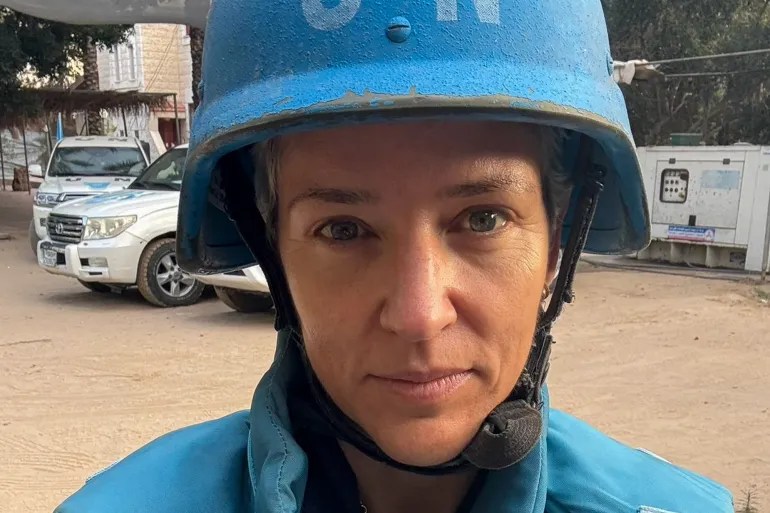
Featured image: Portrait of Dr Victoria Rose, supplied by Victoria Rose and reproduced alongside her June 9, 2025 Al Jazeera interview. The image does not show any of the patients described here.
Editorial note: The six opening cases are from one May 2025 operating list recounted in Rose’s 2025 tribunal testimony. Other patients were described in separate 2024 and 2025 interviews. Individual clinical observations and the surgeon’s estimates are attributed as such; where identities or subsequent outcomes are unconfirmed, the article does not invent them.

