
His sister was in the next bed. He kept asking where she was. He could not recognise her.
He was a young boy whose face and neck had been torn open in an attack on his family home. His sister had burns covering almost her entire body. Their parents and other siblings had been killed. The hospital staff knew who the girl was. Her little brother could see her, but no longer recognised her.
Dr Tanya Haj-Hassan, a paediatric intensive-care physician, was helping to treat them at Al-Aqsa Martyrs Hospital in Gaza in March 2024. The girl died. The boy survived his terrible physical wounds. Afterward, he confided to the doctor that he wished he had died with his family.
Haj-Hassan shared this account with Democracy Now!, with the Associated Press and later in testimony at the United Nations. At the UN, she identified him as Ahmed and described him as thirteen; the contemporaneous AP report described him as ten. His exact age differs between these accounts. What does not differ is the injury, the sister beside him, or her death.
Haj-Hassan had worked in the occupied Palestinian territories before the war. She returned to Gaza with Medical Aid for Palestinians in March 2024, and again in February–March 2025. She has also worked with Médecins Sans Frontières. Her accounts form an extraordinary record of children trying to survive the destruction of their families and hospitals.
These are ten experiences she described. They are not fictional reconstructions. Some are firsthand treatments; where she reports what colleagues or relatives told her, the distinction is made clear.
1. A boy asked for the sister dying in front of him
Ahmed’s severe neck injury left vital structures exposed. Haj-Hassan described the efforts of a young Palestinian plastic surgeon who used tissue from the boy’s chest to reconstruct and protect the wounded area. He survived.
Yet surgery could not tell him that the girl in the neighbouring bed had been his sister, or return their dead family. In her UN speech, the doctor recalled his wish to be reunited with those he loved. His sister’s extensive burns had proved fatal.
The wound that most concerned Haj-Hassan afterward was the one nobody could stitch.
2. A mother had given birth seven days earlier. Her newborn was under rubble.
In her November 2024 UN testimony, Haj-Hassan recalled an injured woman brought into the hospital almost unable to speak. She had given birth only a week earlier. Her seven-day-old infant and her toddler had been buried in the ruins of a building.
Haj-Hassan did not claim to know how the children ultimately fared. What she remembered was the mother’s silence and the unbearable uncertainty around her.
3. Six-year-old Siwar lay unconscious with a traumatic brain injury
Siwar was intubated in intensive care after an attack on her home. Her younger brother was missing. Her mother sat beside her, crying and asking why her daughter had been hurt.
Haj-Hassan feared that even if Siwar survived, the brain injury might prevent her from speaking or interacting as she had before. The doctor could explain the clinical prognosis. She could not explain why the family had been destroyed.
4. Five-year-old Mohammed died without an ICU bed
Haj-Hassan described Mohammed, a five-year-old with a penetrating head injury that she thought was probably caused by gunfire. He died in the emergency department. Intensive-care space was unavailable.
Nobody from his family was known to have survived or to be able to claim his body. The medical staff took him to the morgue. She remembered the smallness of his hands and feet.
5. Two toddler cousins were resuscitated on the same bed
After their residential building was bombed, toddlers Mohammed and Masa were brought into the emergency department. The medical team tried to save them both on one bed, searching desperately for blood vessels small enough to insert intravenous lines.
Mohammed died from bleeding. Masa survived the immediate emergency but had a devastating brain injury and remained in a coma when Haj-Hassan left Gaza. Both of her parents had also been injured; the doctor did not know whether they survived.
6. Shouq called for the mother lying beside her
Fifteen-year-old Shouq suffered serious injuries to her head and chest. Her eyes were badly burned. She kept calling for her mother, not knowing that her mother was right next to her, mortally wounded.
The medical team watched her mother die. Shouq could not see what they could see. Haj-Hassan later explained that the staff knew before the girl did that she was the sole surviving member of her family.
7. A one-year-old girl kept crying for her dead mother
During her return mission in March 2025, Haj-Hassan treated a little girl with newly pierced ears and two small front teeth. The child survived surgery and was taken off the breathing tube. Then she began to cry for her mother.
Her mother had been killed. In a video diary broadcast by ITV News, the doctor described comforting the child while knowing that no explanation could make sense to someone so young.
It was Mother’s Day in much of the Arab world.
8. A mother had lost two daughters. Her third could not move.
Another injured mother came to the hospital after an attack killed two of her little girls. Her remaining daughter was severely wounded and had not spoken or opened her eyes after being taken off the breathing tube. Her right side appeared paralysed.
The mother, herself limping with injuries, begged the doctors to tell her the truth about the child. Haj-Hassan recorded the encounter in the same March 2025 video diary. The report did not establish the girl’s eventual outcome.
9. A sixteen-year-old survived one strike, then was killed in hospital
After the ceasefire collapsed on March 18, 2025, Haj-Hassan was working at Nasser Hospital in Khan Younis. She described a sixteen-year-old patient whose twin had already been killed. The boy had survived the initial injuries and was recovering in the surgical department.
On March 23, an Israeli strike hit part of the hospital. The boy was among those killed, still with an intravenous cannula in his hand. In its response to ITV, the Israeli military defended operations against Hamas and alleged that Hamas used hospital infrastructure for military purposes. Those claims do not erase the obligation to protect patients and civilians under international humanitarian law.
10. An exhausted nurse fell asleep holding a baby he could not save
In her March 2024 interview with Democracy Now!, Haj-Hassan described a Palestinian nurse who had worked for twenty-four hours and tried to resuscitate an infant. Despite the team’s efforts, the child died.
Afterward, the nurse collapsed into exhausted sleep on a stretcher, holding the dead baby. Haj-Hassan said it was often impossible even to locate parents to tell them that their child had died.
She also told the story of a ten-year-old boy who had made himself useful around the hospital, learning tasks and helping the staff while his parents were missing or unreachable. This was how childhood was being rearranged around the emergency ward.
The horror does not end when the doctor leaves
At Al-Aqsa in March 2024, Haj-Hassan saw resuscitations being performed on the floor because the few emergency beds were already occupied. In her interview with Democracy Now!, she described choosing which children could receive limited doses of ketamine for painful procedures because the hospital did not have enough.
After leaving Gaza, she testified publicly, including before the United Nations in November 2024. She returned to work in Gaza in early 2025 and documented how briefly the ceasefire had allowed staff to imagine relief before another flood of casualties arrived.
Her testimony includes moral and political conclusions about Israel’s conduct. Those conclusions are hers; the cases above are presented as her observations and the reported experiences of her patients, not as a substitute for forensic investigations of individual attacks.
What stays with me is the simplest fact. A child was looking at his sister, asking for her, and could not recognise her. There is no political slogan that makes this less terrible.
His sister was right there.
Sources: firsthand testimony and independent reporting
- Democracy Now!, March 28, 2024: Tanya Haj-Hassan describes the wounded boy, his sister, hospital shortages and the nurse carrying a dead infant
- Associated Press, March 28, 2024: Reporting from the Al-Aqsa hospital medical mission and the children’s injuries
- United Nations Web TV, November 26, 2024: Haj-Hassan’s firsthand testimony, including the named children and their injuries
- United Nations: Written statement by Dr Tanya Haj-Hassan, November 2024 (PDF)
- ITV News, March–April 2024: Video diary from Al-Aqsa Hospital
- ITV News, April 1, 2025: Haj-Hassan’s February–March 2025 video diary from Nasser Hospital
- The Guardian, March 23, 2025: Hospital staff describe the casualties after the ceasefire collapsed
- TIME, December 22, 2025: Long-term psychological effects on doctors returning from Gaza
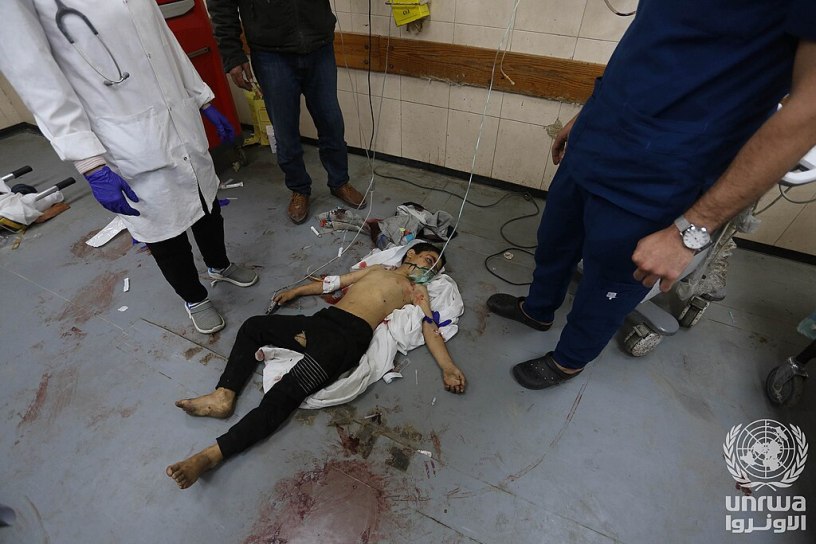
Featured photograph: Medical workers treating an injured child at Al-Aqsa Martyrs Hospital on January 7, 2024, before Haj-Hassan’s March 2024 visit. Ashraf Amra / UNRWA, CC BY-SA 3.0 IGO; original photograph. It does not depict Haj-Hassan or the specific children described in this article. No modifications to the original photograph.
Editorial note: The March 2024 cases and March 2025 cases were witnessed during separate medical missions. Where sources disagree about the age of one child, the disagreement is noted. Where testimony expresses an opinion about culpability or motive, it is distinguished from the injuries and circumstances doctors personally observed.


