
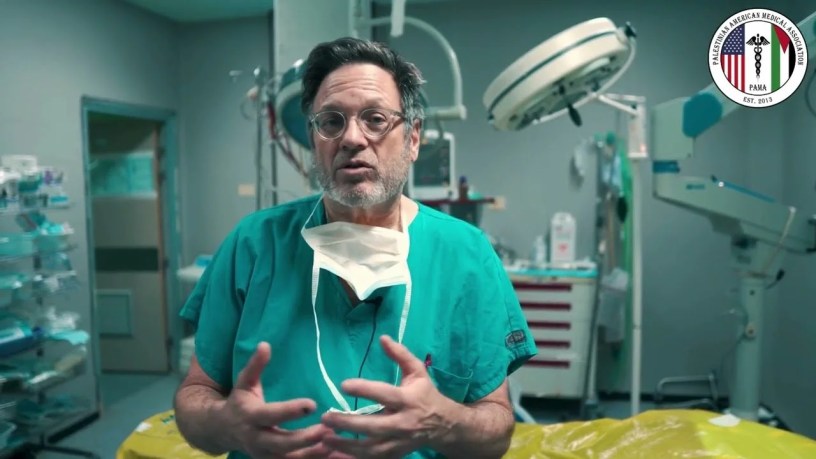
He was amputating the leg of a five-year-old girl. She was fully conscious. There was no anesthesia. The anesthesiologist sang to her. The surgeon hoped she would lose consciousness.
She did not.
Dr Mark Perlmutter is an American Jewish orthopedic and hand surgeon who has treated people injured in disasters including the September 11 attacks and Hurricane Katrina. For more than three decades, he has joined humanitarian medical missions. He went to Gaza in spring 2024 and returned in 2025. His experience there, he says, surpassed everything he had seen before.
In a recorded interview publicized in August 2026 and in the documentary American Doctor, Perlmutter described performing the child’s leg amputation without anesthesia because supplies were unavailable. The anesthesiologist could only sing. The operation continued while she was awake.
We were praying for her to faint.
Dr Mark Perlmutter, recounting the operation in 2026
He said he had amputated hundreds of legs during his humanitarian career. Never before without anesthesia. He did not disclose the child’s name in the accounts cited here, and her eventual recovery is not established by them. The testimony was recorded later; it should not be mistaken for a report made in 2024.
That is the first of ten experiences that should be read together. They come from Perlmutter’s firsthand interviews, a joint account he wrote with surgeon Feroze Sidhwa, and reporting on his 2024 and 2025 medical missions.
1. A five-year-old had her leg amputated while fully awake
When the anesthetic supplies were unavailable, Perlmutter faced a surgical emergency. The anesthesiologist sang to the child through the procedure. He hoped she would faint so she would not have to experience the full ordeal. She remained conscious throughout.
The account appears in Al Jazeera’s August 16, 2026, video report and in NPR’s August 24, 2026, interview about the documentary American Doctor. These are Perlmutter’s own descriptions; the child’s medical records are not publicly provided in those reports.
2. Two children were shot in the chest and head
In July 2024, Perlmutter told CBS Sunday Morning that he had seen children with high-velocity gunshot wounds in the chest, close to the heart, and additional wounds to the head. He showed photographs to the interviewer and said the placement was too precise to be accidental.
He believes Israeli snipers deliberately shot those children. The gunshot wounds he described are medical observations; identifying the shooter and proving intent in individual cases require separate investigation. The Israeli military told CBS it did not deliberately target children.
A claim this grave must be reported with both the seriousness of the witness and the limits of what the witness can independently establish.
3. Shrapnel tore into children’s bodies
Perlmutter described removing fragments of metal from young children and encountering wounds whose small entrances concealed devastating internal injuries. In a July 2024 Guardian investigation, he explained how high-velocity fragments could destroy soft tissue far beyond the visible opening.
A child could arrive with what appeared to be a tiny puncture. Inside, muscle, blood vessels and organs had suffered life-threatening damage.
4. A fifteen-year-old girl was badly wounded while riding her bicycle
During his 2025 return, Perlmutter treated a fifteen-year-old girl with catastrophic injuries to an arm and leg. According to accounts passed on by people at the scene to the ambulance crew, she had been hit by fire from an Israeli military helicopter while riding her bicycle.
The BBC reported the case on March 30, 2025 and examined material provided by the surgeon. Perlmutter feared she might lose one of her limbs. The information available from the operation did not independently prove which aircraft or unit caused the wounds.
5. A fifteen-year-old boy arrived after his grandmother was killed
Another fifteen-year-old, treated in a different hospital about a week apart, had been travelling with his grandmother after being warned to evacuate northern Gaza. Perlmutter said witnesses attributed an attack on the car to Israeli Apache helicopters. His grandmother died.
Perlmutter described the boy’s devastating injuries: the loss of one foot, severe damage to an arm requiring amputation, and other wounds needing multiple operations. The BBC included his account and the Israeli military’s statement that it does not intentionally target uninvolved civilians.
A boy had been told to leave danger. He was wounded while trying to leave it.
6. Nine-year-old Juri had infected wounds crawling with maggots
During their 2024 mission, Perlmutter and his colleague Feroze Sidhwa co-authored an account of a nine-year-old girl named Juri, who was malnourished and in septic shock. She had injuries from an explosion, dead tissue on her face and arms, and severe wounds to her pelvis and leg.
The surgeons took her to the operating room. Sidhwa, who described the case in greater detail, reported that parts of her wounds were infested with maggots and that a segment of her thigh bone was missing. The team managed to control the infection and save her life, but she would require further reconstructive care.
The case is documented in the surgeons’ joint essay for Politico. It is a shared medical-team account, not a reason to attribute every step of Juri’s care exclusively to Perlmutter.
7. A mother called Israa lost her four children
The same joint account described Israa, a twenty-six-year-old mother brought to Gaza European Hospital after a bombing. She had multiple open fractures, serious injuries to her knee and thigh, and burns and shrapnel wounds across her body.
Her operation required three experienced surgeons and lasted almost four hours. After she could speak with the team, she explained that the ceiling of her home had collapsed during the strike and that she had seen her four children die. Relatives confirmed that her immediate family was under the rubble.
The doctors had helped save a mother’s body. They had no operation that could return her family.
8. A 220-bed hospital was trying to care for 1,500 admitted patients
At Gaza European Hospital during their 2024 mission, Perlmutter and Sidhwa reported approximately 1,500 admitted patients in a facility designed for 220 beds. Patient spaces meant for four were holding ten or twelve; families seeking shelter occupied hallways, stairways and other hospital areas.
They estimated that some 15,000 displaced people were sheltering on the grounds and within the hospital. The operating rooms existed inside a building that had also become an enormous refuge.
This was not a question of doctors lacking skill. The system around their skills had been overwhelmed.
9. He worked without basic supplies, and said his instruments were confiscated
In March 2025, Perlmutter told the BBC that hospitals were trying to operate without basic materials, including soap, antibiotics and functioning imaging facilities. Some patients died because staff could not provide appropriate treatment.
In a later NPR interview, he said that antibiotics and instruments he had attempted to bring into Gaza on his second mission had been confiscated at entry. That is his account of the screening process. Israel describes its restrictions in terms of preventing the diversion of items it considers potentially usable for military purposes, a rationale humanitarian organizations have contested.
An operating theatre becomes terrifying in a very specific way when the surgeon knows exactly what should be done, but cannot obtain the tools to do it.
10. He returned to the United States and insisted people look
Perlmutter joined healthcare workers calling for an end to attacks on civilians, protection for medical services and changes in American policy. He and Sidhwa signed public letters to U.S. leaders after working in Gaza.
In the 2026 documentary American Doctor, director Poh Si Teng filmed him discussing photographs of children killed in Gaza. She considered obscuring the images to protect their dignity. Perlmutter argued that hiding the injuries would allow the public to avoid confronting what had happened.
Their disagreement was not about whether children deserved dignity. It was about how to honor that dignity without turning away from evidence of their deaths.
What is the most unbearable part of his testimony?
Some allegations in Perlmutter’s interviews, especially the allegation of intentional sniper targeting, depend on interpretation and still require case-specific independent inquiry. His account of the surgical conditions, the children’s injuries and the amputations is firsthand medical testimony. Those distinctions matter: precision strengthens testimony; it does not weaken it.
But what stands out is not a disputed theory about the war. It is the predicament of a surgeon who has carried out hundreds of amputations and one day finds himself operating on a little girl’s leg without anesthesia.
A trained anaesthesiologist was beside her. The doctor understood pain and how to prevent it. The specialist’s knowledge was not the missing resource.
So the doctor sang.
And the child stayed awake.
Sources and documentation
- Al Jazeera, August 16, 2026 — Perlmutter describes amputating a five-year-old girl’s leg without anesthesia
- NPR, August 24, 2026 — American Doctor, Perlmutter’s testimony and shortages of medical supplies
- CBS Sunday Morning, July 21, 2024 — “Children of Gaza,” with Perlmutter’s interview and the IDF response
- Mark Perlmutter and Feroze Sidhwa, Politico, July 19, 2024 — “We Volunteered at a Gaza Hospital. What We Saw Was Unspeakable.”
- The Guardian, July 11, 2024 — investigation of fragmentation injuries to children
- BBC News, March 30, 2025 — Perlmutter’s second mission, injured teenagers and hospital supply shortages
- Democracy Now!, April 11, 2024 — Perlmutter and Sidhwa speak after their first medical mission
- Gaza Healthcare Letters — physicians’ letters, media materials, and biographical information
Featured photograph: Dr Mark Perlmutter. Image supplied on the Gaza Healthcare Letters press page. It is an editorial portrait, not an image of the child described in this article.
Editorial note: The 2024 and 2025 events described here took place on different missions; the five-year-old child’s amputation was recounted publicly in 2026. Patient accounts are attributed to the surgeons and reporting that documented them. Medical observations do not, by themselves, resolve every question of who carried out a particular attack or why.

