
Four boys. Twelve to fifteen years old. All four shot in their testicles and groins. All four brought into the same Gaza hospital on the same day, within roughly an hour.
This is not a story invented to make anyone angry. It is an episode recorded in a British surgeon’s interviews and signed witness statement.
On July 12, 2025, four teenage boys arrived at Nasser Hospital in Khan Younis after being shot near a Gaza Humanitarian Foundation food distribution point. British surgeon Dr Nick Maynard saw them with his colleagues. The urologists, not Maynard, performed the operations.
It was the repetition that shocked him. Four boys, each with a gunshot wound to the same intimate part of the body. He and the other clinicians had already noticed that different days appeared to bring clusters of wounds to different parts of the body.
A surgeon can describe an injury precisely. He cannot, from an operating room alone, prove what was in the mind of the person who fired. Maynard nevertheless came away convinced that the pattern indicated deliberate targeting.
I would never have believed this possible unless I’d witnessed this with my own eyes.
Dr Nick Maynard, speaking to Sky News, July 25, 2025
Maynard had worked in Gaza over a period of fifteen years, knew its hospitals and many of its surgeons, and had witnessed the devastation of earlier wars. During his mission from June 24 to July 22, 2025, he found something worse than he had imagined.
Here are ten of the incidents and observations he recorded.
1. Four boys, aged twelve to fifteen, were shot in the testicles and groins
Maynard’s signed witness statement of August 4, 2025 gives a date: July 12. Four boys had come from a food distribution site with gunshot wounds to their testicles and groins. Their ages ranged from twelve to fifteen.
He saw the boys and the doctors treating them. He did not perform those operations himself because urology was not his surgical specialty. In his NPR interview, he said they arrived in the space of an hour.
The physical injuries were real patients in front of his colleagues. The allegation that the shooters intentionally selected the boys’ genitals is the conclusion he and others drew from the pattern, not a finding established by a completed forensic investigation.
2. Another day it was the head. Another the chest. Another the abdomen.
Maynard and his Palestinian medical colleagues saw clusters of gunshot wounds concentrated in certain body regions on certain days. Sometimes patients were arriving with head and neck wounds. Other days, chest, abdomen, arm or leg wounds predominated.
He said a local emergency physician reported an episode involving as many as twenty teenage boys with head and neck gunshot wounds. This larger figure was a colleague’s report to Maynard, not a group of twenty patients he personally examined.
To Maynard, the clustering looked less like random injury distribution than what he suspected might be target practice. It was a disturbing allegation requiring independent investigation.
3. A twelve-year-old went looking for food. He died on the operating table.
Maynard operated on a boy of twelve after a gunshot wound to the abdomen severed his aorta, the body’s main artery. The boy could not be saved.
According to Maynard’s testimony, many of the boys arriving with similar injuries had been trying to obtain food for their families at militarised distribution sites. Their families were hungry. Children were risking their lives to try to bring something home.
The surgeons could identify the severed artery and the cause of death. The accounts of where and by whom the boys were shot came from patients, relatives and other witnesses.
4. On July 19, dozens more teenagers arrived
In his written testimony, Maynard described another day, July 19, 2025, when approximately eighty teenagers were brought from a food distribution point to Nasser Hospital. He said thirty were pronounced dead on arrival and forty to fifty were injured.
Those numbers are his eyewitness estimate of that hospital influx, not a separately audited casualty total. He operated on some of the boys with abdominal gunshot wounds while colleagues treated injuries elsewhere.
That is what a food-distribution crisis had become in the emergency department: a procession of boys, some already dead, others requiring surgery before they could bleed to death.
5. An eleven-year-old girl called Habiba survived surgery, but died afterward
Habiba had suffered a severe explosive injury to her chest. She had an injured oesophagus, the tube connecting the throat to the stomach. Maynard spent a night operating on her and inserted feeding tubes so that she could receive nutrition without swallowing.
But Habiba was already badly malnourished. The hospital did not have the specialist intravenous nutrition that she needed. The team found a limited supply of liquid feed, yet her damaged metabolism could not tolerate it properly.
She was alive when Maynard left Gaza. He later received a call saying she had died. He believed the lack of suitable nutritional support was a major contributing factor to her preventable death.
6. A thirteen-year-old boy called Hasan could not heal
Hasan had a terrible gunshot wound to the duodenum, the first part of the small intestine. Maynard and colleagues repaired it, but the boy was so malnourished that the surgical repair continued to leak.
The boy was alive when Maynard left. The surgeon did not know his later fate. In a normal hospital, treating the injury would have been only the beginning: survival also required food, wound healing and prolonged care.
7. Women were shot while sheltering in tents
Maynard treated two women with severe abdominal gunshot injuries. One was breastfeeding her seven-month-old child; the other was three months pregnant. Both lived in makeshift tents near a food distribution centre.
The women and their families reported that quadcopter drones had fired toward their shelters. Maynard could establish their injuries and performed surgery on both women, but could not independently verify the weapon or shooter from their wounds alone.
One bullet narrowly missed the pregnant woman’s uterus. Both women survived their operations.
8. A seven-month-old baby looked like a newborn
In a July 17 report by Medical Aid for Palestinians, Maynard described a seven-month-old infant so severely malnourished that the child resembled a newborn.
The paediatric unit lacked suitable formula and liquid nutrition. Maynard said infants were receiving little more than diluted sugar water. He also reported four recent neonatal deaths associated with malnutrition.
The smallest patients were paying for the absence of food before they had even learned what hunger meant.
9. The surgeons themselves were starving
Maynard encountered colleagues whom he had known for years but hardly recognised. Some had lost twenty or thirty kilograms. They were caring for patients and then returning to shelters where they struggled to feed their families.
Malnutrition meant operations were increasingly likely to fail. Repaired bowel leaked. Infections spread. A surgeon could complete the technically correct procedure and still lose the patient because the body did not possess the resources to recover.
10. He could hear bombardments from inside the hospital
The danger was not confined to the emergency department. In his August 4 witness statement, Maynard recalled near-daily explosions, nights of relentless gunfire and a period when Israeli forces were reportedly only a few hundred metres away.
On July 17, a nearby explosion shook the building while he was showering. He fell, struck his head, lost consciousness and required stitches. He spent the day recovering from a concussion.
Meanwhile, patients frightened by the prospect of military activity near the hospital sometimes wanted to leave, even shortly after major life-saving operations.
What Maynard’s testimony proves — and what it does not
The testimonies of Maynard and his colleagues document grave injuries to children, deaths during surgery, patterns of gunshot wounds, severe malnutrition and deteriorating hospital conditions. His signed account makes clear which operations he performed, which patients he personally saw and what he learned from other staff and families.
His claim that Israeli soldiers were deliberately choosing particular body parts for target practice is more difficult to establish independently. In response to his allegations, the Israeli military told Sky News that it categorically rejected intentional harm to civilians of the kind described, said its orders prohibited deliberately shooting civilians and stated that reports of casualties at distribution sites were being examined.
That denial belongs in the record. So does Maynard’s testimony. A serious investigation would examine the patients’ medical records, the circumstances at the aid sites, ballistic evidence, witness accounts and the conduct of the units present.
But the allegation should not distract from the medical reality already on the record.
On July 12, four boys aged twelve to fifteen reached a Gaza hospital after being shot in their testicles and groins. They needed urological surgery. They had been trying to get food.
A child goes to find something for his family to eat. He comes home in an ambulance, if he comes home at all. And the adults who witnessed what happened are left explaining it to a world that has become accustomed to hearing the impossible.
Sources and firsthand testimony
- Dr Nick Maynard, signed witness statement, August 4, 2025 — dates, ages, testicular injuries, surgeons involved, the twelve-year-old, Habiba, Hasan, and the women injured in tents.
- NPR, July 21, 2025: “Inside a Gaza hospital: A British surgeon on what he’s witnessing firsthand” — Maynard’s recorded account of four teenage boys arriving within an hour and other patterns of injuries.
- Sky News, July 25, 2025: British surgeon’s allegations of “target practice” — the injuries, his interpretation, and the IDF’s response.
- Medical Aid for Palestinians, July 17, 2025: Severe malnutrition and preventable deaths in Nasser Hospital — firsthand medical observations and the photograph.
- RTÉ News, July 25, 2025: Surgeon describes patterns of gunshot wounds — separate recorded interview.
- Zeteo conversation with Nick Maynard and Dr Ambereen Sleemi, August 10, 2025 — extended firsthand discussion.
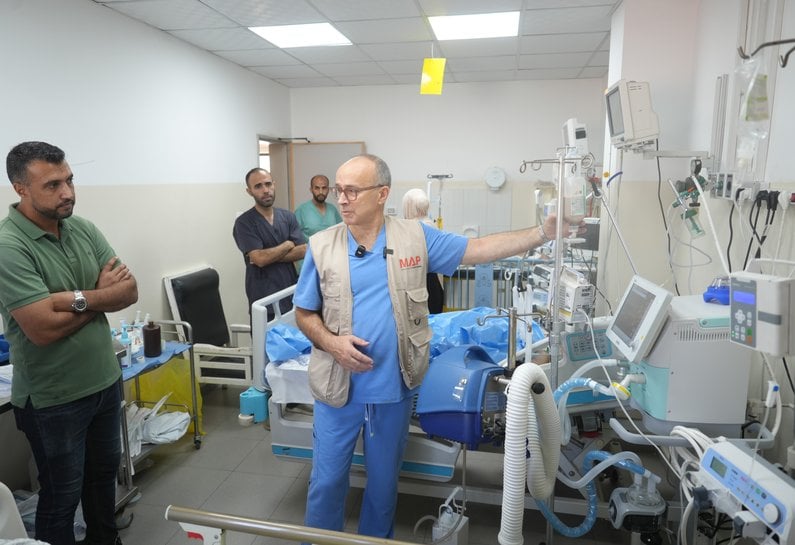
Featured photograph: Dr Nick Maynard with colleagues at Nasser Hospital, Khan Younis, 2025. Photograph published by Medical Aid for Palestinians. The photograph does not depict any of the injured children described in the article.
Editorial note: This article reports events witnessed or described during Maynard’s June–July 2025 mission. It attributes claims about the identity and intent of shooters to the people making those claims. No medical observation alone proves the perpetrator or motive of an individual shooting.

