One of yesterday’s highlights in my unbearably disenchanted, low pleasure, low intimacy, low meaningful connection existence was a Dutch lesson with two half Dutch, half Slovak, teenagers.
Am almost apologizing for teaching them something that I have decided matters. But does it really?
Am already annoyed that we have to read a simplified version.
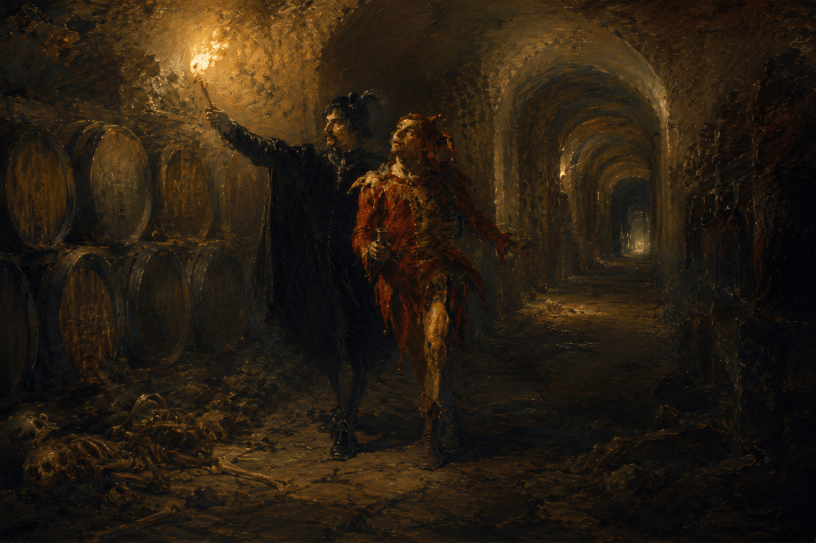
If I put them through the original it would be a form a abuse. Not child abuse, just abuse, because most adults I know would experience reading the Cask of Amontillado only as an introduction to how very little they know. Out of sadistic curiosity and sociological interest I might try it with one guy today. He’s fluent in English, but has never read even one book in his entire 30 something life. I think he doesn’t even know English on Poe’s level exists. I know what he’ll tell me: ‘I don’t know why I would ever spend time on this.’ He said exactly that after we watched a light philosophy documentary.
I have more hope for these two teenagers, perhaps the smartest two people I regularly work with. Certainly the only ones who always manage to make me laugh.
I read the story to them, because they struggle to read. Yes, I repeat they are very intelligent, but yes, they struggle to read.
Even though the language is simplified, the questions at the end can be answered in very short sentences and I am doing the reading for them, I know they will struggle to absorb what’s in the text. They are not used to taking in a story. They’ve told me they rarely watch whole movies. They watch clips, they play video games, they do their home work, they scroll social media, they might have a YouTube video running in the background as they’re playing or doing math. They’re good at math. Math doesn’t come with feelings and the rules are pretty clear. There is only one clear right answer. Math is clean. Math is important. Math runs the closest thing to God today: the algorythms who capture you and then mold you into a fragmented version of whoever you could have been before the endless scrolling and reacting to notifications.
Am not sure if it’s a good idea to read the Cask of Amontillado to them. If it has any real value. It’s always made me feel something. I’ve always identified with Montresor. I don’t know if I’d kill someone like Fortunato if I thought I could get away with it. But I’d certainly want to punish him. I’d certainly want to use his outsized ego against him.
I suppose the most important takeaway for them is that Montresor tricks Fortunato into following him to the place where he will be murdered by suggesting he will consult Luchesi to test his newly bought Amontillado.
Fortunato is too proud and needy to let those honors go to Luchesi.
They manage to answer a few of the 10 simple questions correctly.
Because over the years we have built quite a good bond and they know I actually value them, care about them, see them and never treat them as adults usually treat kids, they are willing to sit with me and listen to the story.
Before we start I let them watch a two minute summary on YouTube.
Is this good teaching or my adapation to the collapse of attention spans?
After the Cask of Amontillado we watch The Simpsons halloween special featuring The Raven. Which is very, very well done.
I tell them a little bit about Poe.
I stress how much I like the atmosphere he creates, the vocabulary and that the plots in his stories are quite simple.
I know they did retain some of what I’ve said.
But does it matter?
Where it certainly matters is that Poe may come up in school at some point and they will be a few steps ahead of their classmates and they may impress some other teacher.
They may one day in their adult lives stumble across Poe, remember our weekly lessons fondly – I ALWAYS bring them all kinds of treats worth like 3 to 5 euro and let them joke and be goofy, within reason – and they might dive a little deeper. Am not sure if even that matters. I mean look at me, I did read Poe at their age, and even earlier, and by society’s standards I am basically a kind of loser, with the only things going for me being that I have some savings, own some real estate, have one happy child and have no addictions. But that is not really what society, if it could speak to us honestly, counts as a succesful life. You know that, I know that.
Another thing they MIGHT take away from it is that it teaches something about manipulation. They have very little insight in dark psychology or any kind of psychology.
And last but not least, maybe it boosts their self-esteem in the healthiest of ways, that an adult thought they were important enough to nudge them to something the adult considers to be profoundly meaningful, even sacred. Even if the word ‘sacred’ is not even something they are right now equipped to experience.
We play some boardgames in Dutch in the second half of the class.
During play I smuggle in questions, all in Dutch.
I invite them to ask me any questions, but they genuinely can’t come up with questions.
They ask me funny questions like: ‘How much tchoot does the tchoot tchoot tchoot?
I ask them about the world cup. If they feel anything when the Dutch team plays. ‘A little’, they say.
The youngest one, who is more active on social media than the older one, tells me some goalkeeper of some tiny country had a crazy number of saves, stopped several potential own goals, and the game ended zero to zero. He ask me to what number his follower count jumped overnight. From 70,000 to…
‘2 million?’, I wonder. A quick calculation that feels very plausible to me, given how popular the World Cup is.
‘Yes, 2 million’, he says.
‘That’s just insane. Am surprised that doesn’t break down Instagram’, I say.
I aske them to tell me the five top things that they would want on their perfect day.
I tell them NOT to tell me ‘sleep’ five times.
The youngest one says sleep, food, video games, something I forgot and sleep again.
I said he used sleep twice.
He counters: ‘Sleep in the morning is different from sleep in the evening.’
I accept and say: ‘Ok, so daysleep and nightsleep.’
The oldest one’s answers are similar, but he doesn’t half cheat by putting the same thing in twice. This is consistent with how I know him.
I tell them I won’t leave until they guess at least 2 out of 5 things that would have to happen on my perfect day.
Great food?
No.
Sleep?
Hell no. I hate sleeping.
Teaching?
I say, yes, working with people I respect like you two. Doesn’t have to be teaching, can be therapeutic work.
After that for a long time they can’t guess anything anymore.
Until the youngest one enthusiastically raises himself up.
‘Oh, I know! Time with your son!’
Bingo.
To take them seriously as people, I say: ‘You know, you could have simply said sex. With a woman preferably.’
‘How old?’, asks the youngest.
‘Anything above 18. Zero, absolutely zero, pedo vibes here.’
I don’t tell them but I remember that moment my father told me: ‘I’ll forgive anything, but not abuse of children.’
That I don’t tell them, they know enough about me already.
The youngest one asks again to tease me:
‘Are you sure?’
I emphatically say: ‘Yes, zero pedo vibes.’
The oldest one, already on the way to his computer I suppose, mumbles: ‘That’s just what your lawyer told you to say.’
‘Did you hear that?’, asks the youngest one.
‘Yes, that was actually pretty funny.’
And then off to homework (the oldest one) and videogames (the youngest one) they are.
And now brace for it:
These are the only two under 18 year olds I teach and they’re also about the closest I get to teaching people who haven’t been turned into needy infantilized status seeking worker drones.
To those reading the Cask of Amontillado isn’t just a little boring, it feels like an attack, because it’s confronting them with using their brains in a way they know they haven’t ever used it.
The Cask of Amontillado doesn’t get them promoted at work, it’s not a hyped up dish in a new restaurant and it doesn’t get you priority boarding at the airport.
Musing in the morning with Joe, Notes From The Mountain Fortress
Hunting aliveness in a post-apocalyptic world. Tricking people into following me into their own catacombs. A little hope here, a little despair there. And somehow I roll through the day. Like a half domesticated tiger in a petting zoo. On reading the Cask of Amontillado with two teenagers.