
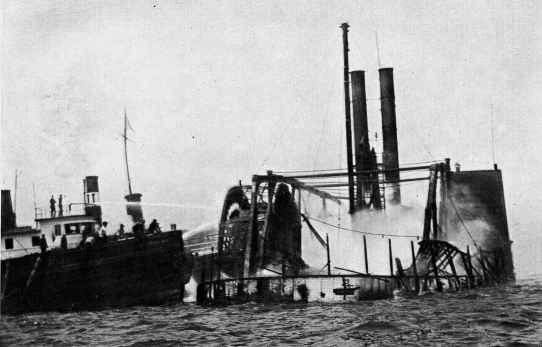
New York, 1904. Mothers put life jackets on their children and threw them from a burning ship to save them. The rotten jackets soaked up water. Instead of keeping the children afloat, some dragged them beneath the river.
On June 15, 1904, more than 1,300 people boarded the General Slocum for a summer excursion organised by St. Mark’s Evangelical Lutheran Church, part of New York’s German-American community. Most passengers were women and children. They expected music, a picnic and a day away from the city.
The paddle steamer was named for Henry Warner Slocum, a Union general who fought at Gettysburg and served in William Tecumseh Sherman’s campaigns during the American Civil War.
A fire broke out in a storage compartment. The crew tried to use the ship’s fire hoses, but they were rotten and failed. The lifeboats could not be launched. The flames spread through the wooden vessel as Captain William Van Schaick continued upriver.
Parents faced an impossible choice: remain on the burning ship or send their children into the East River.
Some mothers fastened life preservers around their children and dropped them into the water.
Then they saw the children sink.
Life preservers that became weights
The life jackets were not merely old. Many contained granulated cork or cork dust inside rotting covers. When the material became waterlogged or spilled out, the preservers lost the buoyancy they were supposed to provide. Some contained concealed pieces of iron, inserted into compressed cork blocks to make them meet weight requirements.
The defects were documented in the official federal investigation. In an October 1904 letter accompanying that investigation, President Theodore Roosevelt condemned the manufacture of cork blocks containing hidden iron bars.
The ship’s other safety provisions failed too. Fire hoses burst or could not deliver water; lifeboats remained beyond reach; passengers were trapped between flame and river. Many could not swim.
1,021 people died, most of them women and children. The disaster devastated the German-American community of Manhattan’s Little Germany.
The ship had passed a federal inspection on May 5, just six weeks before the fire. Captain Van Schaick was convicted of criminal negligence and imprisoned. The catastrophe led to new scrutiny of maritime inspection and lifesaving standards.
Until September 11, 2001, the General Slocum fire was New York City’s deadliest disaster.
Those parents had reached for the equipment provided to save their children. They had no way of knowing that some of the life jackets could become the very things that pulled them under.
Featured photograph: the General Slocum burning in the East River on June 15, 1904. Originally published in Harper’s Weekly, June 24, 1904. Public domain; Wikimedia Commons.
Sources and historical records
US Commission of Investigation, Report on the General Slocum Disaster (1904) — official investigation of the ship, safety equipment, and deaths.
Library of Congress, General Slocum Steamboat Tragedy — contemporary newspaper accounts and historical guide.
Harper’s Weekly photograph of the burning General Slocum, via Wikimedia Commons.
Support DEPTH
Independent historical research and writing take time. If you value these stories, you can support the work through PayPal.

Boost us
If you like our content help us to create more.
$5.00
Discover more from The Confessor
Subscribe to get the latest posts sent to your email.

